How to Help, Not Hinder Global Growth
IMF Blog, June 5, 2019
Source details
- Canonical URL
- How to Help, Not Hinder Global Growth
Other formats
Bibliographic details
- Authors: Christine Lagarde
- Published: June 5, 2019
Trade tensions (author and date)
- Author: Christine Lagarde
- Date: June 5, 2019
- Context: G-20 finance ministers and central bank governors meeting in Fukuoka; Fukuoka described as Japan’s “startup city” and example of embracing trade, innovation, and openness.
Signs of stabilization
- IMF cut its global growth forecast to 3.3 percent in 2019, largely because of temporary, country-specific factors and the tangible effects of trade tensions.
- IMF projected a pickup in growth in the second half of 2019 and a further acceleration to 3.6 percent in 2020, the same growth rate as in 2018.
- Policy responses supporting stabilization:
- More patient pace of monetary normalization by the US Fed and the European Central Bank.
- Increased fiscal stimulus in China.
- Recent data: while first-quarter activity disappointed in parts of emerging Asia and Latin America, growth was stronger than expected in the United States, the euro area, and Japan.
Significant stumbling blocks
- Uncertainty over whether first-quarter momentum in advanced economies will hold and whether improvements in stressed economies will materialize or take longer.
- Potential adverse impacts from a no-deal Brexit and recent increases in oil prices.
- Underlying vulnerabilities:
- Elevated corporate debt levels that could trigger disruptive capital outflows from emerging markets if financial conditions shift suddenly.
- Disappointing medium-term growth prospects due to population aging, slow productivity, and excessive economic inequality.
Trade tensions are looming larger
- Estimated impacts of tariffs:
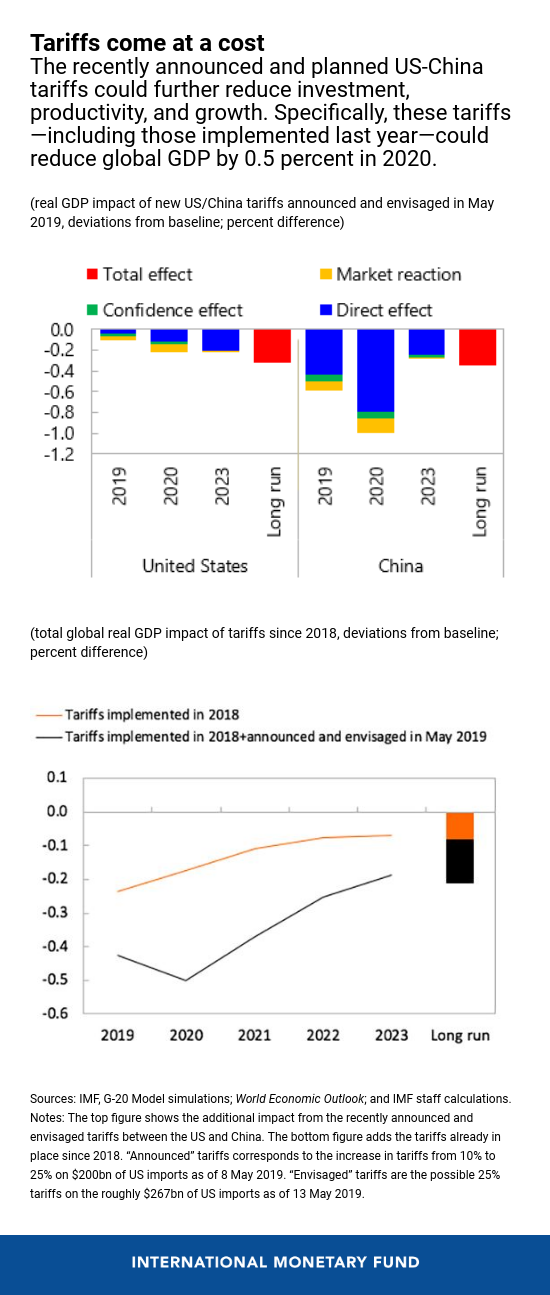
- Recently announced and envisaged US-China tariffs could subtract about 0.3 percent from global GDP in 2020, with more than half of the impact stemming from business confidence effects and negative financial market sentiment.
- Overall, US-China tariffs—including those implemented last year—could reduce global GDP by 0.5 percent in 2020.
- This 0.5 percent reduction amounts to a loss of about US$455 billion.
- Distributional effects:
- Protectionist measures are hurting growth and jobs, making tradable consumer goods less affordable, and disproportionately harming low-income households.
- Policy prescription on trade:
- Remove recently implemented trade barriers and avoid further barriers in whatever form.
The G-20 can help (trade and institutional reform)
- Immediate priority: resolve current trade tensions and modernize the international trade system.
- Areas for strengthening WTO rules: subsidies, intellectual property, and trade in services.
- Potential gains from liberalizing services:
- IMF research shows that liberalizing trade in services could add about US$350 billion to global GDP in the long run.
- Additional cooperative priorities:
- Reform international corporate taxation.
- Strengthen the global financial safety net.
- Tackle climate change.
Strengthening resilience and inclusiveness
- Fiscal constraints:
- High public debt and low interest rates have left many countries with limited policy room, requiring carefully calibrated fiscal policies balancing growth, debt sustainability, and social objectives.
- Addressing adjustment costs:
- Policies needed to manage dislocations from trade and technological innovation and to support those left behind.
- Structural reform agenda:
- Lower barriers to entry in retail and professional services.
- Encourage greater participation of women in the workforce.
- Estimated payoff: jointly implemented structural measures could boost G-20 GDP by 4 percent in the long term.
- Structural reforms also increase resilience and inclusiveness of growth.
Coordinate if growth falters
- Contingency planning: prepare for the next downturn by being ready to use all policy tools to maximize combined effect.
- Policy mix in a downturn:
- Support demand through decisive monetary easing and fiscal stimulus wherever possible.
- Use supportive policies to boost the impact of structural reforms where demand is weak.
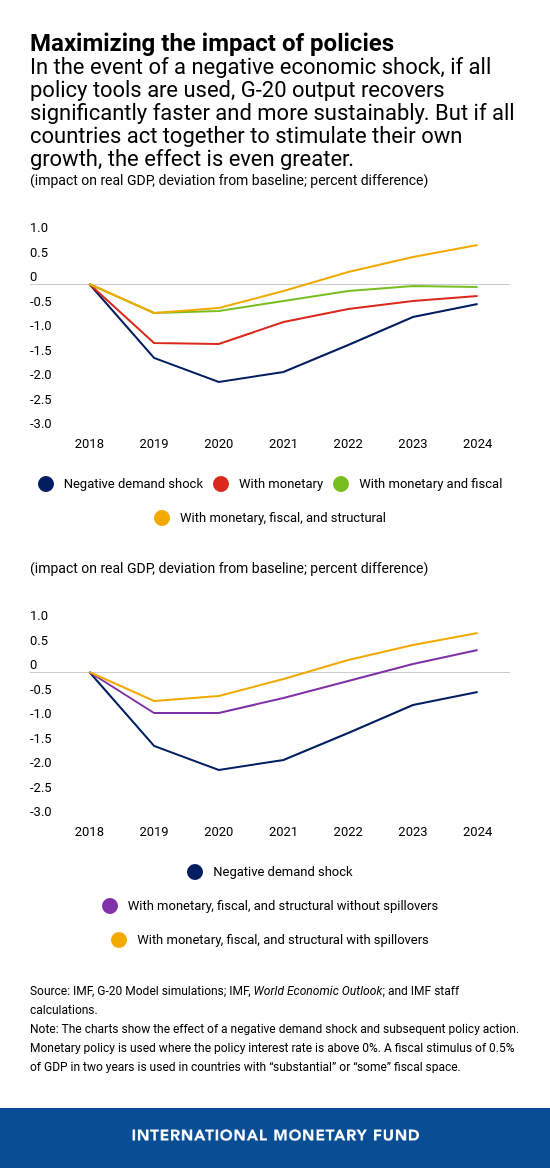
- Simulation findings from IMF G-20 note:
- Under a scenario where all policy tools are used, G-20 output recovers significantly faster and more sustainably.
- Policy coordination across countries produces reinforcing positive spillovers; if all countries act decisively, the collective benefit is larger.
Conclusion
- International cooperation is critical now, not only in a downturn, because the global economy faces a delicate moment.
- For G-20 nations, the imperative is to “help, not hinder” the expected pickup in growth by removing stumbling blocks and harnessing openness.
- The “Fukuoka spirit” of openness can help set the global economy on a more durable and inclusive path.
Source: How to Help, Not Hinder Global Growth — Christine Lagarde, June 5, 2019.