Blunting the Impact and Hard Choices: Early Lessons from China
IMF Blog, March 20, 2020
Source details
- Canonical URL
- Blunting the Impact and Hard Choices: Early Lessons from China
Other formats
Bibliographic details
- Authors: Helge Berger, Kenneth Kang
- Published: March 20, 2020
Hard choices
- Success in containing the virus comes at the price of slowing economic activity, whether social distancing and reduced mobility are voluntary or enforced.
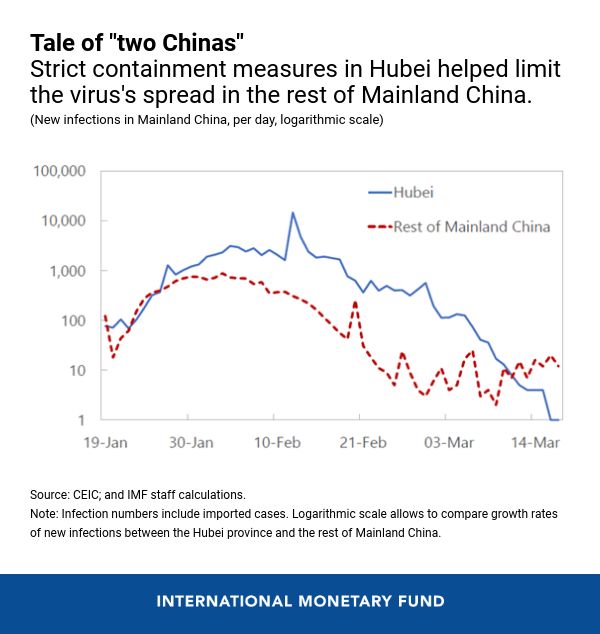
- Chinese policymakers implemented strict mobility constraints at national and local levels; at the height of the outbreak, many cities enforced strict curfews.
- Hubei province suffered heavily despite much help from the rest of China, reflecting the tradeoff between containment and economic disruption.
- Mitigating the impact of this severe shock requires providing support to the most vulnerable.
- The pandemic will require support for those hit the hardest—within countries and across countries—to help contain the virus and delay its spread to others.
High costs
- The outbreak brought terrible human suffering in China and significant economic costs.
- By all indications, China’s slowdown in the first quarter of 2020 will be significant and will leave a deep mark for the year.
- Initial sudden stops in economic activity cascaded through the economy, morphing into a full-blown shock simultaneously impeding supply and demand.
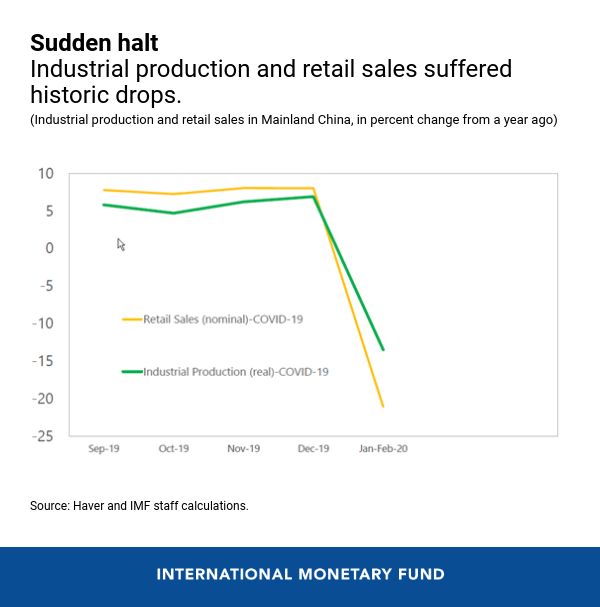
- Weak January-February readings of industrial production and retail sales illustrate the simultaneous supply and demand shock.
- The coronavirus shock is severe even compared to the Great Financial Crisis in 2007–08, as it hit households, businesses, financial institutions, and markets all at the same time—first in China and now globally.
Quick action
- Mitigating the impact requires targeted support to the most vulnerable households and new ways to reach smaller firms.
- Chinese policy measures included waiving social security fees and utility bills, and channeling credit through fintech firms.
- Authorities arranged subsidized credit to support scaling up the production of health equipment and other critical outbreak-response activities.
- Safeguarding financial stability required assertive and well-communicated action to prevent liquidity shortages and market disruptions from amplifying the shock.
- Measures in China included:
- early backstops for interbank markets and financial support to firms under pressure;
- guidance for banks to work with borrowers affected by the outbreak;
- incentives for banks to lend to smaller firms via special funding from China’s central bank;
- targeted cuts to reserve requirements for banks;
- allowing larger firms, including state-owned enterprises, to maintain relatively stable credit access supported by large state banks.
- Caveats and risks of relief tools:
- Allowing a broad range of debtors more time to meet obligations can undermine financial soundness later if not time-limited and well-targeted.
- Subsidized credit can be misallocated.
- Keeping already non-viable firms alive could hold back productivity growth later.
- Wherever possible, use well-targeted instruments.
Not over
- There are reassuring signs of economic normalization in China—most larger firms have reported reopening and many local employees are back at their jobs.
- Stubborn risks remain, including the possibility of new infections rising again as national and international travel resumes.
- Even absent another outbreak in China, the global pandemic creates economic risks: as more countries face outbreaks and global financial markets gyrate, consumers and firms may remain wary, depressing global demand for Chinese goods just as the economy is getting back to work.
- Chinese policymakers will need to be ready to support growth and financial stability if needed.
- Given the global nature of the outbreak, many efforts will be most effective if coordinated internationally.
Source: Blunting the Impact and Hard Choices: Early Lessons from China (Helge Berger, Kenneth Kang), March 20, 2020.