Emerging-Market Banks’ Government Debt Holdings Pose Financial Stability Risks
IMF Blog, April 18, 2022
Source details
- Canonical URL
- Emerging-Market Banks’ Government Debt Holdings Pose Financial Stability Risks
Other formats
Bibliographic details
- Authors: Andrea Deghi, Fabio Natalucci, Mahvash S Qureshi
- Published: April 18, 2022
Context and overview
- Publication: Blog post by Andrea Deghi, Fabio Natalucci, Mahvash S. Qureshi, dated April 18, 2022.
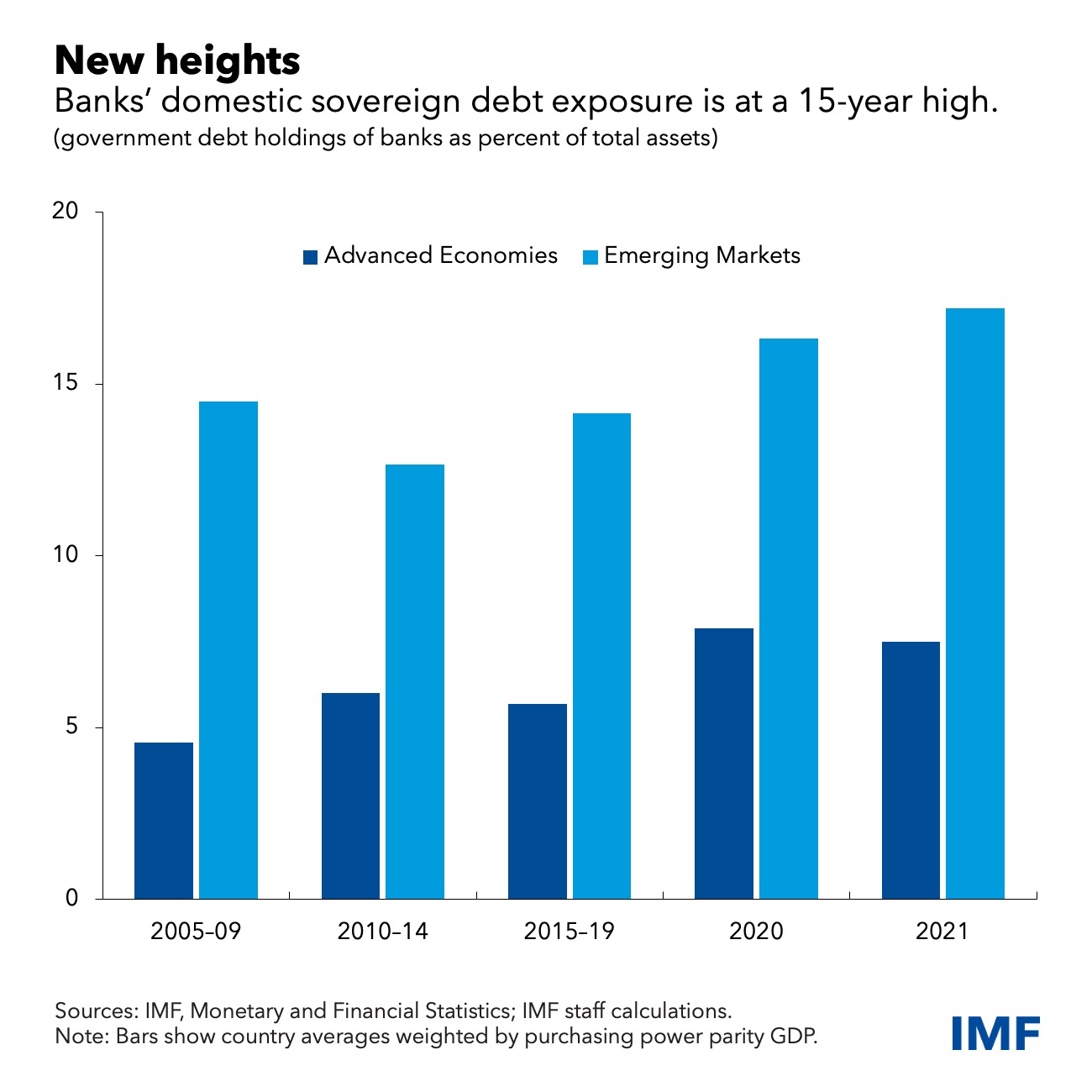
- Main point: The pandemic has left emerging-market banks holding record levels of government (sovereign) debt, increasing the odds that pressures on public-sector finances could threaten financial stability.
- Aggregate fiscal metric highlighted: the average ratio of public debt to gross domestic product rose to a record 67 percent last year in emerging market countries (per Chapter 2 of the IMF’s April 2022 Global Financial Stability Report).
Key findings and statistics
- Emerging-market banks’ holdings of government debt reached a record 17 percent of bank assets in 2021.
- In some economies, government debt amounts to a quarter of bank assets.
- Emerging-market economies face greater risk than advanced economies because:
- Their growth prospects are weaker relative to the pre-pandemic trend compared with advanced economies.
- Governments have less fiscal firepower to support the economy.
- External financing costs have generally risen, increasing borrowing costs for governments.
- Historical instances of the sovereign-bank adverse feedback loop (“doom loop”): Russia in 1998 and Argentina in 2001-02.
Risk channels linking sovereign stress and banks
- Direct exposure channel:
- Large holdings of sovereign debt expose banks to losses if government finances come under pressure and the market value of government debt declines.
- Resulting bank losses could force lending retrenchment to companies and households, weighing on economic activity and tax revenue, further pressuring public finances.
- Guarantee and fiscal support credibility channel:
- Strains on government finances could hurt the credibility of government programs (for example, deposit insurance) designed to support banks, weakening investor confidence and banks’ profitability.
- Troubled lenders may require government bailouts, further straining public-sector finances.
- Macro-financial channel:
- A blow to public finances could push economy-wide interest rates higher, hurting corporate profitability and increasing credit risk for banks, limiting banks’ ability to lend and curbing economic growth.
Triggers and scenarios that could start a doom loop
- A sharp tightening of global financial conditions, resulting in higher interest rates and weaker currencies, driven by:
- Monetary policy normalization in advanced economies.
- Intensifying geopolitical tensions (for example, the war in Ukraine).
- Domestic shocks, such as an unexpected economic slowdown, that undermine investor confidence in governments’ ability to repay debts.
Policy recommendations and measures for authorities
- Fiscal policy and investor confidence:
- Exercise fiscal prudence to avoid further intensification of the sovereign-bank nexus.
- Draw up credible plans to narrow deficits over the medium term to bolster investor confidence.
- Strengthening bank resilience:
- Conserve loss-absorbing capital buffers by limiting distributions to shareholders through dividends and stock buybacks given heightened uncertainty.
- Conduct asset quality reviews to quantify hidden losses and identify weak banks once forbearance has ceased.
- Additional policy options and structural measures (to be tailored to country circumstances):
- Develop resolution frameworks for sovereign domestic debt to facilitate orderly deleveraging and restructuring if needed.
- Improve transparency on all banks’ material sovereign exposures to assess risks from possible sovereign distress.
- Conduct bank stress tests that take into account the multiple channels of risk transmission in the nexus.
- Consider options to weaken the nexus—such as capital surcharges on banks’ holdings of sovereign bonds above certain thresholds—once the economic recovery is more firmly established and depending on market circumstances.
- Strengthen procedures to wind down banks in an orderly fashion if needed and to provide liquidity in a crisis.
- Promote a deep and diversified investor base to strengthen market resilience in countries with underdeveloped local currency bond markets.
Conclusion
- With appropriate fiscal prudence, strengthened bank capital and transparency, tailored resolution and stress-testing frameworks, and measures to deepen investor bases, emerging-market economies can lessen the sovereign-bank nexus and reduce the risk of a financial or economic crisis.
Source: Emerging-Market Banks’ Government Debt Holdings Pose Financial Stability Risks — IMF Blog (April 18, 2022).