The Economics of Trust
IMF Blog, May 10, 2017
Source details
- Canonical URL
- The Economics of Trust
Other formats
Bibliographic details
- Authors: The Editors
- Published: May 10, 2017
Overview
- Trust in other people is described as "the glue that holds society together" and is reported to be increasingly in short supply in the United States and Europe.
- The Editors — May 10, 2017.
Evidence and findings
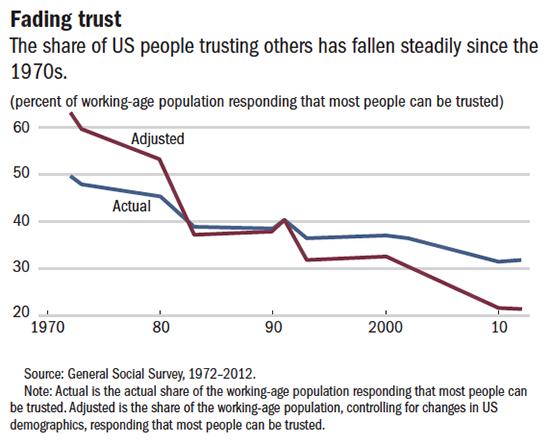
- Survey trend: The share of Americans who say that most people can be trusted has fallen to 33 percent from about 50 percent over the past 40 years.
- Research by Eric D. Gould (professor of economics at Hebrew University) and Alexander Hijzen (senior economist at the Organisation for Economic Cooperation and Development) analyzed data from the American National Election Survey from 1980 to 2010.
- Key quantitative finding: Wider income inequality explains 44 percent of the drop in trust.
- Similar results were found in Europe.
- Note: the authors reported their findings in an IMF working paper (working papers do not represent the views of the IMF).
Implications
- A substantial body of research indicates governments may be unable to find the support needed to solve pressing problems in a divided and distrustful society.
- Distrust can prevent policies from being implemented effectively.
- Growing evidence suggests trust promotes economic growth because people who trust each other are more likely to collaborate in trade, innovation, and entrepreneurship.
- Surprisingly, the authors found that inequality doesn’t appear to spur greater demand for redistribution.
Policy recommendations and pathways
- Policies that seek to restore trust by reducing market wage dispersion before taking into account taxes and benefits appear more promising.
- Examples mentioned: raising the minimum wage; strengthening collective bargaining.
Further reading
- The article is noted to be available in the March 2017 issue of Finance & Development.
The Editors, May 10, 2017.