A New Twist in the Link Between Inequality and Economic Development
IMF Blog, May 11, 2017
Source details
- Canonical URL
- A New Twist in the Link Between Inequality and Economic Development
Other formats
Bibliographic details
- Authors: Francesco Grigoli
- Published: May 11, 2017
Research scope and methods
- Sample: 77 countries at different stages of development and representing all geographical regions, with at least 20 years of data.
- Focus: income inequality only (owing to data limitations, wealth inequality is not analyzed).
- Approach: techniques that address some shortcomings in the literature and allow heterogeneity in the inequality–growth relationship across countries.
Main empirical findings
- The effect of income inequality on economic growth can be either positive or negative; it is not uniform across countries.
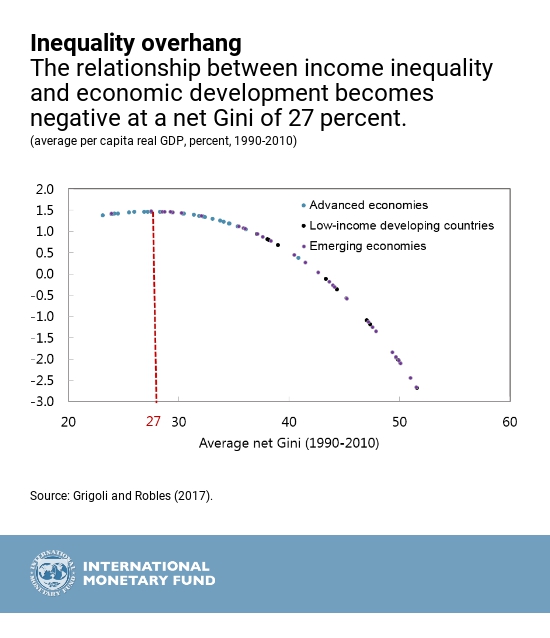
- There is a hump-shaped relationship between inequality and economic development, termed an “inequality overhang.”
- Turning point: the direction of the relationship changes at a Gini of about 27 percent (net Gini, measured after taxes and transfers).
- For net Gini values below 27 percent, the impact of income inequality on economic development is positive.
- For net Gini values above 27 percent, the impact becomes negative, and as countries become more unequal the negative impact on economic development becomes larger.
- Country heterogeneity:
- Median impact of inequality growth on per capita GDP growth is negative and significant, lasting about 2 years.
- Some countries show large negative effects (examples: Ecuador, Jordan, Nigeria, and Panama).
- Some countries show positive effects (example at the 25th percentile: Finland).
- Implication: average effects commonly estimated in the literature can be misleading because of large dispersion across countries.
Mechanisms and interpretation
- Positive channel at low inequality: increased inequality can endow the rich with means to start businesses and create incentives to increase productivity and investment.
- Negative channels at high inequality:
- Reduced aggregate demand by the general population and lower investment in education and health, impairing long-term growth.
- Increased rent-seeking behavior with the top appropriating a larger share of national income.
- Greater risk of reduced social consensus and social unrest, hindering the implementation of pro-growth reforms.
Policy analysis: trade-offs and win-win options
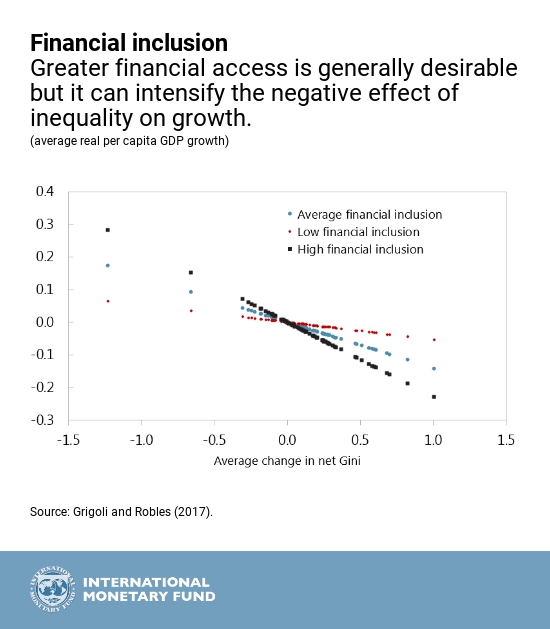
- Financial inclusion and female labor participation are examined as tools to mitigate harmful effects of rising inequality.
- Financial access:
- Generally desirable, but can exacerbate the negative impact of income inequality on economic development.
- Mechanism: banks may curtail credit to customers at the lower end of the income distribution because of inability to repay, potentially deepening adverse effects.
- Policy implication: consider mechanisms to ensure those who lose access to credit when income becomes more concentrated can continue consuming even when their income falls.
- Female labor participation:
- Considered a win-win: enlarges the pool of talent available to work and reduces (or even reverses) the negative impact of inequality on growth.
- Caution: policies that expand access to credit or labor supply could also have adverse effects (e.g., over-leveraging poorer households or generating an oversupply of labor) and should be designed to manage these trade-offs.
Source: A New Twist in the Link Between Inequality and Economic Development (May 11, 2017), Francesco Grigoli
References
- عربي
- inequality
- Inequality Overhang
- Inequality and Growth: A Heterogeneous Approach
- https://www.imf.org/wp-content/uploads/2017/05/ENG_May_9_Inequality_1-1.jpg
- https://www.imf.org/wp-content/uploads/2017/05/ENG_May_9_Inequality_2-3.jpg
- https://www.imf.org/wp-content/uploads/2017/05/ENG_May_9_Inequality_3.jpg
- https://www.imf.org/wp-content/uploads/2017/05/ENG_May_9_Inequality_4.jpg