Fed Tightening May Squeeze Portfolio Flows to Emerging Markets
IMF Blog, December 14, 2017
Source details
- Canonical URL
- Fed Tightening May Squeeze Portfolio Flows to Emerging Markets
Other formats
Bibliographic details
- Authors: Robin Koepke
- Published: December 14, 2017
Overview and context
- Author: Robin Koepke
- Publication date: December 14, 2017
- Topic: Impact of US Federal Reserve monetary policy normalization on portfolio flows to emerging markets (foreign purchases of emerging market stocks and bonds).
- Source analysis basis: IMF’s new model and the IMF’s latest Global Financial Stability Report; econometric model adapted from a 2014 paper.
Key findings from the IMF model
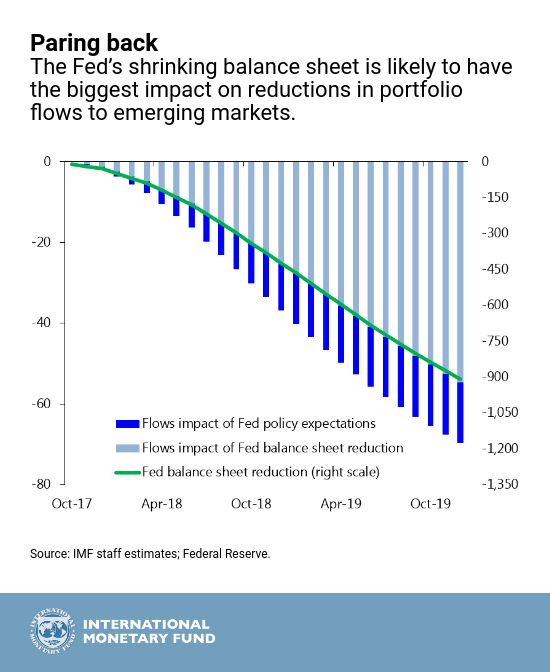
- Normalization—raising the policy interest rate and shrinking the balance sheet—will likely reduce portfolio inflows by about $70 billion over the next two years, compared with average annual inflows of $240 billion since 2010.
- Shrinkage in the Fed’s $4.5 trillion balance sheet, which began in October, accounts for most of the impact on portfolio flows.
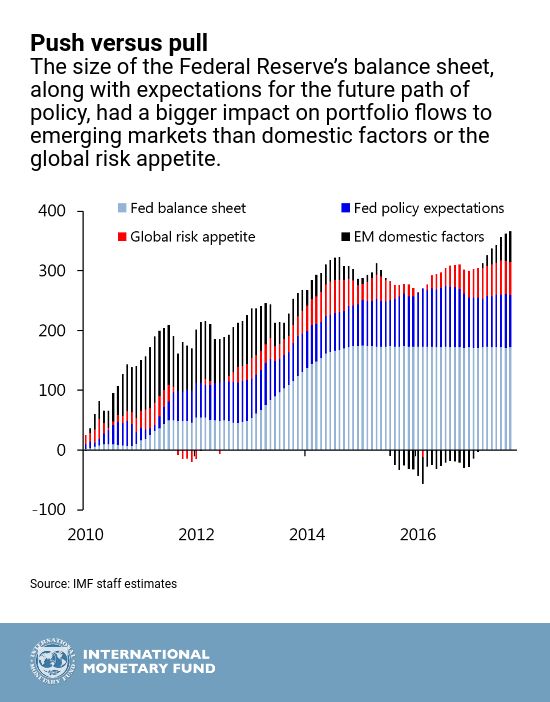
- Since 2010, about $260 billion in portfolio inflows resulted from the “push” of unconventional Fed monetary policy rather than domestic “pull” factors.
- Of that $260 billion, $170 billion is attributed to the Fed’s large scale asset purchases as investors rebalanced toward higher-yielding emerging market assets.
- Downward shifts in market expectations for future Fed policy rates accounted for $90 billion.
- Model projections:
- Reduction in the size of the Fed’s balance sheet will cut flows by $55 billion over the next two years.
- Additional rise in short-term interest rates in line with IMF forecasts could reduce flows by an additional $15 billion.
- Assumes the US policy rate will rise to just under 3 percent by the end of 2019, and that tightening will be orderly and will not take a toll on emerging market growth.
Risks and historical precedent
- Even limited withdrawals of foreign capital, if concentrated over a short period, could create significant stress for emerging market borrowers.
- Example: During the “taper tantrum” in 2013, when markets interpreted Fed communication as signaling an accelerated reduction in asset purchases, some $40 billion flowed out of emerging markets over a period of seven weeks as exchange rates depreciated sharply and asset prices declined.
Policy implications and recommendations
- A gradual pace of normalization is crucial to allow emerging markets to adjust to reduced inflows of funds.
- The Fed and other advanced-economy central banks should:
- Change policy gradually.
- Provide well-communicated plans on unwinding their holdings of securities.
- Provide guidance on any potential changes to their frameworks to ensure a smooth normalization process.
Source: IMF blog post "Fed Tightening May Squeeze Portfolio Flows to Emerging Markets" by Robin Koepke, December 14, 2017.
Content in this bundle
- 美联储收紧政策可能导致新兴市场的证券投资流入减少, IMF博客; 2017年12月14日
- 連邦準備制度による引き締め措置の結果、新興市場国への証券投資が減少する可能性がある; ロビン・クプケ IMF ブログ 2017年12月14日掲載
- 121417r
References
- https://www.imf.org/wp-content/uploads/2017/12/BLOG-1024x600-Singapore-derivatives-traders-Caro-Rupert-Oberhaeuser-Newscom-carophotos361882.jpg
- https://www.imf.org/wp-content/uploads/2017/12/FED-Blog-Chart-1.jpg
- Global Financial Stability Report
- https://www.imf.org/wp-content/uploads/2017/12/FED-Blog-Chart-2.jpg