Women in Finance: An Economic Case for Gender Equality
IMF Blog, September 19, 2018
Source details
- Canonical URL
- Women in Finance: An Economic Case for Gender Equality
Other formats
Bibliographic details
- Authors: Martin ihk, Ratna Sahay
- Published: September 19, 2018
Overview
- Women are underrepresented at all levels of the global financial system, from depositors and borrowers to bank board members and regulators.
- Greater inclusion of women as users, providers, and regulators of financial services would have benefits beyond addressing gender inequality: it would foster greater stability in the banking system, enhance economic growth, and contribute to more effective monetary and fiscal policy.
- The blog post is the first in a series stemming from the IMF’s research on gender; posts on technology and productivity will follow.
Key statistics and findings
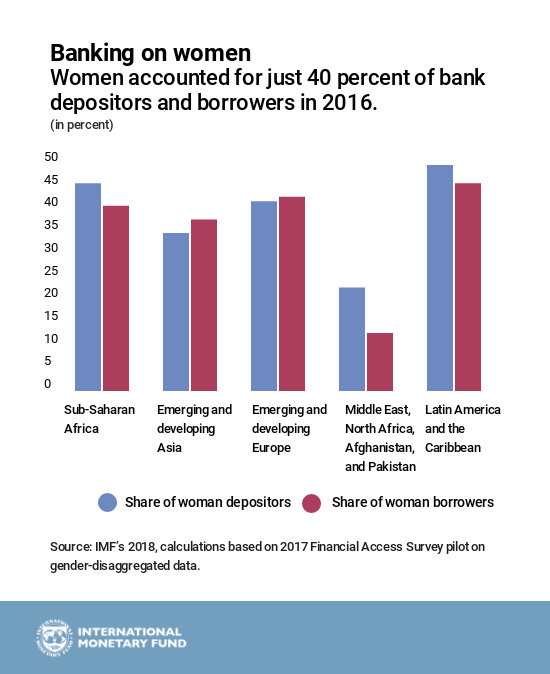
- Women on average accounted for just 40 percent of bank depositors and borrowers in 2016, according to IMF survey results published this year.
- Regional examples illustrating variation:
- Women accounted for 51 percent of borrowers in Brazil.
- Women accounted for only 8 percent of borrowers in Pakistan.
- Empirical examples of benefits from increased financial inclusion:
- In Kenya, women merchants who opened a basic bank account invested more in their businesses.
- Female-headed households in Nepal spent more on education after opening a savings account.
- Leadership representation in banks and supervision:
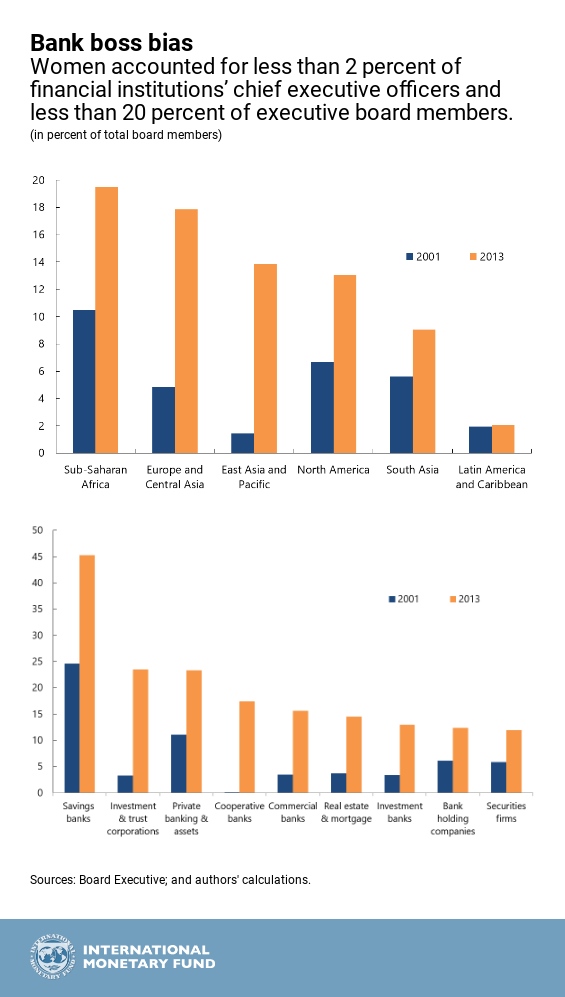
- Women accounted for less than 2 percent of financial institutions’ chief executive officers.
- Women accounted for less than 20 percent of executive board members.
- The proportion of women on the boards of banking-supervision agencies was just 17 percent on average in 2015.
- Regional distribution of female banking executives:
- Sub-Saharan African countries had the highest shares of female banking executives.
- Latin America and the Caribbean had the lowest shares.
- Advanced economies were in the middle.
- Relationship with bank stability:
- Banks with higher shares of women board members had higher capital buffers, a lower proportion of nonperforming loans, and greater resistance to stress.
- A similar relationship was found between bank stability and the presence of women on banking regulatory boards.
Mechanisms and explanations
- Four possible reasons why a higher share of women on bank and supervisory boards may contribute to financial stability:
- Women may be better risk managers than men;
- Discriminatory hiring practices may mean that the few women who do make it to the top are better qualified or more experienced than their male counterparts.
- More women on boards contributes to diversity of thought, which leads to better decisions; and
- Institutions that tend to attract and select women in top positions may be better-managed in the first place.
- The authors find that the observed higher stability is most likely due to:
- The beneficial effects of greater diversity of views on boards, and
- Discriminatory hiring practices that lead to hiring better qualified or more experienced women than men.
Implications for policy and research
- The findings strengthen the case for financial inclusion of women to enhance economic growth and foster financial stability.
- More inclusive financial systems can magnify the effectiveness of fiscal and monetary policies by broadening financial markets and the tax base.
- The authors call for more research and better data to:
- Explain how to achieve these benefits, and
- Identify the conditions that facilitate the entry of women into leadership roles in banks and supervisory agencies.
Martin Čihák, Ratna Sahay; September 19, 2018 — Women in Finance: An Economic Case for Gender Equality
Content in this bundle
- 雷曼兄弟事件十年——经验教训与未来挑战; IMF blog; 2018年9月5日
- 金融领域的妇女境况:性别平等的经济理由
- 女性と金融 男女平等を推進する経済的な理由; マーティン・チハク ラトナ・サヘイ著、IMFブログ, 2018年9月19日
- Женщины в финансовой сфере: экономические аргументы в пользу гендерного равенства
References
- عربي
- Português
- https://www.imf.org/wp-content/uploads/2018/09/BLOG-1024x600-womeninfinance2-Sebastiao-Mareira-Newscom-efephotos555641.jpg
- Our new study
- IMF survey results
- https://www.imf.org/wp-content/uploads/2018/09/eng-september-6-women-in-finance-4.png
- https://www.imf.org/wp-content/uploads/2018/09/eng-september-6-women-in-finance.png
- paper
- https://www.imf.org/wp-content/uploads/2018/09/eng-september-6-womeninfinance2-3.png
- Ending Harassment Helps #TheEconomyToo
- Banking on Women Leaders: A Case for More? IMF Working Paper
- Chart of the Week: Educate Girls and Women to Boost Equality