Women, Technology, and the Future of Work
IMF Blog, November 16, 2018
Source details
- Canonical URL
- Women, Technology, and the Future of Work
Other formats
Bibliographic details
- Authors: Era Dabla-Norris, Kalpana Kochhar
- Published: November 16, 2018
Key findings on automation risk and gender
- On average, women face an 11 percent risk of losing their jobs due to automation, compared to 9 percent of their male counterparts.
- We estimate that 26 million women’s jobs in 30 countries are at high risk of being displaced by technology within the next 20 years.
- We find that women’s jobs have a 70 percent or higher probability of automation. This translates globally to 180 million women’s jobs.
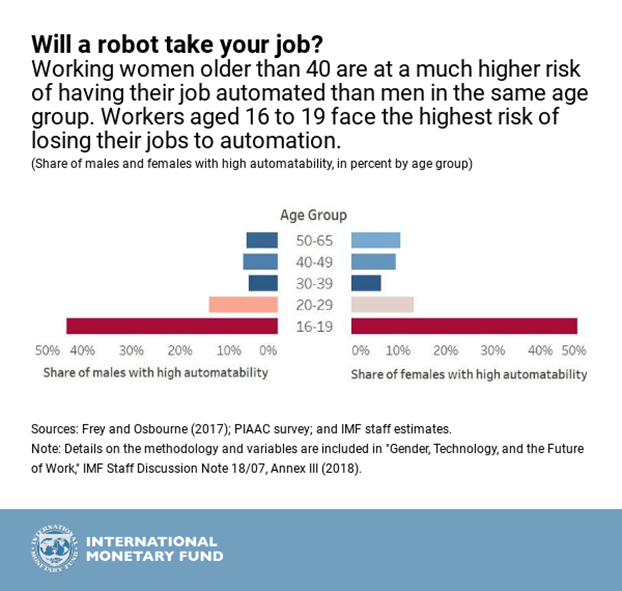
- Women who are 40 and older, and those in clerical, service, and sales positions are disproportionately at risk.
- Nearly 50 percent of women with a high school education, or less, are at high risk of their jobs being automated, compared to 40 percent of men.
- The risk for women with a bachelor’s degree or higher is 1 percent.
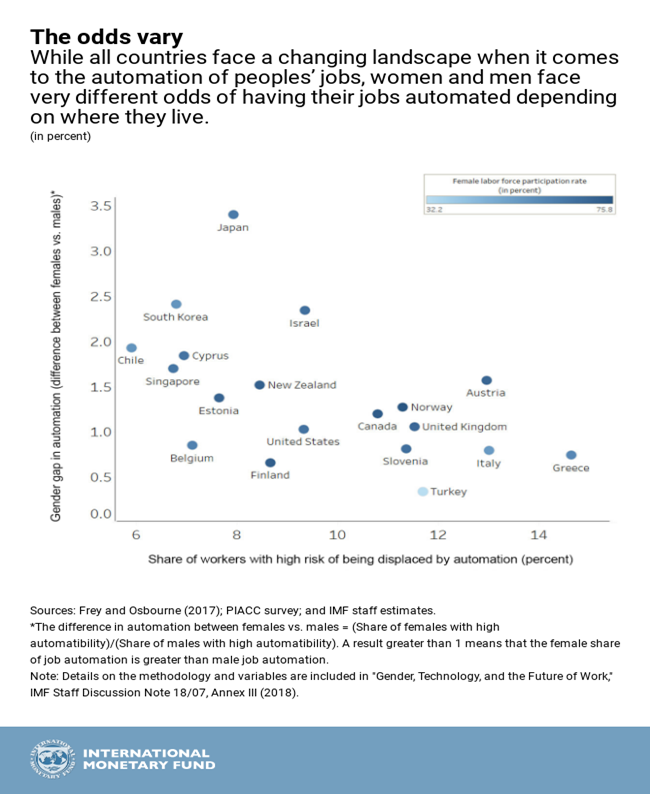
- Country-level variation: men and women in the United Kingdom and the United States face about the same amount of risk for job automation; in Japan and Israel, women’s jobs are more vulnerable to automation than men’s; women’s jobs in Finland are less vulnerable to automation than men’s.
Opportunities and structural challenges
- Women are underrepresented in fields experiencing job growth, such as engineering and information and communications technology.
- In tech:
- Women are 15 percent less likely than men to be managers and professionals.
- Women are 19 percent more likely to be clerks and service workers performing more routine tasks, leaving them at higher risk of displacement by technology.
- Routineness of job tasks exacerbates gender inequality in returns to labor:
- Even after accounting for differences in skill, experience and choice of occupation, nearly 5 percent of the wage gap between women and men is because women perform more routine job tasks.
- In the US this means women forfeit $26,000 in income over the course of their working life.
- Bright spots: in advanced and emerging economies experiencing rapid aging, jobs are likely to grow in traditionally female-dominated sectors such as health and social services—jobs requiring cognitive and interpersonal skills and thus less prone to automation.
- Coping with aging populations will require both more human workers and greater use of artificial intelligence, robotics, and other advanced technologies to complement and boost productivity of workers in healthcare services.
Policy recommendations
- Provide women with the right skills:
- Early investment in women in STEM fields (example: Girls Who Code in the US) and peer mentoring to break down gender stereotypes and increase women in scientific fields.
- Tax deductions for training those already in the workforce (example: the Netherlands).
- Portable individual learning accounts (example: France) to remove barriers to lifelong learning.
- Close gender gaps in leadership positions:
- Provide affordable childcare and replace family taxation with individual taxation (examples: Canada and Italy) to boost women’s career progression.
- Set recruitment and retention targets, and promotion quotas (example: Norway), and establish mentorship and training programs to promote women into managerial positions.
- Bridge the digital gender divide:
- Public investment in capital infrastructure and ensuring equal access to finance and connectivity (example: Finland).
- Ease transitions for workers affected by automation:
- Support workers with training and benefits linked to individuals rather than jobs (examples: individual training accounts in France and Singapore).
- Adapt social protection systems to new forms of work; consider expansion of non-contributory pensions and adoption of basic income guarantees where warranted to address deteriorating income security associated with rapid technological change.
Conclusion
- Automation increases the urgency of policies that level the playing field between men and women so that all have equal opportunities to contribute to, and benefit from, a more technology-enabled world.
Source: Women, Technology, and the Future of Work (Era Dabla-Norris, Kalpana Kochhar, November 16, 2018).