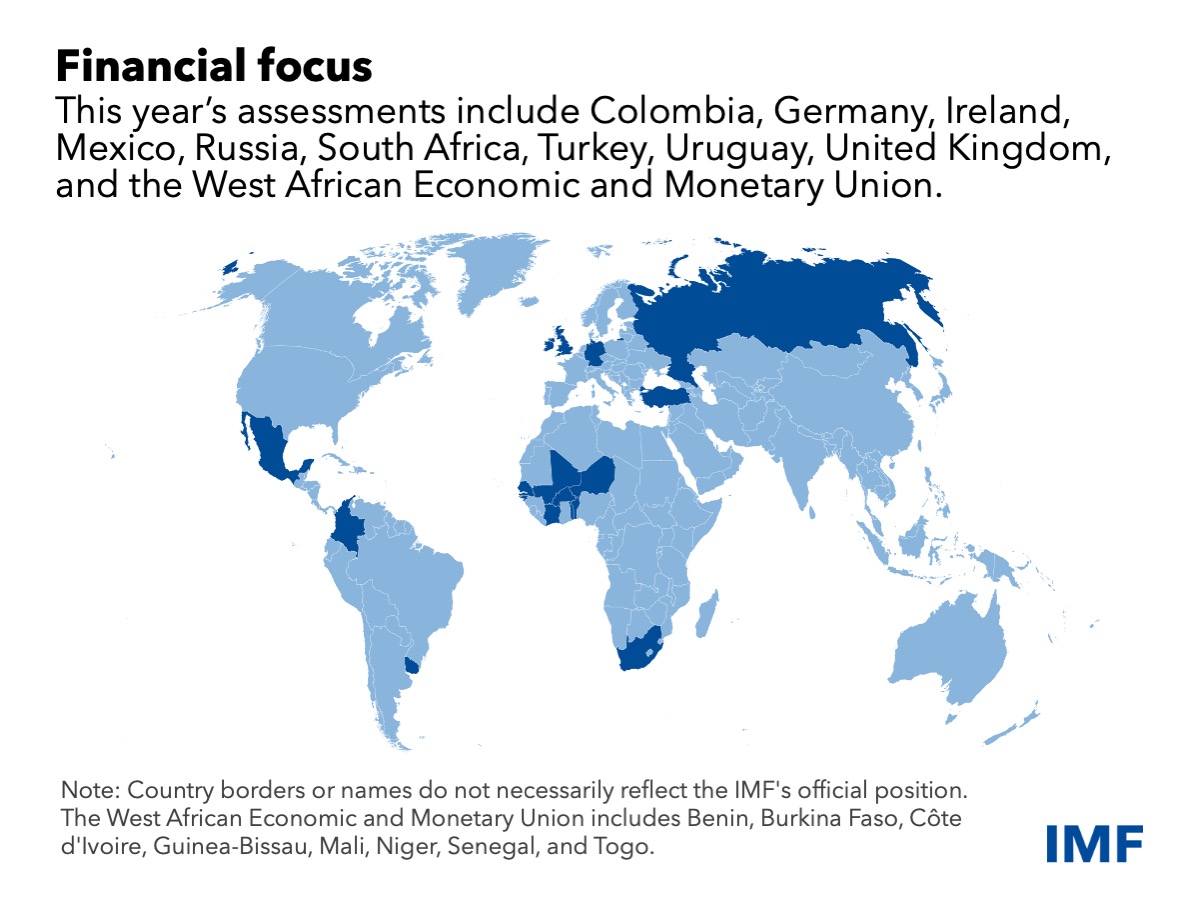
Countries in the IMF Financial Stability Spotlight in 2022
IMF Blog, February 3, 2022
Source details
- Canonical URL
- Countries in the IMF Financial Stability Spotlight in 2022
Other formats
Bibliographic details
- Authors: The Editors
- Published: February 3, 2022
FSAP purpose and approach
- The Financial Sector Assessment Program (FSAP) is described as a key pillar of IMF surveillance that:
- undertakes deep-dives into potential systemic risks to financial stability;
- conducts “stress tests” to gauge the ability of financial institutions to withstand adverse shocks to the economy;
- evaluates the strength of supervisory and regulatory frameworks to mitigate risks;
- assesses the adequacy of crisis management tools and safety nets.
- FSAPs consider country-specific features and tailor their analysis.
- The IMF assesses advanced economies itself and evaluates other economies jointly with the World Bank.
Context and cross-cutting themes in 2022
- Many countries entered the pandemic with strong bank capital and supervisory frameworks, but uncertainties remain regarding the underlying state of banks and other intermediaries as economies recover.
- Cross-cutting themes highlighted across FSAPs include:
- climate change and transition risks;
- cyber security;
- fintech and regulatory aspects of financial technology;
- macroprudential policy frameworks and crisis management arrangements;
- financial inclusion and capital markets development;
- effects of phasing out extraordinary COVID-19 support and potential global tightening of financial conditions.
Coverage and cadence
- This year’s assessments address seven economies with systemically important financial sectors: Germany, United Kingdom, Mexico, Russia, Turkey and Ireland, which are reviewed every five years, and South Africa, which is assessed once every 10 years.
- Additional assessments requested by the countries themselves include: Colombia, Uruguay and the West African Economic and Monetary Union.
Country-specific assessment focuses (selected highlights)
- Colombia
- Assess soundness and resilience of banks to adverse economic shocks.
- Perform interconnectedness and contagion analysis and corporate stress testing.
- Explore transition risks from climate change.
- Evaluate bank oversight, macroprudential policy, and safety-net arrangements.
- World Bank focus: role of the state, competition, digital financial inclusion, insurance supervision, insolvency regimes and creditor rights.
- Germany
- Financial sector dominated by banks; includes two globally systemic lenders, a large insurer, and a major global central counterparty.
- Assess financial stability implications of low banking profitability and price misalignments in the real estate sector.
- Analyze risks from a global resurgence of COVID-19, inflationary pressures, and shifts in market sentiment against some high-debt euro area countries.
- Assess institutional framework for macroprudential policy, targeted banking and insurance regulation and supervision reviews, financial crisis management, deposit insurance, institutional protection schemes, and a deep dive of systemic financial infrastructure.
- Profile climate transition risks and cover financial technology regulatory aspects.
- Ireland
- Market-based financial (MBF) sector is the largest component and is now the second largest in Europe, behind Luxembourg.
- FSAP themes: post-Brexit landscape, climate change, phasing out of COVID-19 support.
- Examine supervision of banking, insurance, and MBF; conduct stress testing; assess macroprudential frameworks and financial safety net and crisis management; analyze MBF interconnectedness.
- Assess insolvency and creditor rights given comparatively low collateral recovery rates in Ireland.
- Mexico
- Examination amid risks from continued pandemic disruptions and possible sharp tightening in global financial conditions or capital flow volatility.
- Assess resilience to system-wide liquidity shocks; financial sector oversight and crisis management.
- Evaluate challenges and opportunities from climate change, cyber security, and fintech.
- Russia
- Bank-dominated, largely state-owned and concentrated system.
- Key risks: intensified economic sanctions, reliance on emission-intensive exports, rapid credit growth in riskier retail segments, and dominant banks expanding non-core businesses.
- FSAP to examine progress in macroprudential tools, banking regulation and supervision, securities oversight, and crisis management and resolution.
- Systemic risk assessment includes bank solvency and liquidity stress tests and impact of various climate policy scenarios.
- South Africa
- Home to Africa’s largest financial sector with big cross-border banking groups and a well-developed investment fund and insurance sector.
- Assessment will examine financial strength amid subdued economic growth and large fiscal deficits, aggravated by weak state-owned enterprise finances and the ongoing pandemic.
- Cover banking, insurance, securities markets; pension and cyber risk supervision; crisis management and resolution; fintech; financial inclusion; climate risk; and capital markets development.
- Turkey
- Bank-dominated system that has grown rapidly in recent years.
- FSAP to examine systemic risks amid a challenging macroeconomic environment.
- Analyze resilience of banking and corporate sectors to adverse shocks and bank-corporate-sovereign interlinkages.
- Evaluate banking supervision and regulation, macroprudential framework, systemic liquidity management, crisis management, and cyber risks.
- Uruguay
- Small, open economy with a heavily dollarized financial system and high participation of state banks.
- System withstood the pandemic in part due to extensive policy support.
- Focus on resilience to a pandemic resurgence and possible rise in global borrowing costs.
- Evaluate bank supervision (jointly with the World Bank), macroprudential policy including measures to tackle dollarization, crisis-management arrangements, and financial integrity.
- World Bank to focus on the role of the state and prospects for developing capital markets.
- United Kingdom
- FSAP discussed with national authorities alongside Article IV consultation conclusions in December.
- Recognized swift policy actions at pandemic onset to restore market liquidity and maintain financial stability.
- Soundness of UK banks and insurers has increased since the 2008 Global Financial Crisis; they are well placed to face near-term challenges.
- Assessed financial stability framework as resilient and noted opportunities for enhancements, many of which are cross-border and require international cooperation (including bridging data gaps in the nonbank financial institutions subsector).
- Highlighted UK leadership on managing future risks such as climate and cyber resilience and the importance of preserving the primacy of financial stability objectives.
- West African Economic and Monetary Union (Benin, Burkina Faso, Côte d'Ivoire, Guinea-Bissau, Mali, Niger, Senegal, and Togo)
- Rapid banking sector growth with dominant intra- and extra-regional banking groups; government debt is a critical part of banks’ portfolios.
- FSAP developing tail-risk scenarios for economic growth and inflation amid uncertainty about global inflation and growth.
- Assess systemic liquidity management and macroprudential policy; examine banking regulation and supervision; crisis management and bank resolution; access to finance; payment systems; climate risk; capital markets development; and the role of state-owned banks.
Source: Countries in the IMF Financial Stability Spotlight in 2022 (February 3, 2022).
Content in this bundle
- Country Report