Restructuring Debt of Poorer Nations Requires More Efficient Coordination
IMF Blog, April 7, 2022
Source details
- Canonical URL
- Restructuring Debt of Poorer Nations Requires More Efficient Coordination
Other formats
Bibliographic details
- Authors: Guillaume Chabert, Martin Cerisola, Dalia Hakura
- Published: April 7, 2022
Overview
- Low-income countries face fewer debt challenges today than 25 years ago due to the Heavily Indebted Poor Countries initiative, which slashed unmanageable debt burdens across sub-Saharan Africa and other regions.
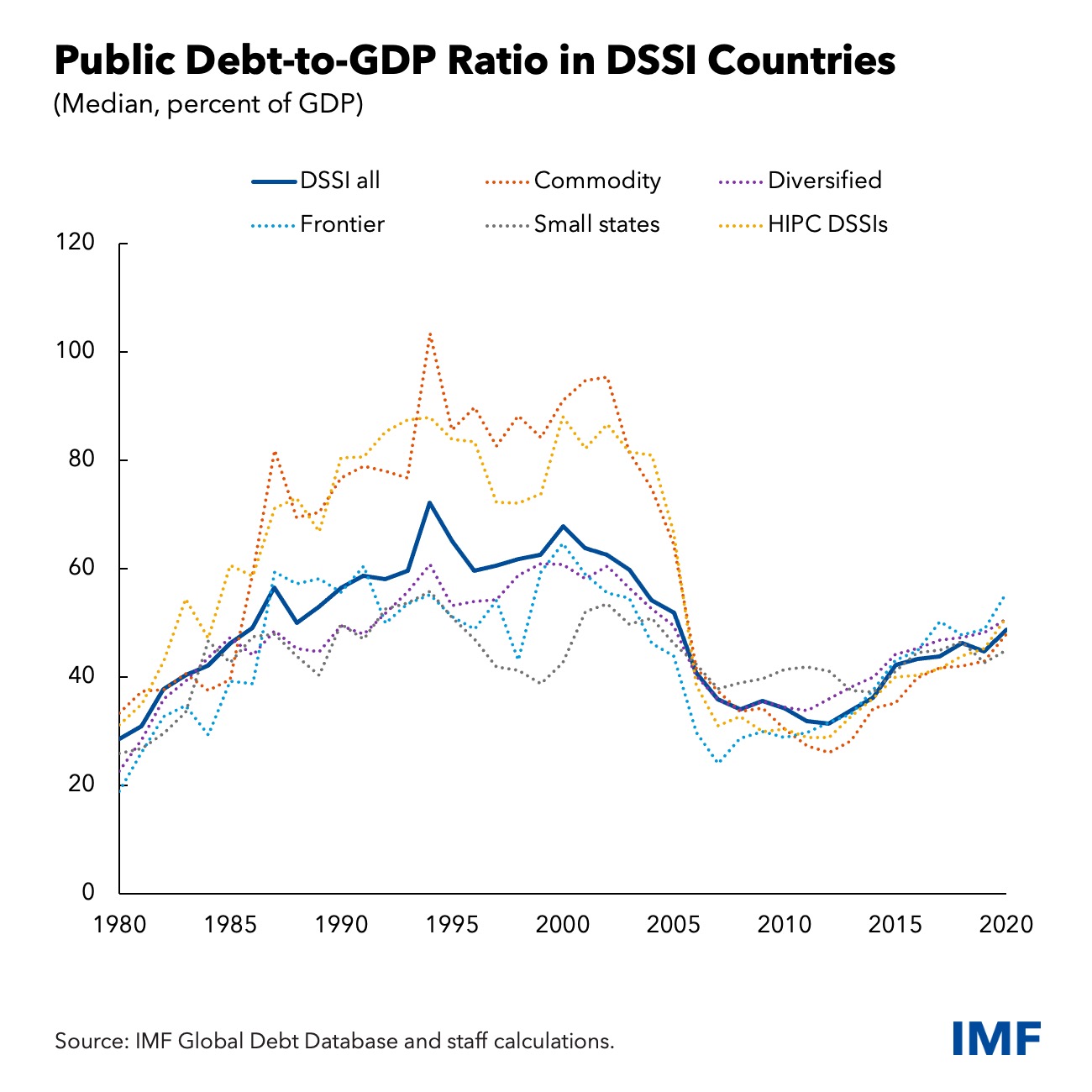
- Despite lower debt ratios than in the mid-1990s, debt has been creeping up for the past decade and the changing composition of creditors will make restructurings more complex.
- Improvements to the Group of Twenty Common Framework for Debt Treatments—from which the 73 countries that were eligible for the G20 Debt Service Suspension Initiative (DSSI) in 2020-21 can now benefit—could clear a path through increasing creditor complexity.
- Only a handful of countries have requested to use the common framework, which was launched in November 2020, underscoring the need for change to build confidence and encourage participation.
Rising risks of debt distress
- Drivers of increased debt ratios among DSSI countries:
- Low interest rates.
- High investment needs.
- Limited progress raising additional domestic revenue.
- Stretched systems for managing public finances.
- New shocks exacerbating debt challenges:
- COVID-19 pandemic.
- War in Ukraine.
- Central banks starting to raise interest rates.
- Key statistics and country situations:
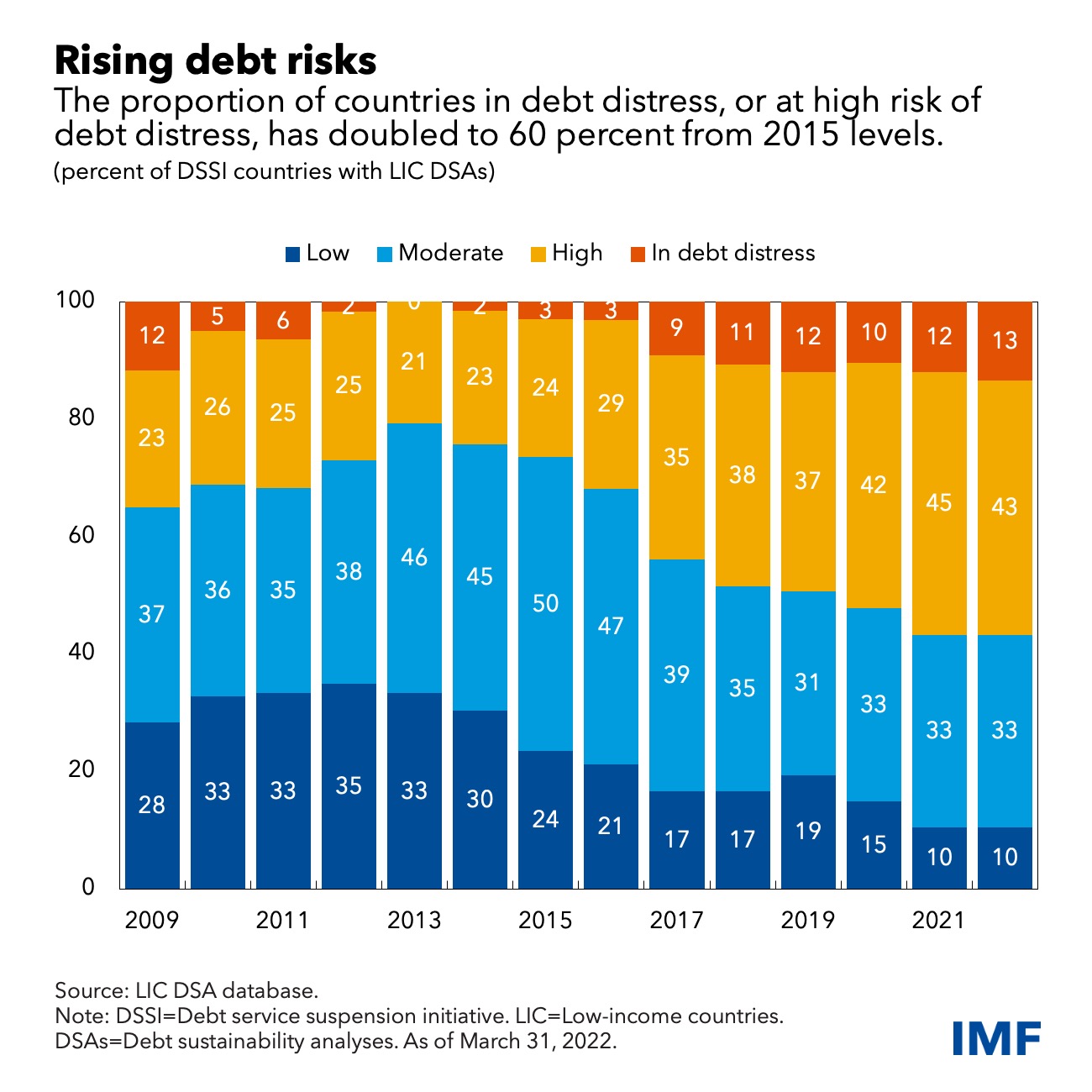
- About 60 percent of DSSI countries are at high risk of debt distress or already in debt distress.
- Among the 41 DSSI countries at high risk of or in debt distress, Chad, Ethiopia, Somalia (under the HIPC framework) and Zambia have already requested a debt treatment.
- Around 20 other DSSI countries exhibit significant breaches of applicable high-risk thresholds; half of these also have low reserves, rising gross financing needs, or a combination of the two in 2022.
- Domestic debt dynamics:
- Local currency debt for the median DSSI country doubled from 7 percent of gross domestic product in 2010 to 15 percent in 2021.
- For those DSSI countries with market access, the share of local currency debt more than tripled from 8 percent to 28 percent in 2021.
- Many DSSI countries have experienced a tightening of sovereign-bank links, with larger holdings of domestic sovereign debt at domestic banks.
- Trade-offs:
- Difficult trade-offs exist between restructuring sovereign debt owed to domestic banks and maintaining financial sector stability and domestic banks’ capacity to finance growth.
Coordination challenge
- Changing creditor landscape compared with past decades:
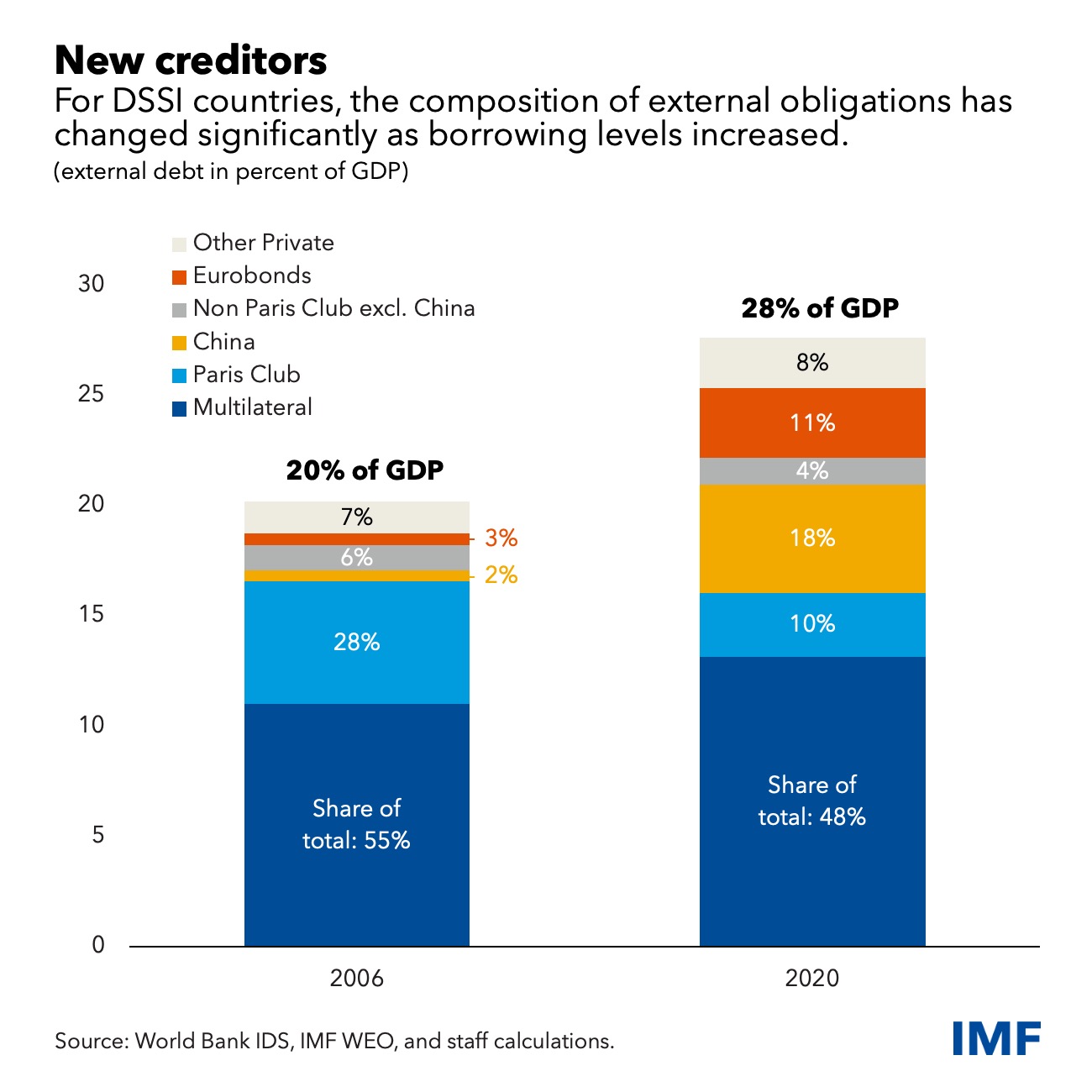
- Historically, DSSI countries borrowed mainly from Paris Club official creditor nations and private banks, alongside multilateral institutions.
- Today, China and private bondholders play a much larger lending role.
- Shifts in creditor shares (DSSI countries, 2006 to 2020):
- Share owed to Paris Club creditors fell from 28 percent in 2006 to 11 percent in 2020.
- Share owed to China rose from 2 percent to 18 percent.
- Share of Eurobonds sold to private creditors increased from 3 percent to 11 percent.
- Country heterogeneity:
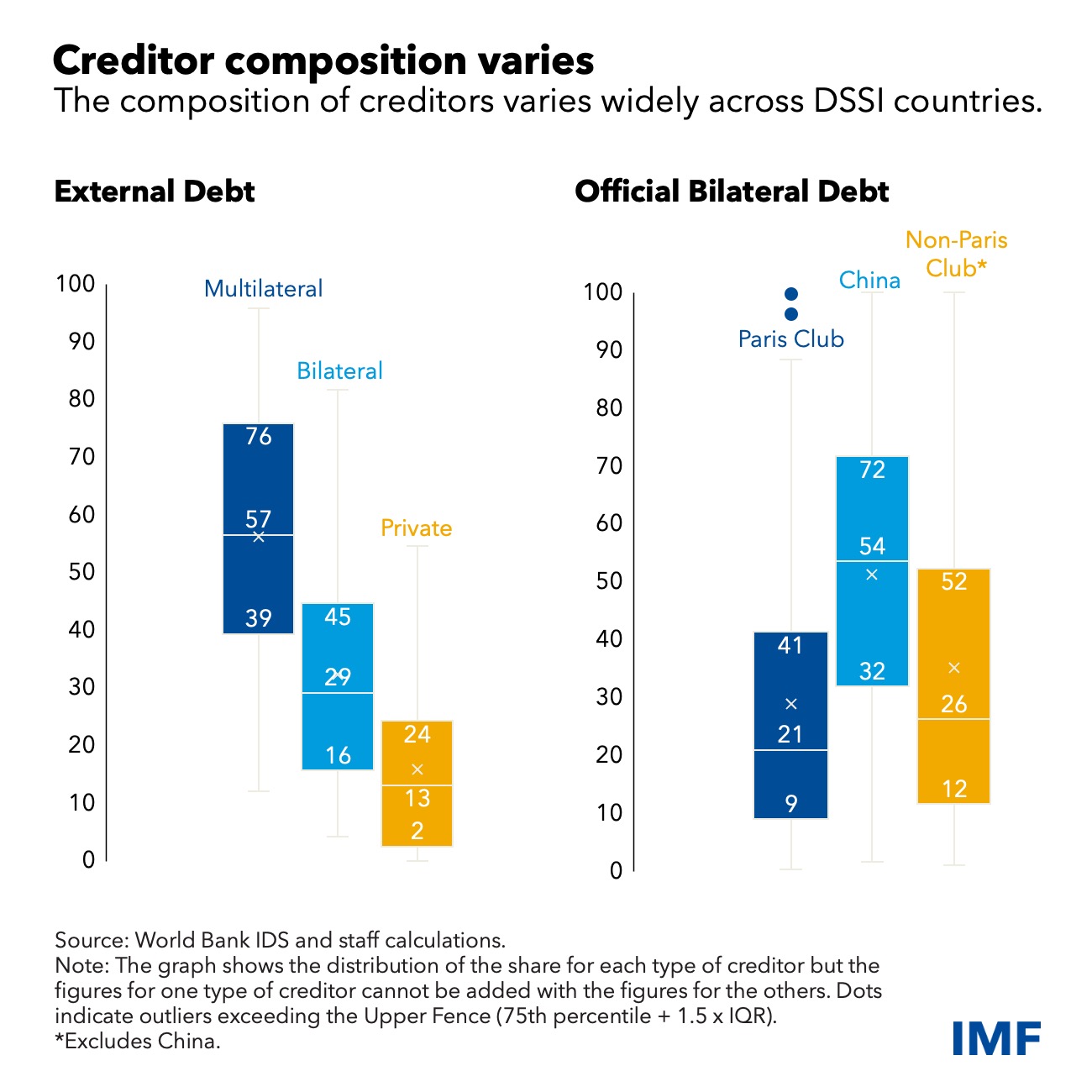
- Averages conceal a diversity of debt composition across countries, including shares of bilateral, multilateral and private creditors, and the composition of official bilateral creditors themselves.
- China is now the largest official bilateral creditor in more than half of DSSI countries, including when counting all 22 Paris Club creditors as a single pool.
- China would therefore play a key role in most DSSI countries’ debt restructurings that involve official bilateral creditors.
- Implication:
- While creditor composition diversity calls for attention to country specificities, appropriate coordination mechanisms will be key in all cases.
Common Framework and needed improvements
- Urgent need:
- Putting in place mechanisms that ensure coordination and confidence among creditors and debtors has become urgent.
- Role of the G20 Common Framework:
- Improvements to the G20 Common Framework could play an important role by ensuring broad participation of creditors with fairer burden sharing.
- Experience-based gaps to address:
- Greater clarity on restructuring steps is needed.
- Earlier engagement of official creditors with the debtor and with private creditors is needed.
- A standstill in debt service payments during negotiations is needed.
- Specifying the mechanics of comparability of treatment is still needed.
- Complementary priorities:
- Strengthening debt management and debt transparency should be priorities to help countries manage debt risks, reduce the need for debt restructurings, and facilitate more efficient and durable resolution if debt becomes unsustainable.
- Broader benefit:
- Speedy, smooth, and efficient debt restructurings, where necessary, would support global stability and prosperity.
This blog reflects research contributions from Prateek Samal and Dilek Sevinc and was authored by Guillaume Chabert, Martin Cerisola, Dalia Hakura on April 7, 2022.
References
- Heavily Indebted Poor Countries initiative
- debt ratios are lower
- G20 Debt Service Suspension Initiative (DSSI)
- https://www.imf.org/wp-content/uploads/2022/04/DSS-Chart-1-V2.jpg
- https://www.imf.org/wp-content/uploads/2022/04/DSSI-Blog-Chart-2-v2-1.jpg
- https://www.imf.org/wp-content/uploads/2022/04/DSSI-Charts-Blog-chart-3.jpg
- G20 Common Framework
- questions and answers