Why Countries Must Cooperate on Carbon Prices
IMF Blog, May 19, 2022
Source details
- Canonical URL
- Why Countries Must Cooperate on Carbon Prices
Other formats
Bibliographic details
- Authors: Jean Chateau, Florence Jaumotte, Gregor Schwerhoff
- Published: May 19, 2022
Overview
- An international carbon price floor (ICPF) is proposed to speed the world’s transition to green energy without compromising countries’ competitiveness.
- The proposal calls for the world’s largest emitters to pay a floor price of $25-$75 per ton of carbon depending on their level of economic development.
- The ICPF would be phased in by 2030 and can be implemented alongside alternative policies (regulations) that achieve at least the same emissions reductions as the carbon price floor.
Key findings
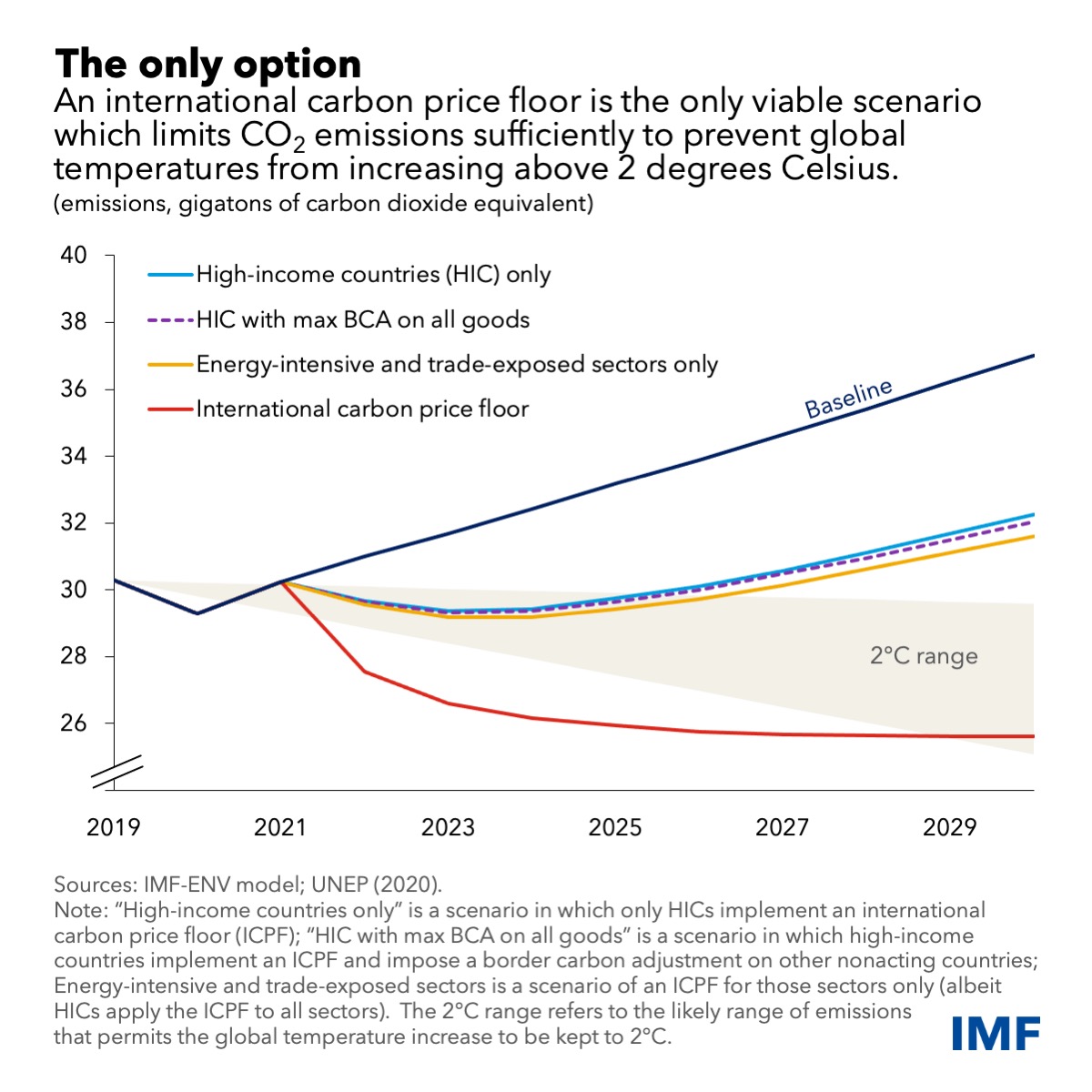
- An ICPF introduced by all countries simultaneously—and with the same tiered price floors based on income level—would:
- Reduce emissions sufficiently to accomplish the 2-degree target.
- Be the only feasible option out of all those considered in the underlying staff paper to prevent the planet from heating to dangerously high temperatures.
- Have only a small impact on global economic growth—provided countries also invest in low-carbon energy.
Economic impacts and distributional effects
- Estimated global impact:
- The ICPF would reduce global gross domestic product by 1.5 percent by 2030 relative to what it would have been in the absence of the price floor.
- The world’s poorest countries would see a much smaller slowdown: 0.6 percent by 2030.
- The proposal argues this is a price worth paying to avoid the far larger costs of failing to curb carbon emissions, described as "many trillions of dollars" in a recent United Nations Intergovernmental Panel on Climate Change report.
Differentiation and fairness
- The ICPF allocates transition costs according to differentiated responsibilities through tiered carbon price floors:
- $25 per ton of carbon for low-income countries.
- $50 per ton of carbon for middle-income countries.
- $75 per ton of carbon for high-income countries.
- These are floor prices; many high-income countries may set higher prices to meet ambitious nationally determined contributions (NDCs).
- For many middle- and low-income countries, the floors are higher than implied by their NDCs, indicating a need to strengthen their contributions to limit temperature increases.
Competitiveness, border measures, and international cooperation
- In the absence of a global agreement, high-income countries have considered border carbon adjustments (BCAs) to protect domestic industry.
- The study confirms previous work showing that BCAs:
- Can protect energy-intensive and trade-exposed industries.
- Do not incentivize enough emissions reductions to achieve global temperature goals because they only tax exported goods from countries without a domestic carbon tax.
- A simultaneous and differentiated ICPF would remove the need for high-income countries to impose BCAs:
- With all country groups acting together, high-income countries would suffer no major losses to competitiveness.
- Because goods from middle- and low-income countries are typically more carbon-intensive, the lower carbon price and higher carbon intensity tend to offset one another, so a given good would require similar carbon payments across income groups.
Policy recommendation and rationale
- Implement an international carbon price floor, tiered by income level ($25, $50, $75 per ton), introduced simultaneously by all countries and phased in by 2030.
- Complement the price floor with investment in low-carbon energy to limit GDP costs and accelerate the green transition.
- Strengthen NDCs for middle- and low-income countries to ensure global temperatures remain in check.
Source: Why Countries Must Cooperate on Carbon Prices (May 19, 2022) — Jean Chateau, Florence Jaumotte, Gregor Schwerhoff