Facing a Darkening Economic Outlook: How the G20 Can Respond
IMF Blog, July 13, 2022
Source details
- Canonical URL
- Facing a Darkening Economic Outlook: How the G20 Can Respond
Other formats
Bibliographic details
- Authors: Kristalina Georgieva
- Published: July 13, 2022
Context and current outlook
- Author: Kristalina Georgieva
- Date: July 13, 2022
- When the G20 last met in April, the IMF had cut its global growth forecast to 3.6 percent for this year and next; since then multiple downside risks have materialized and the outlook has darkened.
- Recent developments worsening the outlook:
- War in Ukraine: worsening human tragedy and economic impact, especially through commodity price shocks.
- Inflation: higher than expected and broadened beyond food and energy.
- Monetary policy: major central banks have announced further monetary tightening.
- Pandemic disruptions: continuing pandemic-related disruptions, especially in China.
- Supply chains: renewed bottlenecks hampering economic activity.
- Near-term projection: weak second quarter implied by recent indicators and a further downgrade to global growth for both 2022 and 2023 will be projected in the World Economic Outlook Update later this month.
- Risk scenario highlighted: further disruption in natural gas supply to Europe could plunge many economies into recession and trigger a global energy crisis.
- Summary assessment: It is going to be a tough 2022—and possibly an even tougher 2023, with increased risk of recession.
Priority 1 — Bring down high inflation
Findings:
- Inflation has reached multi-decade highs in many countries, with both headline and core inflation continuing to rise.
- Monetary tightening has become increasingly synchronized:
- 75 central banks—or about three-quarters of the central banks tracked—have raised interest rates since July 2021.
- On average, they have done so 3.8 times.
- For emerging and developing economies, the average total rate increase has been 3 percentage points—almost double the 1.7 percentage points for advanced economies.
- Portfolio flows and exchange rate pressures:
- Emerging markets experienced a fourth consecutive month of outflows in June, the longest such run in seven years.
- The appreciation of the US dollar has coincided with these portfolio outflows.
Policy recommendations:
- Most central banks must continue to tighten monetary policy decisively, especially where inflation expectations are de-anchoring.
- Clear communication of policy actions to preserve credibility and manage expectations.
- Where external shocks are highly disruptive, policymakers should be ready to use:
- Foreign exchange interventions.
- Capital flow management measures in a crisis scenario.
- Pre-emptively reduce reliance on foreign currency borrowing where debt levels are high.
- IMF support measures:
- Advice on managing reserve assets.
- Technical assistance to strengthen central bank communications.
- Overarching goal: get everyone safely to the other side of this tightening cycle.
Priority 2 — Fiscal policy that supports disinflation and shields the vulnerable
Findings:
- Countries with elevated debt levels will need to tighten fiscal policy to reduce borrowing burdens and complement monetary efforts.
- In countries where recovery is more advanced, shifting away from extraordinary fiscal support will help tamp down demand and price pressures.
- Some people will need more support, not less, due to high energy or food prices.
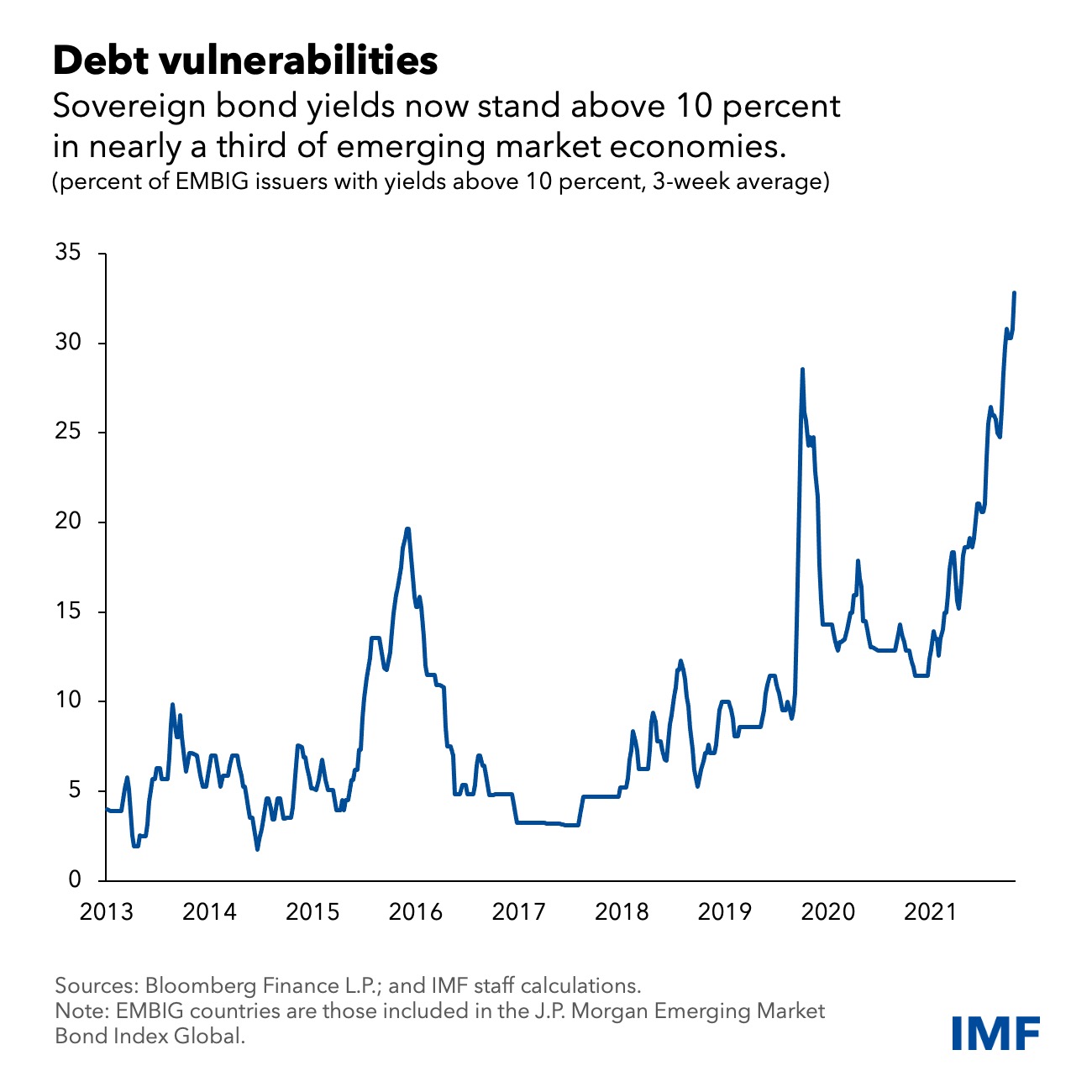
- Sovereign FX bond yields:
- Have reached more than 10 percent in around a third of emerging economies—close to highs after the global financial crisis.
- Debt distress prevalence:
- 30 percent of emerging market countries are in or near debt distress.
- 60 percent of low-income nations are in or near debt distress.
Policy recommendations:
- Use targeted and temporary measures to support vulnerable households, e.g., direct cash transfers rather than distortionary subsidies or price controls.
- Ensure new measures are budget-neutral—funded through new revenues or expenditure reductions elsewhere, without incurring fresh debt.
- Structural reforms over the medium-term to bolster growth, including labor market policies to increase workforce participation, especially for women.
- Reduce debt urgently, especially for economies with FX-denominated liabilities vulnerable to tightening global financial conditions.
IMF actions and mechanisms:
- Offer tailored analysis and advice.
- More agile lending framework: emergency financing, increased access limits, new liquidity and credit lines.
- Last year’s historic SDR allocation of $650 billion.
Debt treatment:
- Urgent need to improve and implement the G20’s Common Framework for debt treatment.
- Large lenders—both sovereign and private—need to step up.
- Critical creditor committee meetings for Chad, Ethiopia, and Zambia are expected to deliver as much progress as possible this month.
Priority 3 — Renewed global cooperation led by the G20
Findings:
- Coordinated international action is urgently needed to avoid potential crises and boost growth and productivity.
- Recent progress exists in areas including taxation, trade, pandemic preparedness, and climate change.
- G20’s new $1.1 billion fund for pandemic prevention and preparedness cited as an example of what is possible.
- The cost-of-living crisis impact:
- Pushing an additional 71 million people into extreme poverty in the world's poorest countries, according to the United Nations Development Programme.
- Rising risks: social instability, hunger, malnutrition, and migration as food and energy concerns increase.
- Conditions in many African countries are particularly difficult:
- Higher food prices are acutely felt where food accounts for a higher share of income.
- Inflation, fiscal, debt and balance of payments pressures are intensifying.
- Many African countries are largely shut out from global financial markets and lack large domestic markets.
Policy recommendations and international actions:
- Wealthier countries should provide urgent support for those in need, including new bilateral and multilateral financing, especially through the World Food Programme.
- Reverse recently imposed restrictions on food exports immediately because such restrictions are harmful and ineffective in stabilizing domestic prices.
- Strengthen supply chains and help vulnerable countries adapt food production to cope with climate change.
- IMF contributions:
- Working with international partners through a new multilateral food security initiative.
- The Resilience and Sustainability Trust will provide $45 billion in concessional financing for vulnerable countries to address longer-term challenges such as climate change and future pandemics.
- IMF readiness to do more.
Closing appeal and spirit for cooperation
- As the G20 meets, the needed spirit is captured by the Balinese phrase menyama braya, “everyone is a brother or sister.”
- The IMF emphasizes decisive action, strong international cooperation, and leadership by the G20 to navigate the “sea of troubles.”
IMF Blog — Facing a Darkening Economic Outlook: How the G20 Can Respond (Kristalina Georgieva, July 13, 2022)
Content in this bundle
- G20 Surveillance Note
References
- https://www.imf.org/wp-content/uploads/2022/07/G20-Blog-July-Chart-111.jpeg
- IMF’s institutional view
- https://www.imf.org/wp-content/uploads/2022/07/G20-Blog-Chart-2-updated39.jpg
- historic SDR allocation of $650 billion
- https://www.imf.org/wp-content/uploads/2022/07/G20-Blog-July-Chart-393.jpeg
- multilateral food security initiative
- Resilience and Sustainability Trust