Intervention de M. Jacques CHIRAC
President of France,
to the French staff of the multilateral institutions
Washington, D.C- Thursday, February 18, 1999
Presidents of the World Bank Group and of the Interamerican Development Bank,
Mr. Minister,
Executive Directors,
Dear countrymen of the International Monetary Fund, World Bank,
Inter-American Development Bank, and Intelsat,
Ladies and Gentlemen,
 |
My visit is the first of a French head of state to the Bretton Woods organizations. And it is not just a courtesy visit. For me, it is an event charged with great significance. It is both a demonstration of confidence, and an urgent plea to the institutions you represent.
I would like, first of all, to recognize the work already accomplished. I fully realize the difficulties and the responsibilities. Your organizations have served global development well. And France has confidence in your institutions, and fully supports their efforts at adapting themselves to better serve the needs of the 21st century.
The world of today is very different from the post-war world into which you were born. Globalization of markets, capital, and economies has become a reality, and the need for cooperation, coordination, and risk-sharing is more necessary than ever. This new world confers important new responsibilities upon you.
Even more than in the past you must help these multilateral institutions to fully play their role in study, foresight, impetus and decision. We need to better organize the global economy and you must be at the forefront of this effort. You have the legitimacy of representing the whole community of nations. This is why France is in favor of increasing the resources necessary for your mission: whether it be for quotas and for financing of the Enhanced Structural Adjustment Facility at the IMF, for IDA at the World Bank, or for the resources of the InterAmerican Development Bank.
We must be able to count on you, first and foremost, for a better organized and more secure world, so that instability and exclusion can be reduced to the extent possible.
But, there must be something to counterbalance the expansion of your roles and of the reliance which governments place upon you: the general policy orientation of your institutions must be defined by the political authorities of your shareholders. Ministers in the governing bodies must act side by side with the respective Boards of Directors, whose roles are irreplaceable, to give impetus to and provide democratic oversight for the policy directions adopted. This is the spirit in which France has proposed to transform the Interim Committee of the IMF into a decision-making body as provided for in its statutes. The same should go for the Development Committee of the World Bank.
You have the good fortune to work with all nations, all outlooks, all cultures. You must cultivate this diversity of experience, of staff nationality, or points of view to fully encompass global reality. This is why I am so deeply committed to the French presence in your institutions, and at all levels.
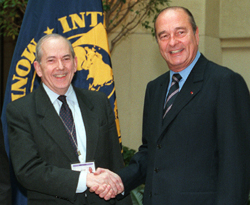
I am, of course, very happy and very proud that the international community has put its trust in the French to lead certain of your organizations. I will not cite all our countrymen who have made their mark in the past half- century. I would like, simply, this evening to bear witness to Michel Camdessus' qualities of courage and spirit and to express my great respect for what he is accomplishing at the helm of the IMF. And, I would like to tell you how happy I am to see so many of you here. Your presence underscores the vitality of the French community. Thanks to you, our country is present through its culture and is making heard what is universal in its message. I hope to see even more of you in the service of the international community, and, as the Minister of Economy and Finance knows, I am paying attention to this.
Finally, I would like to take advantage of our meeting to tell you my thoughts on the need to increase international financial stability, and the crucial fight against poverty and exclusion.
The world needs stability to achieve growth. Of course, we will never completely avoid crises. But we must do everything in our power to prevent them and to limit their effects.
The financial crisis which developed over the last two years, the grave consequences of which, we have, alas, taken the measure, illustrated the fragility of the global economic system. In this globalized world, no country is safe from the shocks which strike its neighbors.
The financial community, it is true, has been able to mobilize to face up to the situation, thanks, notably to strong intervention by the IMF and the World Bank, and the financial support of the G7. Europe and France, were, as you know, neither inactive nor indifferent. We have fully assumed our share of the requisite efforts.
But, beyond the short term, more far-reaching responses are called for, which must withstand two temptations:
The first is to blame globalization for all our troubles. I do not think this is justified. We must not stigmatize a development which is the source of the exceptional recent growth of world trade. It is mainly the globalization of trade and capital flows that has fostered very strong world growth. Globalization has permitted countries which only ten years ago were still part of a rigid system of state-run, centralized economies to be rapidly integrated into the world economy. It is globalization that has permitted many countries to emerge onto the world economic scene.
The second stumbling block we must avoid is the temptation to resort to backward-looking and inappropriate solutions. Let us acknowledge that market liberalization has occurred in a disorderly manner. Banking systems have often been too fragile to carry out the tasks incumbant upon them. Even so, the way out is not to be found in fear, or retrenchment, or in outmoded approaches. The problems we must solve call for pragmatic solutions, not ideological responses. It is not a question of backing away from free capital movements and repartitionning economic life. Nor is it a question of seeking a new financial protectionism, which would be rapidly followed by a new trade protectionism, making victims of us all.
Awareness of our vulnerability came late. It is painful. Let us accept the consequences and rapidly build the "new financial architecture" we so need. Let us reform the Bretton Woods system.
We know the reforms which must be achieved. Of course, we must first implement good economic policy in each of our countries. That is a prerequisite. But, it is also necessary to increase the transparency, both of members countries and of the international financial institutions. We must increase our capacity for crisis prevention. We must adopt a veritable "traffic code" or "highway code" for capital flows, a code which applies to all, including hedge funds and off-shore establishments. The private sector must be better encorporated to the solution of crises. We must identify and define the role of "lender of last resort" for the world financial system.
1998 was a year for understanding and stemming the crisis. 1999 must be the year of decision and reform. I am counting particularly on the IMF to take the lead in this field. For the world remains fragile.
I expect much from next meetings of the Interim Committee of the IMF and the Development Committee of the World Bank and the Annual meeting of the IDB which I will have the pleasure of welcoming in Paris. This will be an occasion for me to pay special and sincere tribute to Mr. Enrique IGLESIAS.
The Summit of the G7 in Cologne, next June, will dedicate a major part of its work to the reforms being prepared. And you are aware that France has proposed a Summit to bring together notably the Heads of State and Government of the IMF Interim Committee member countries to be held in Paris, if possible this autumn. Its purpose would be to officially adopt the reforms and to give them the requisite international legitimacy.
Expectations are great. These are the spheres where Heads of State and Government must squarely face their responsibilities. I intend to fully exercise my own.
Since January 1, 1999, our country, along with ten of its European Union partners, now has a new currency: the Euro. Its creation contributes to international stability.
The Euro holds out the promise of growth and employment if we implement the appropriate economic, structural and social policies. Europe must be a high growth zone. As the leading world economic power, Europe must play its role of engine of world growth.
Shifts between the Euro, the Yen and the Dollar will dominate the international scene. One cannot hope for world financial stability, while, at the same time, accepting unstable exchange rates. We must aim for more stable relations between currencies. This is a daunting task. At a time when so many emerging countries are making considerable effort to surmount their difficulties, we must move forward together in order to maintain a global environment which fosters growth.
Strengthening stability goes hand in hand with the fight against poverty and the social consequences of crisis. This is a political problem. Growth and economic development are the foundations of democracy: we know that demogogues find fertile ground when confidence in the future is shaken. That is why the IMF, the World Bank, and all development banks must take concerted action. A globalization which does not benefit humanity and help man to flourish is unjustifiable. We must take care that globalization leave no country by the side of the road.
This is the intent of France's course of action in support of public development aid. Concerned by the worrying decrease in contributions, France is advocating in every forum for real solidarity between nations on this issue.
This is the intent of our initiatives and proposals aimed at finding a solution to the painful, chronic problem of debt in the poorest countries. We have made progress, but it has not gone far enough. We must push ahead. I hope the Cologne Summit will help us move forward. There, I want us to express, in a decisive way, our determination to alleviate the burden of the poorest countries. This problem of debt, which is dealt with in the Paris Club, is increasingly becoming a multilateral debt problem. Balanced and shared efforts will thus be necessary to find a solution.
And as soon as the next meeting of G7 Finance Ministers is held, that is, the day after tomorrow, Mr. STRAUSS-KAHN will propose, on behalf of France, an initiative based on three principles: greater generosity--indeed, much greater generosity--toward indebted countries; a fair division of efforts among creditor countries, which is only just; and a serious effort on the part of the concerned countries to strive for better management and better governance.
Let me here acknowledge the generous vision and action of Mr. Jim Wolfensohn. He gave the impetus to the Bank's new global strategy highlighting the social and environmental dimensions of development. Yes, we must give priority to education and human development. Develop the rule of law in all countries. Fight against corruption. Assist in better public sector management.
This international solidarity must translate into real priority for the poorest countries, notably in Africa.
So, here are France's goals: to fight against poverty, to prevent crisis and to better insure financial and monetary stability, and through these efforts, to achieve stronger, more balanced world growth which will benefit everyone, and above all, democracy. In a word, as President CLINTON so rightly put it, "to humanize globalization".
I know, dear fellow citizens, that you will put all your talents and your courage to work towards this indispensable progress for our world. You are essential actors in the quest for international solidarity. I encourage you to pursue your action. It is thus that you will best serve our country.
Thank you.