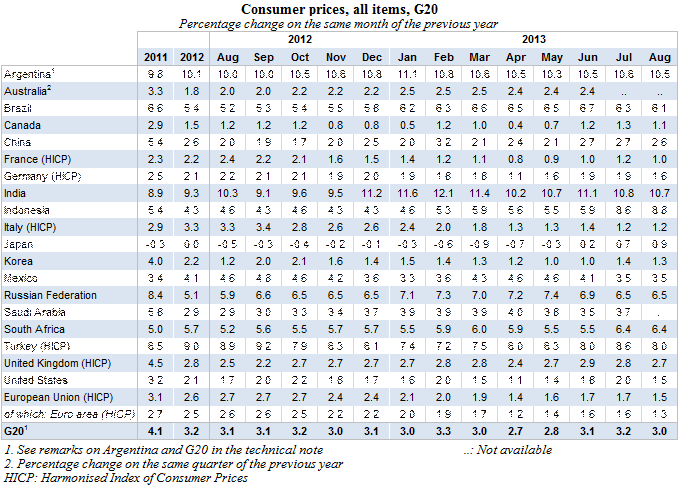
Consumer prices, all items, G20
August 2013, percentage change on the same month of the previous year
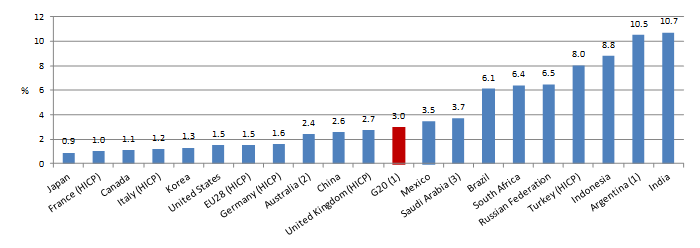 1. See remarks on Argentina and G20 in the technical note
2. Percentage change Q2 2012 to Q2 2013
3. July 2013
1. See remarks on Argentina and G20 in the technical note
2. Percentage change Q2 2012 to Q2 2013
3. July 2013
Consumer prices, all items, selected areas
Percentage change on the same month of the previous year
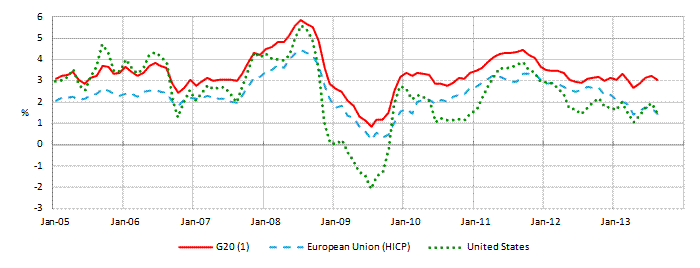
1. See remarks on Argentina and G20 in the technical note
HICP: Harmonised Index of Consumer Prices
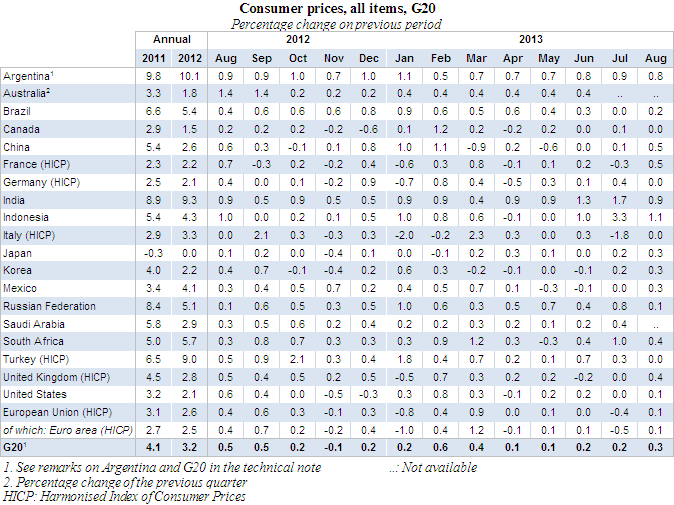
Consumer prices, all items, G20
August 2013, percentage change on the previous month
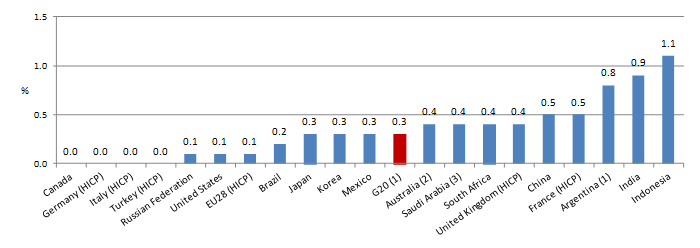
1. See remarks on Argentina and G20 in the technical note
2. Percentage change Q1 2013 to Q2 2013
3. July 2013
Technical note for IAG G20 CPI News Release
Consumer price indices (CPIs) measure inflation as price changes of a representative basket of goods and services typically purchased by households. The G20 CPI aggregate reflects national CPIs for all G20 countries (with the exception of Turkey) that are not part of the European Union (EU) while it reflects the Harmonised Indices of Consumer Prices (HICP) for the EU, its Member States, and for Turkey.
In most instances, national CPIs are compiled in accordance with international statistical guidelines and recommendations. However, national practices may differ in the coverage and treatment of certain items and in the use of index number formulas. In particular, country methodologies for the treatment of owner-occupied housing vary significantly and, where included, carry large weights in the index. The European HICP is based on a harmonised approach and a single set of definitions in order to arrive at comparable measures of inflation in the EU; owner-occupied housing is excluded from the scope of the HICP.
The G20 CPI is produced by the OECD Secretariat following a methodology agreed by the Inter-Agency Group on Economic and Financial Statistics. It is based on CPI/HICP data reported by G20 countries and Eurostat.
The G20 CPI has been calculated for the headline indicators only (CPI/HICP All items). It is an annual chain-linked Laspeyres-type index. The weights for each country in each link are based on the previous year’s relative share of individual final consumption expenditure of households and non-profit institutions serving households expressed in Purchasing Power Parities (PPPs).
Country specific cases
Argentina – The data for Argentina are officially reported data. The IMF has, however, issued a declaration of censure and called on Argentina to adopt remedial measures to address the quality of the official CPI-GBA data. 2 Alternative data sources point to considerably higher inflation rates than the official data since 2007. In this context, the Fund is also using alternative estimates of CPI inflation for the surveillance of macroeconomic developments in Argentina.
Australia – Australian national CPI is published at a quarterly frequency.
China – China refers to the People’s Republic of China.
Korea – Korea refers to the Republic of Korea unless otherwise stated.
Saudi Arabia – Saudi Arabian national CPI is usually published with a time lag of one month in comparison to other G20 economies.
G20 Aggregate
The G20 consists of the following economies: Argentina, Australia, Brazil, Canada, China, France, Germany, India, Indonesia, Italy, Japan, Korea, Mexico, the Russian Federation, Saudi Arabia, South Africa, Turkey, the United Kingdom, the United States, and the European Union. The G20 aggregate is calculated taking the fifteen individual country members of the G20 (other than France, Germany, Italy and the United Kingdom) plus the European Union as an aggregate. The European Union refers to the current composition of the European Union (28 countries) for the entire period of the time series. The Euro Area refers to the current composition of the Euro Area (17 countries) for the entire period of the time series.
The IMF has issued a declaration of censure and called on Argentina to adopt remedial measures to address the quality of the official CPI data. In the absence of a single validated alternative measure and given the small weight of Argentina in the G20 CPI, the official data of Argentina have been included in the G20 aggregate (each deviation in CPI inflation of 10 percentage points, for example, will affect G20 aggregate inflation by about 0.1 percentage point). Furthermore, in the absence of data for Saudi Arabia for the most recent period, the relevant CPI has been imputed using the weighted average of the percentage CPI change of the previous period covering all the members whose CPI are available. In the case of Australia, the values of the individual three months within a quarter have been set equal to the value of the available quarterly data.
Further information
Further methodological information can be downloaded from: http://www.oecd.org/std/prices-ppp/CPI-G20-methodology.pdf
As measured by the Harmonised Index of Consumer Prices (HICP)
2 .Please see the IMF press release dated February 1, 2013, available at: http://www.imf.org/external/np/sec/pr/2013/pr1333.htm