Speeches Republic of Kazakhstan and the IMF Russian Federation and the IMF The IMF and Good Governance -- A Factsheet Free Email Notification Receive emails when we post new
items of interest to you.  |
|
|
|
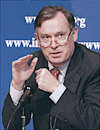
Opportunities and Challenges for Central Asia Speech by Horst Köhler Managing Director of the International Monetary Fund At the Conference for the Tenth Anniversary of the Introduction of the Tenge Almaty, Kazakhstan, November 14, 2003 As Prepared for Delivery 1. It is with great pleasure that I join you today in celebrating the tenth anniversary of the introduction of the tenge. Over the past decade, Kazakhstan has made significant strides in the transition to a market economy. And the introduction of its own currency marked not only an economic milestone, but also a major step in the development of a new nation. As a basis for the pursuit of sound monetary policy, the tenge has contributed to the strong economic performance of recent years. Based on oil sector development and the steady implementation of structural reforms, Kazakhstan is now experiencing a phase of robust high growth. I congratulate Kazakhstan, its leadership and its people, for its achievements. By building on these, and continuing the process of political and economic reform, Kazakhstan will be able to fulfill its promise for a bright future for its people. And I would like to join others in paying particular tribute to you, Mr. Governor, for being named Central Bank Governor of the Year by Euromoney. The global and regional economic outlook 2. The global economic outlook is improving. Prospects for a recovery are firming in the advanced economies, led by developments in the United States. This is good news for emerging market and developing country economies as well, which are also benefiting from a supportive financial market environment. But we know that risks remain. Chief among these risks are the excessive dependence of the world economy on growth in the United States and the resulting global current account imbalances. Resolving these imbalances in an orderly manner must be the primary objective of international economic policy. This requires a cooperative approach involving all major countries and regions. Such an approach must strengthen the domestic forces of growth, particularly in Europe and Asia, building on the new momentum for structural reform. And where reserve accumulation has been rapid and current account surpluses large, allowing greater exchange rate flexibility would be helpful, both domestically and globally. 3. The Central Asian region has been relatively resilient to the global economic downturn. Indeed, economic performance has improved considerably in the period since the 1998 Russia crisis, in particular in those countries that have succeeded in achieving macroeconomic stabilization and implementing market reforms. In these countries, including in Kazakhstan, prudent fiscal and monetary policies have sharply reduced inflation and export performance has often been impressive. And in most countries, structural reforms are beginning to pay off, yielding successive years of robust economic growth. But these gains have yet to translate into widespread rising living standards. The dual challenge in the coming years for most countries in the region will be to ensure that economic progress is sustained by strengthening structural reforms, and that it is followed in equal measure by broad-based social progress. Policy challenges for the region 4. An outward-looking strategy of accelerated integration into the world economy offers significant benefits in creating jobs and raising living standards for Central Asia. New growth hubs are emerging in Asia, where growth has outpaced Europe by 5 percentage points per year over the past decade - and according to our World Economic Outlook will continue to do so in the coming years. This economic potential of Asia, and of China in particular, will provide significant new economic opportunities for the region. Seizing these opportunities will require that countries in the region stay the course and consolidate the gains they have realized in achieving macroeconomic stability. This means first and foremost ensuring sound fiscal policies that also provide adequate public resources for strengthening social safety nets and developing regional infrastructure; and moving toward more flexible exchange rate regimes, to help ensure internal and external balance. But equally important is the creation of a healthy business climate, an area where, according to the latest EBRD Transition Report, Central Asia continues to lag behind other transition economies. There is an unfinished reform agenda, especially in the establishment of strong institutions to support a market economy through transparent, predictable, and well-enforced rules and regulations. In particular, the business environment in many countries in the region continues to suffer from weak competition policies and a lack of transparency, including in the tax regimes. 5. Looking ahead, I see four main challenges for the region to achieve sound and sustained growth over the medium term:
6. The energy sector has played a particularly important role in generating economic growth in Kazakhstan. I welcome its prudent management of oil revenue, which has been instrumental in maintaining macroeconomic stability. But with oil production projected to rise sharply over the next decade or so-perhaps even tripling-the challenge for Kazakhstan will be to ensure that these resources contribute to rising living standards for all. Macroeconomic policies will need to ensure resilience in the face of the inevitable volatility in global commodity markets, and more flexible exchange rate management can play an important role as a shock absorber. And using the revenue from natural resources well also requires tackling the unfinished reform agenda. This means first and foremost strengthening domestic institutions to encourage investment, building human and physical capital, and providing adequate and sustainable social protection mechanisms. The Role of the IMF in Central Asia 7. The IMF remains fully engaged in assisting Central Asia in its quest for faster sustained growth and rising living standards for all. In this partnership, how can the IMF be most helpful?
Ladies and Gentlemen, 8. The last decade has brought significant change to Central Asia. These changes have not been without difficulties, but they are increasingly paying off and delivering economic growth, jobs, and a better life for your populations. Building on this success will require perseverance. It will also require embracing further change as an opportunity to foster Central Asia's integration in the global economy. In this effort, you may rest assured that the IMF stands by your side. 1 Glennester, Rachel, and Yongseokh Shin, Is Transparency Good For You, and Can the IMF Help?, IMF Working Paper 132, June 2003. 2 Central Asian countries mostly have scores in the bottom third of Transparency International's Corruption Perception Index, and the World Bank's 2002 Business Environment and Enterprise Performance Survey shows a high "bribe tax" for many countries in the region. IMF EXTERNAL RELATIONS DEPARTMENT
| |||||||||||||||