Emigration Slows Eastern Europe’s Catch Up With the West
IMF Blog, July 20, 2016
Source details
- Canonical URL
- Emigration Slows Eastern Europe’s Catch Up With the West
Other formats
Bibliographic details
- Authors: Nadeem Ilahi, Anna Ilyina, Daria Zakharova
- Published: July 20, 2016
Overview and scale of emigration
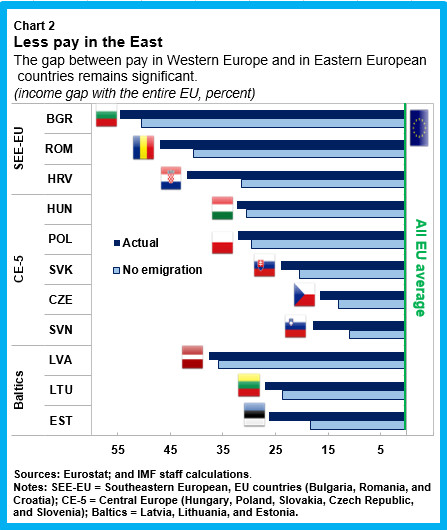
- Close to 20 million, mostly young and skilled Eastern Europeans, left their countries over the past 25 years to seek better opportunities abroad — equal to the combined population of the Czech Republic and Hungary.
- Emigration has been sizable and persistent since the early 1990s opening up of Eastern Europe.
Main drivers and characteristics of migration
- Economic motives predominate: the primary motivation to leave is better jobs and higher pay.
- Migrants tend to be younger and highly skilled (examples given: doctors, architects, engineers).
- Weaker government effectiveness and weaker institutions (guarding the rule of law, upholding accountability and fighting corruption) increase the likelihood that young and educated people emigrate.
Economic impact on sending countries (Eastern Europe)
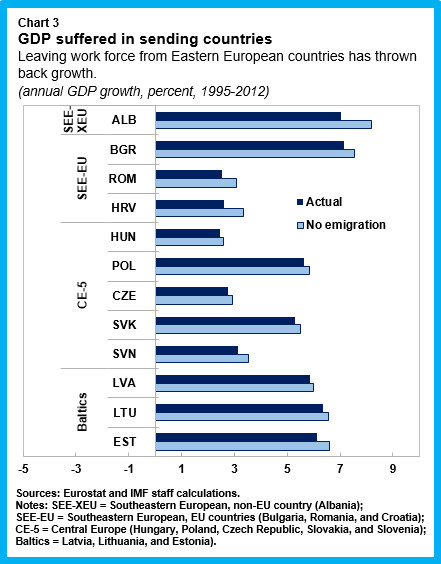
- Emigration slowed both overall and per capita output growth rates.
- Analytical IMF staff work estimates that in the absence of emigration between 1995 and 2012, real GDP growth would have been altogether 7 percentage points higher on the average in the region.
- Skills shortages lowered productivity growth in Eastern Europe.
- Large inflows of remittances supported investment and consumption but also:
- Led to exchange rate appreciation, making economies less competitive.
- Pushed up starting wages and reduced incentives to work, causing wages to rise faster than productivity and eroding returns on investment.
- Fiscal and labor-market consequences:
- Lower output increased government spending on social benefits relative to GDP.
- Aging demographics (departure of young) increased spending on retirement benefits relative to GDP.
- Governments often responded by raising labor taxes, which lowered employers’ incentives to create jobs and made budgetary structures less jobs- and growth-friendly.
Impact on receiving countries and the EU
- Westward migration contributed to stronger growth in Western European countries and was an economic boon for the European Union as a whole.
- Economic migration is framed as an indicator of the European Union project's success (freedom of movement aiding economic integration and higher incomes).
Policy recommendations — For Eastern Europe (sending countries)
- Improve institutions and economic policies to:
- Make countries more attractive for people to stay.
- Encourage emigrants to return.
- Attract workers from other countries.
- Consider further liberalization of immigration regimes, especially for skilled workers.
- Work with diasporas abroad to leverage expertise and savings, and provide incentives for remittances to be invested rather than spent.
- Retain and better utilize existing workforce through:
- Better matching of education to employment needs.
- More opportunities for on-the-job training.
- Fiscal policy choices matter: avoid increases in labor taxes; rely more on consumption taxes to be more conducive for investment and long-run growth.
Policy recommendations — For the European Union (collective response)
- Given that East-West migration benefited the European Union as a whole, consider better redistributing the gains.
- Example measure: explicitly account for the negative effects of emigration on sending countries’ economic potential when determining the size and composition of European Union structural and cohesion funds.
- Such redistribution would align with the EU goal of reducing economic and social disparities across regions and promoting sustainable development.
Source: IMF blog post by Nadeem Ilahi, Anna Ilyina, Daria Zakharova, July 20, 2016.
Content in this bundle
- Емиграцията забавя процеса на догонване на Запада от Източна Европа
- Emigrace zpomaluje východní Evropu při dohánění Západu
- Väljaränne aeglustab Ida-Euroopa võimalust jõuda Läänega samale tasemele
- A kivándorlás lassítja Kelet-Európa felzárkózását a Nyugathoz
- Emigrācija palēnina Austrumeiropas spēju panākt Rietumus
- Emigracija lėtina Rytų Europos augimą ir trukdo pasivyti Vakarus
- Emigracja spowalnia konwergencję Europy Wschodniej z Zachodem
- Emigraţia încetinește convergența Europei de Est față de Vest
- Emigracija usporava hvatanje priključka istočne Evrope sa Zapadom
- Emigrácia spomaľuje východnú Európu pri doháňaní západu
- Восточная Европа медленнее «догоняет» Запад