Fiscal Policies to Contain the Damage from COVID-19
IMF Blog, April 15, 2020
Source details
- Canonical URL
- Fiscal Policies to Contain the Damage from COVID-19
Other formats
Bibliographic details
- Authors: Vitor Gaspar, Mehdi Raissi, Raphael Lam
- Published: April 15, 2020
Overview and key findings
- Fiscal policy is essential to save lives, protect people and firms, and enable a recovery during the pandemic; policymakers should "do whatever it takes but make sure to keep the receipts."
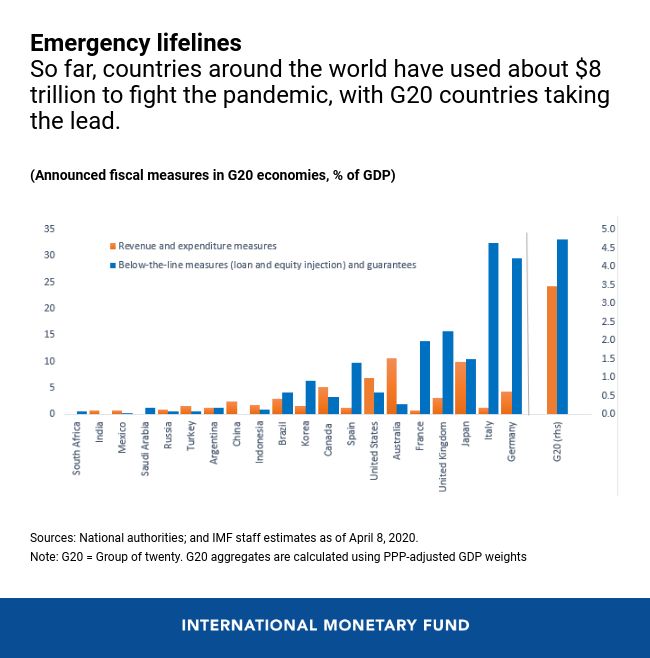
- So far, countries have taken fiscal actions amounting to about $8 trillion to contain the pandemic and its damage to the economy.
- Emergency lifelines provided globally include:
- higher spending and foregone revenues: $3.3 trillion
- public sector loans and equity injections: $1.8 trillion
- guarantees: $2.7 trillion
- The Group of Twenty advanced and emerging economies have taken actions totaling $7 trillion.
- Fiscal support also operates through automatic stabilizers such as progressive taxation and unemployment benefits.
Rules of the road (guiding principles)
- Target support to households to ensure access to basic goods and services and to a decent standard of living.
- Target support to viable businesses to limit layoffs and bankruptcies and avoid permanent scarring.
- Deploy resources in a temporary and efficient way and reflect the costs in multi-year fiscal reports.
- Reinforce principles of good governance commensurate with the scale of intervention, including:
- accurate accounting
- frequent, timely and complete disclosure of information
- adoption of procedures to allow for ex-post evaluation and accountability
- Assess, monitor, and disclose fiscal risks because not all measures have immediate effects on deficits and debts; for example, government guarantees on business loans may impose future fiscal costs if businesses default.
Actions to save lives and health-sector priorities
- Governments should finance additional health and emergency services as much as needed.
- Challenges:
- Countries with limited health-care capacity cannot adequately scale up resources.
- Borrowing constraints in many emerging market and developing economies require shifting expenditure toward the health sector while safeguarding social protection spending and vital public services (transport, energy, communications).
- Global coordination is needed to achieve a universally low cost vaccine and medicine, and to support countries with limited health capacity through aid, medical resources, and concessional emergency financing.
- The IMF stands ready to deploy $1 trillion lending capacity to assist member countries, with a focus on low-income developing countries.
Protecting livelihoods: targeted fiscal measures
- Social distancing and closures (schools, restaurants, shopping centers, offices, factories) create large economic costs; people and businesses need large, timely, temporary, and targeted fiscal support.
- Capacity to provide lifelines depends on countries' institutional and financial capacity.
- Examples of measures by country type:
- Advanced economies: wide range of spending, tax, and liquidity measures supported by strong tax-benefit systems. Examples include extended unemployment benefits (including for the self-employed), payroll tax deferral, and wage subsidies to small and medium enterprises.
- European countries: liquidity lifelines such as affordable loans or guarantees.
- France and Japan: government-funded paid sick and family leave for those unwell, self-isolating, or caring for children during school closings.
- Emerging market and developing economies: face multiple shocks (the pandemic, a steep drop in external demand, plunging commodity prices, capital flight, higher borrowing costs) and have less developed tax-benefit systems; measures include:
- cash transfers using unique identification systems and digital technologies (examples: India, Kenya)
- in-kind provision of food and medicine (example: Bangladesh)
- temporary tax relief for most-affected people and firms (example: China)
- full and timely value-added tax refunds to grant businesses access to cash
Facilitating the recovery and fiscal outlook
- As the pandemic abates and the Great Lockdown ends, a globally coordinated, broad-based fiscal stimulus may effectively foster the recovery; coordination enhances effectiveness but must respect cross-country differences in financing capacity.
- The pandemic and the Great Lockdown led to increases in debt and deficits beyond those recorded in the global financial crisis.
- As the pandemic abates and the economy recovers in 2021, public debt ratios are expected to stabilize at new—higher—levels.
- If the adverse scenario in the World Economic Outlook were to materialize, debt levels would be even higher and debt dynamics more unfavorable.
- Uncertainty about the timing and circumstances of the eventual recovery reinforces the policy implication: do whatever it takes but make sure to keep the receipts.
Content from "Fiscal Policies to Contain the Damage from COVID-19" (April 15, 2020) by Vitor Gaspar, Mehdi Raissi, Raphael Lam.