Crypto Prices Move More in Sync With Stocks, Posing New Risks
IMF Blog, January 11, 2022
Source details
- Canonical URL
- Crypto Prices Move More in Sync With Stocks, Posing New Risks
Other formats
Bibliographic details
- Authors: Tobias Adrian, Tara Iyer, Mahvash S Qureshi
- Published: January 11, 2022
Main findings
- Crypto assets have risen from a niche asset class to a significant component of the digital asset ecosystem, raising financial stability concerns.
- The market value of crypto assets rose to nearly $3 trillion in November from $620 billion in 2017.
- The combined market capitalization had retreated to about $2 trillion (as of the week of publication), still representing an almost four-fold increase since 2017.
- Increased adoption has coincided with significantly higher correlation between crypto assets and traditional holdings such as stocks, limiting perceived risk diversification benefits and raising contagion risk.
Correlation and spillovers
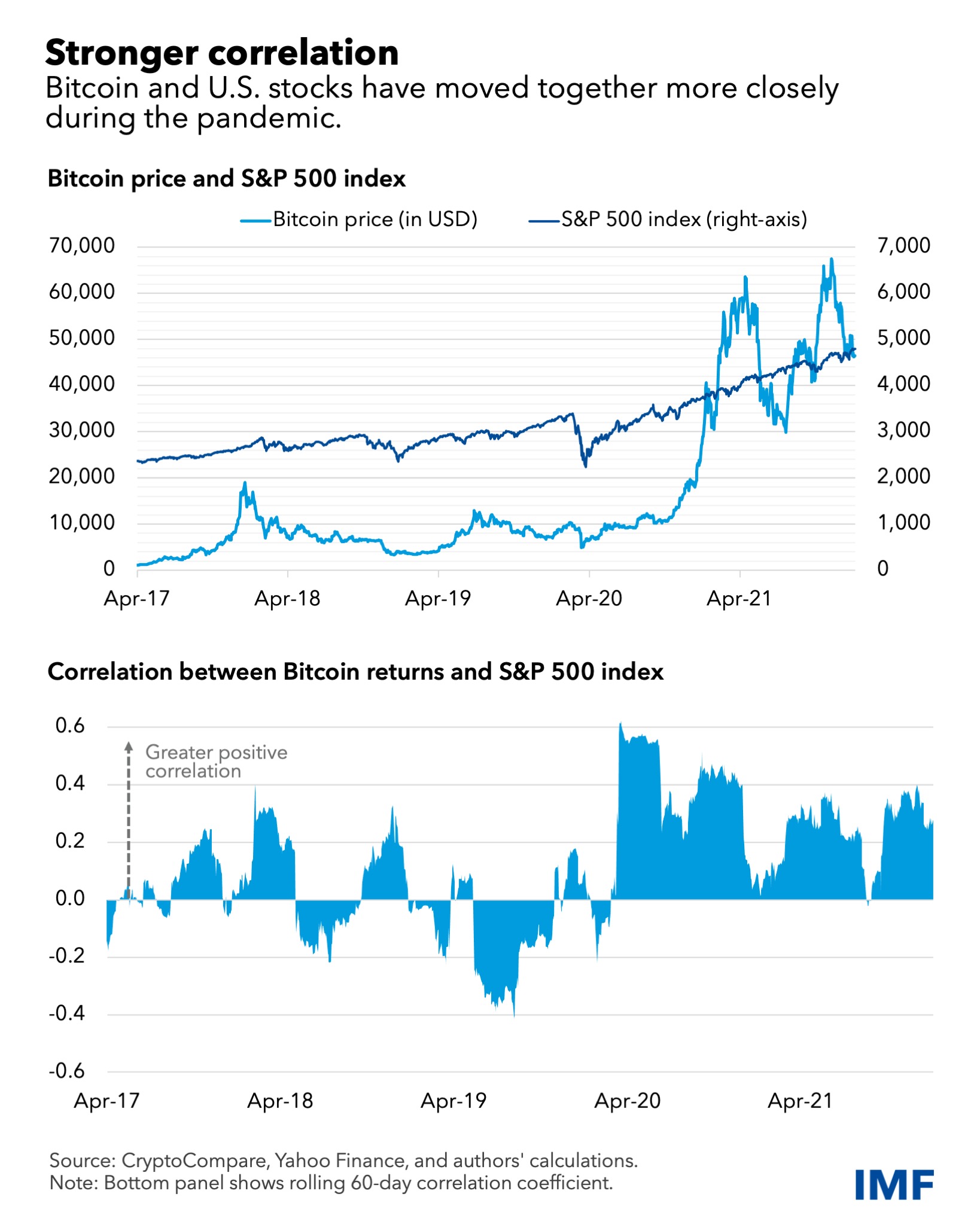
- Before the pandemic, Bitcoin and Ether showed little correlation with major stock indices; returns on Bitcoin and the S&P 500 had a correlation coefficient of 0.01 in 2017–19.
- That correlation jumped to 0.36 for 2020–21, indicating the assets increasingly moved together.
- In emerging market economies, correlation between returns on the MSCI emerging markets index and Bitcoin was 0.34 in 2020–21, a 17-fold increase from the preceding years.
- Bitcoin’s correlation with stocks is higher than the correlation between stocks and other assets such as gold, investment grade bonds, and major currencies, pointing to limited diversification benefits.
Quantified spillovers
- Spillovers from Bitcoin returns and volatility to stock markets, and vice versa, have risen significantly in 2020–21 compared with 2017–19.
- Bitcoin volatility explains about one-sixth of S&P 500 volatility during the pandemic.
- Bitcoin volatility explains about one-tenth of the variation in S&P 500 returns.
- Spillovers from the dominant stablecoin, Tether, to global equity markets increased during the pandemic but remain considerably smaller than those of Bitcoin, explaining about 4 percent to 7 percent of the variation in US equity returns and volatility.
- Spillovers between crypto and equity markets tend to increase in episodes of financial market volatility (for example, the March 2020 market turmoil) or during sharp swings in Bitcoin prices (for example, early 2021).
Systemic concerns and risks
- The increased and sizeable co-movement and spillovers indicate growing interconnectedness that permits transmission of shocks across asset classes and can destabilize financial markets.
- Given relatively high volatility and valuations of crypto assets, their increased co-movement could soon pose risks to financial stability, especially in countries with widespread crypto adoption.
- Crypto assets are no longer on the fringe of the financial system.
Policy recommendations
- Adopt a comprehensive, coordinated global regulatory framework to guide national regulation and supervision and mitigate financial stability risks stemming from the crypto ecosystem.
- Design regulations tailored to the main uses of crypto assets.
- Establish clear requirements on regulated financial institutions concerning their exposure to and engagement with crypto assets.
- Swiftly fill data gaps created by the anonymity of such assets and limited global standards to better monitor and understand rapid developments in the crypto ecosystem and the risks they create.
IMF blog — Tobias Adrian, Tara Iyer, Mahvash S. Qureshi; January 11, 2022