Why Jobs are Plentiful While Workers are Scarce
IMF Blog, January 19, 2022
Source details
- Canonical URL
- Why Jobs are Plentiful While Workers are Scarce
Other formats
Bibliographic details
- Authors: Carlo Pizzinelli, Ippei Shibata
- Published: January 19, 2022
Overview and context
- In the United States and the United Kingdom, job openings remain plentiful while workers have not fully returned to the labor market; the employment rate is below its pre-COVID level in both countries.
- High vacancy-to-unemployment ratios and elevated job quits coexist with an incomplete employment recovery.
- The Omicron wave may have a cooling effect on labor markets, potentially extending the trend.
- The broader trend has important implications for growth, inequality, and inflation: a sluggish employment recovery amid sustained labor demand could constrain economic growth while fueling wage increases and further inflation.
Four explanations evaluated (IMF staff research using granular US and UK data)
- Generosity of income support programs
- Hypothesis: COVID-related income support allowed workers to be picky, slowing applications, acceptances, and employment recovery.
- Evidence: Preliminary findings, including from phasing out of the US federal unemployment insurance supplement, suggest the early removal of COVID-related unemployment benefits had only a modest and temporary effect on getting people back to work.
- Mismatch between available jobs and jobseekers
- Observation: Jobs requiring in-person interactions (restaurants, hotels, entertainment) were hit hardest; “teleworkable” jobs fared better; delivery services boomed.
- Quantitative finding: As of early last fall, mismatch explains about 18 percent of the outstanding employment gap versus pre-COVID levels in the US and 11 percent in the UK.
- Note: The employment loss due to mismatch during the crisis has been modest and smaller than during the Global Financial Crisis.
- The “She-cession” (US-specific)
- Mechanism: Prolonged school closures and scarcity of childcare pushed many mothers of young children out of the labor force.
- Quantitative finding: Excess employment contraction for mothers of children younger than 5 years old accounted for around 16 percent of the total US employment gap with respect to pre-COVID levels as of October 2021; that was down from 23 percent in early September, partly due to return to in-person schooling later that month.
- Contrast: There was no She-cession in the UK; employment fell less for females than for males, potentially because nurseries in the UK remained open throughout the pandemic.
- Withdrawal of older workers
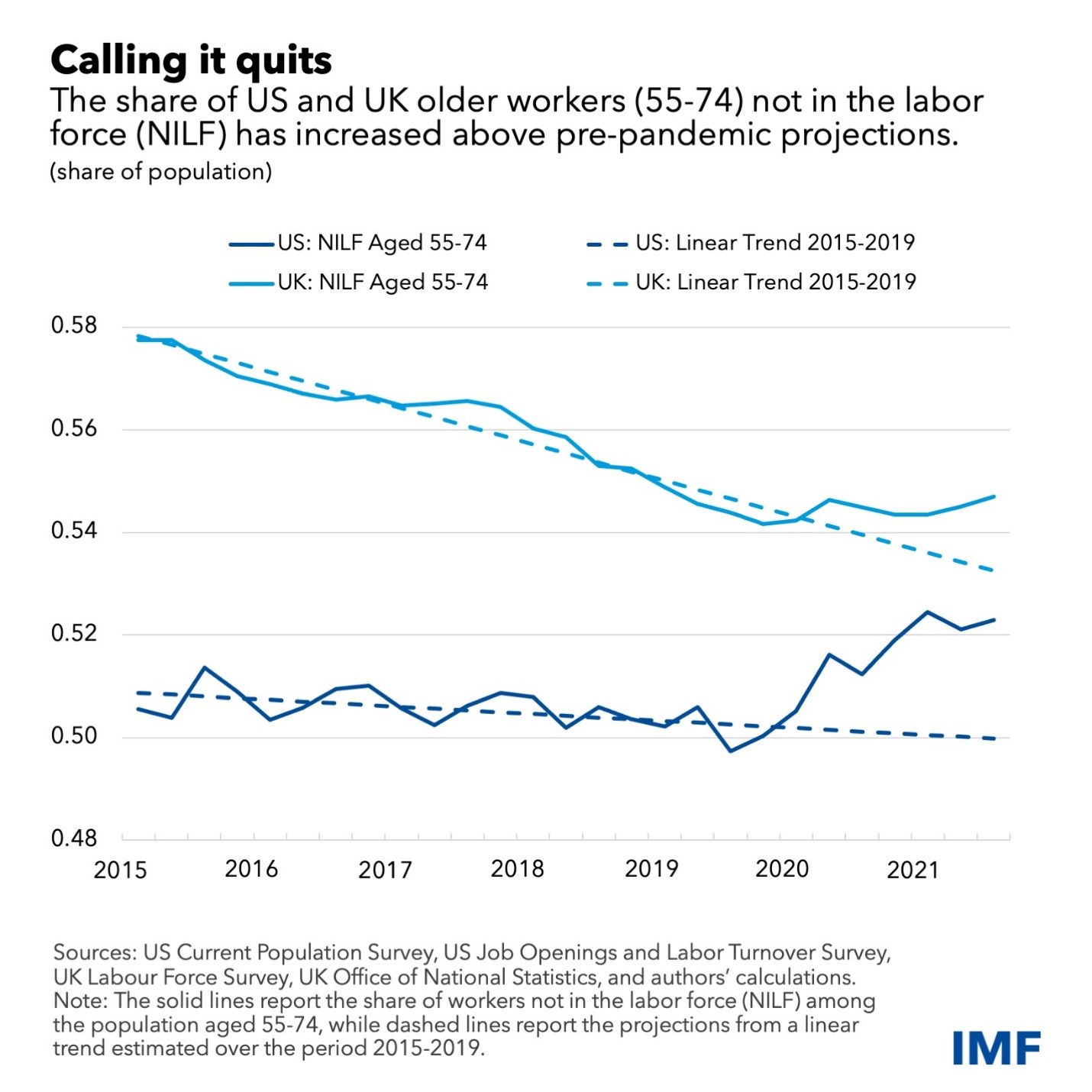
- Mechanism: Older workers (age 55 and up) exiting the labor force—possibly due to health concerns or re-evaluation of need to work as housing and financial asset prices grew—reduces labor supply.
- Quantitative finding: As of September, the rise in inactivity among workers age 55 and up accounted for around 35 percent of the outstanding employment gap versus pre-pandemic levels in both economies.
- Uncertainty: It is unclear how many of those who retired or quit may eventually return to the labor force.
Aggregate contributions to the employment gap
- United States (approximate attribution as of research period):
- Mismatch, She-cession, and older workers’ withdrawal together may account for roughly 70 percent of the US employment gap compared with pre-COVID levels.
- Residual role remains for other factors such as elevated unemployment benefits and other pandemic-related income support.
- United Kingdom (approximate attribution as of research period):
- About 10 percent of the employment gap can be attributed to mismatch and 35 percent to older workers’ withdrawal from the labor force.
- No She-cession detected.
Sectoral and skill patterns, and potential preference shifts
- Vacancies are highest among low-skill occupations while employment in these jobs remains below pre-2020 levels.
- The rise in voluntary quits—the “great resignation”—is greatest for low-skilled jobs, suggesting a possible change in worker preferences triggered by the pandemic.
- Outflow of foreign workers after Brexit, accelerated by the pandemic, reduced the number of potential jobseekers available to fill open vacancies.
Implications and policy recommendations
- To minimize risk of persistent scarring to employment:
- Address the pandemic itself so workers are fully able to return to the labor market.
- Implement well-designed training programs to reduce risks of mismatch.
- Expand childcare and preschool opportunities—particularly in the US—to help mothers of young children return to work.
- Monitor whether older workers’ exits are permanent; large permanent retirements would imply longer-lasting labor supply effects with implications for growth and inflation.
Carlo Pizzinelli, Ippei Shibata, January 19, 2022