Why We Must Resist Geoeconomic Fragmentation—And How
IMF Blog, May 22, 2022
Source details
- Canonical URL
- Why We Must Resist Geoeconomic Fragmentation—And How
Other formats
Bibliographic details
- Authors: Kristalina Georgieva, Gita Gopinath, Ceyla Pazarbasioglu
- Published: May 22, 2022
Global context and challenges
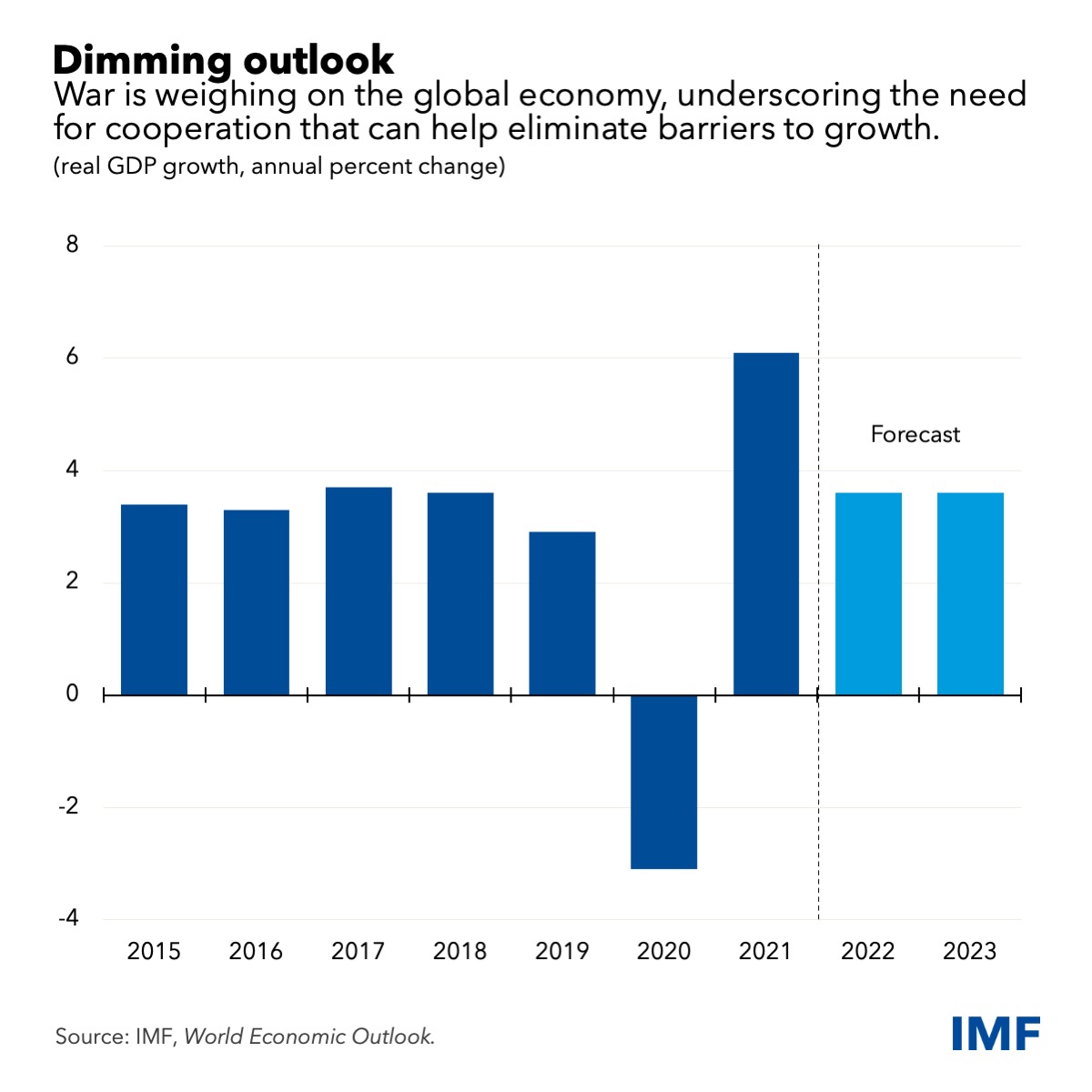
- Russia’s invasion of Ukraine has compounded the Covid-19 pandemic, “a crisis upon a crisis,” with consequences including:
- Devastating lives, dragging down growth, and pushing up inflation.
- High food and energy prices weighing heavily on households.
- Tightening financial conditions pressuring highly indebted nations, companies, and families.
- Re-evaluation of global supply chains amid persistent disruptions.
- Additional risks: sharply increased volatility in financial markets and the continuing threat of climate change.
- Over the past three decades, integration of capital, goods, services, people, technologies, and ideas:
- Tripled the size of the global economy.
- Lifted 1.3 billion people out of extreme poverty.
- Growing tensions and consequences:
- Uncertainty around trade policies alone reduced global gross domestic product in 2019 by nearly 1 percent, according to IMF research.
- Since the war in Ukraine started, monitoring indicates that around 30 countries have restricted trade in food, energy, and other key commodities.
Costs and mechanisms of geoeconomic fragmentation
- Broad economic and social costs:
- Enormous across countries; harms people at every income level—from highly-paid professionals and middle-income factory workers who export, to low-paid workers who depend on food imports.
- Potential increase in dangerous migration as people seek opportunity elsewhere.
- Specific channels and quantified impacts:
- Reconfigured supply chains and higher barriers to investment can make it harder for developing nations to sell to the rich world, gain know-how, and build wealth; advanced economies would face higher prices and lower productivity.
- IMF research estimates technological fragmentation alone can lead to losses of 5 percent of GDP for many countries.
- Designing products to use substitutable or more widely available parts can reduce losses by 80 percent (example from auto manufacturers and others).
- Parallel, disconnected payment systems would create new transaction costs for people and businesses.
Four priorities to restore trust and cooperation
- Priority 1 — Strengthen trade to increase resilience:
- Lower trade barriers now to alleviate shortages and lower prices of food and other products.
- Diversify imports and supply chains to preserve benefits of global integration; businesses should play a role.
- New IMF research: diversification can cut potential GDP losses from supply disruptions in half.
- Diversify exports and implement policies such as enhancing infrastructure, increasing broadband access, and improving the business environment.
- The WTO can help via support for more predictable, transparent trade policies.
- Priority 2 — Step up joint efforts to deal with debt:
- Roughly 60 percent of low-income countries have significant debt vulnerabilities; some will need debt restructuring.
- Decisive cooperation to ease burdens is required to enable return to debt sustainability, which will draw new investment and spur inclusive growth.
- The Group of Twenty’s Common Framework for Debt Treatment must be improved without delay, with clear procedures and timelines, and made available to other highly-indebted vulnerable countries.
- Priority 3 — Modernize cross-border payments:
- Inefficient payment systems are a barrier to inclusive growth; the average cost of an international transfer is 6.3 percent.
- This cost means some $45 billion per year are diverted into the hands of intermediaries and away from millions of lower-income households.
- A possible solution: a global public digital platform as payment infrastructure with clear rules, enabling minimal-cost, fast, safe transfers and connecting various forms of money, including central bank digital currencies.
- Priority 4 — Confront climate change:
- During the COP26 climate conference, 130 countries, representing over 80 percent of global emissions, committed to achieve net-zero carbon by around mid-century.
- Urgent need to close the gap between ambition and policy.
- IMF advocates a comprehensive approach that combines carbon pricing, investment in renewables, and compensation for those adversely affected.
Progress for people — policy recommendations and multilateral roles
- Principle: policies are for people — “Instead of globalizing profits, we should act to localize the benefits of a connected world.”
- Domestic and social measures:
- Invest in health and education for communities left behind by the “old globalization” and set back by the pandemic.
- Help displaced workers learn in-demand skills and transition to careers in expanding industries; firms that export pay higher salaries on average—as do greener jobs.
- Multilateral and IMF actions:
- Multilateral institutions should reshape global cooperation and resist fragmentation, including by strengthening governance to reflect changing global economic dynamics (the upcoming IMF review of capital and voting shares cited as an opportunity).
- Leverage convening power and diversified toolkits (financial instruments, bilateral and global surveillance, even-handed approach).
- Recent cooperative milestones cited as hopeful signs:
- Coordinated monetary and fiscal measures during the pandemic to prevent another Great Depression.
- International cooperation essential to developing vaccines in record time.
- 137 countries agreed on global corporate taxation reforms to ensure multinational enterprises pay their fair share.
- IMF membership supported a historic $650 billion allocation of the Fund’s Special Drawing Rights to strengthen countries’ reserves.
- Members agreed to create the Resilience and Sustainability Trust to provide longer-term affordable financing to help vulnerable members address climate change and future pandemics.
- No silver bullet, but an operational path:
- Work with all stakeholders on urgent common concerns that transcend national borders to begin weaving a stronger, more inclusive global economy.
IMF Blog — Why We Must Resist Geoeconomic Fragmentation—And How (May 22, 2022)
References
- عربي
- български
- 日本語
- Português
- IMF research
- https://www.imf.org/wp-content/uploads/2022/05/COTW-uncertainity-index-updated-May.jpg
- IMF research
- https://www.imf.org/wp-content/uploads/2022/05/Chart-growth.jpg
- New IMF research
- Diversifying exports
- gap between ambition and policy
- higher salaries
- greener jobs