

|
 |

|
 |
March
15, 2002
Prolonged Use of
IMF Resources: Terms of Reference for the Evaluation
|
Prolonged Use of IMF Resources Terms of Reference for an Evaluation by the Independent Evaluation Office (IEO)This note sets out the main issues to be addressed in the evaluation of prolonged use of IMF resources. Section A provides some background on the issue: why prolonged use might be a problem, including the main criticisms by various external observers; a discussion of the extent of prolonged use; and a summary of the available empirical evidence on several of the issues related to prolonged use. Section B then lays out the "terms of reference" for the project—namely, the broad sets of questions to be addressed by the evaluation, along with a preliminary indication of the proposed methodology to address these questions. A final subsection (B.4) raises some questions about what, if anything, should be done to limit the prevalence of prolonged use. By examining the IMF's role in a group of countries which have had especially intractable adjustment problems, the evaluation should also help to cast light on broader questions of program design and the appropriate balance between lending arrangements and surveillance activities. A. Background Information1. Main arguments on the pros and cons of prolonged use of Fund resources (UFR)Why might prolonged use be a problem? The prolonged use of Fund resources by certain countries has been criticized from a number of perspectives. Without taking any a priori view on their merits, the main criticisms, which should be taken into account in framing the evaluation, are as follows:
However, it can also be argued that, in some cases, frequent recourse to IMF arrangements may take place for good reasons and be fully compatible with both the IMF's mandate and a broadly defined sense of economic efficiency:
2. Description of the phenomenon of prolonged use of Fund resources (UFR)3a) Definition of prolonged use The prolonged use of IMF resources can be characterized in several different ways. The most common concepts found in various IMF policy papers and in the literature are summarized in Annex I. The various definitions focus on one of two underlying concepts: either on the amount of time spent under IMF-supported programs—where the primary emphasis is on the length of coverage of Fund conditionality—or on the length of time IMF resources are outstanding. In practice, there is a high degree of correlation between the coverage of the different concepts. In the current project, it is proposed to use mainly a definition based on time spent under IMF arrangements. More specifically, we would define as prolonged users countries which have been under (non-precautionary) arrangements4 for at least 7 out of any ten years period during 1971-2000. Forty four countries would be covered by this definition, of which 15 countries would have had especially prolonged use (i.e. at least 15 years under IMF arrangements during the 30-year period 1971-2000). However, the evaluation will take account of the distinction between users of general and concessional resources; 29 of the 44 prolonged users (and 13 of the "very prolonged users") are PRGF-eligible. A full list of countries is given in Annex III. Unlike the definition used in previous IMF reviews, the proposed definition does not impose any threshold on the outstanding use of Fund resources at the end of the period in order not to exclude countries which have completed their lending cycle, albeit a very long one, and in that sense have "graduated" from IMF support. On the other hand, the minimum amount of time under programs (seven years out of any ten-year period) is set higher than in previous reviews of the phenomenon.5 In principle, a distinction could be made between "prolonged" use and "repeat" use. Repeat users may have interludes when their balance of payments situation improves and they begin to repay the IMF, but such episodes are followed—perhaps as a result of intervening policy slippages—by further BOP problems and recourse to IMF financing. Prolonged users would encounter few such episodes of IMF "abstenance", perhaps reflecting incomplete adjustment within the life of a program or longer term debt sustainability problems that were not adequately addressed up front. In practice, however, it is not possible to make such a clear-cut distinction among the group of extensive users: all such countries appear to have experienced interludes when their external position improved, followed by renewed difficulties. More generally, besides the core definition presented above, the evaluation will need to take account of the following:
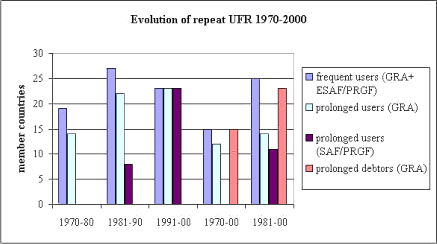
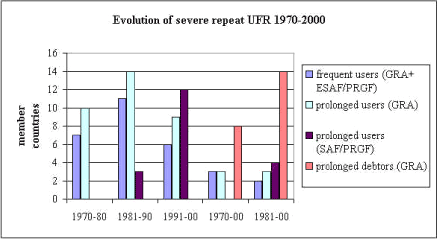
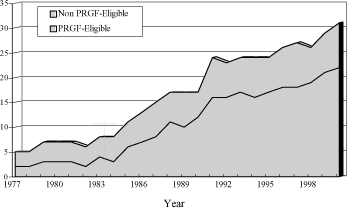
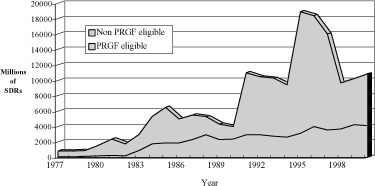
b) Prevalence of prolonged use6 A preliminary analysis of IMF arrangements databases since 1971 suggests that while the incidence of prolonged use has been affected by developments in the international economic environment, it is neither a recent nor a rare phenomenon regardless of the definition employed—nor is it one that is becoming less important (see Chart 1 in Annex II). Evidence collected in previous internal reviews indicate that prolonged use started to build up in the second half of the 1970s and accelerated sharply in the first half of the 1980s as a result of the debt crisis so that, by 1986, 25 member countries were prolonged users of the Fund's general resources according to the definition used in the 1991 review (see Annex I). Thereafter, the availability of concessional resources resulted in a large shift of prolonged users from the general to the concessional window, so that by 1990 the number of prolonged users of general resources had fallen dramatically. In reality, however, the overall number of prolonged users had not declined since by 1990 five of them had fallen into arrears and been declared ineligible for further borrowing from the IMF. Prolonged use rose again in the 1990s, partly due to the expansion of the IMF membership to former Soviet Union states. Countries eligible for concessional facilities now account for by far the largest number of prolonged users, but the smaller group of prolonged users of general resources have a larger total exposure to the IMF (see Charts 3 and 4 in Annex II). Another indication of the extent of prolonged use is found in Jeanne and Zettelmeyer (2001). They measure the timeframe in which IMF members actually eliminate outstanding obligations to the Fund—after taking account of new lending—which they call a "lending cycle".7 They find that, for all developing countries, a surprisingly high 54 percent of the lending cycles initiated since the creation of the IMF were not completed at end-2000, and that the average length of such "incomplete" cycles is 18 years. Not surprisingly, the proportion of uncompleted lending cycles and their length is even higher for HIPC countries. But they also find that 30 percent of emerging market countries8 which initiated their lending cycle between 1947 and 1991 have yet to complete them, and, for these countries, the average length of time with outstanding obligations to the Fund is about 21 years, compared with an average lending cycle of 8 years for other members of this group (see Table 2 of Annex II for details). 3) Insights from the existing empirical literature on prolonged users and the causes of program interruptionsPrevious empirical work on issues involving prolonged users and the causes of program interruptions have employed a range of econometric and other techniques, of varying robustness, and have covered different time periods. However, they suggest the following broad messages:
B. Terms of Reference: Key Questions to be Addressed by the Evaluation and Proposed MethodologiesThis section sets out the main questions that the evaluation project proposes to address along with a preliminary indication (in italics) of the methodological approach that is proposed for each question. For a number of issues, the most suitable methodology is likely to evolve as the evaluation proceeds, but the following broad approaches are envisaged, depending on the particular question posed. External researchers who have done work on these issues are also invited to submit their findings.
It should be recognized at the outset that much of the evidence, especially on the broader questions, may not be amenable to rigorous hypothesis-testing. One central methodological problem is that the decision to enter into an IMF-supported program, or series of programs, is endogenous. This affects both statistical comparisons across groups of countries and the results from case studies (where it could be argued that any sample of cases drawn from the group of prolonged users may be biased against the effectiveness of IMF-supported programs). In many cases, therefore, the evaluation will need to rely upon more qualitative judgments. 1) What does repeat use of IMF resources imply for the effectiveness of IMF-supported programs?a) What are the characteristics of the prolonged users? Bearing in mind the distinction between repeat users of general (GRA) and concessional resources, the following sets of questions will be investigated:
[Empirical analysis of the set of prolonged users, perhaps supplemented by econometric analysis on a large sample of prolonged and temporary users drawing primarily on existing and ongoing work (e.g. by Bird, Conway, and Barro and Lee)].
[Desk review of selected "graduators" from prolonged use] b) Why does it take so long to achieve balance of payments sustainability in the prolonged users?
2) What are the implications of prolonged use for the borrower and the IMF?
3) Is internal governance adequately structured to minimize ineffective repeat use of IMF resources?
4) What lessons and possible changes are suggested by the experiences of the prolonged users?While it is premature to predict the lessons that will be derived from the evaluation, the following broad areas will be considered. a) In the design of programs
b) In the internal IMF governance process and the respective roles of surveillance and lending arrangements
c) In the design and use of various facilities and relations with other donors The 2000 review of facilities has led to the adoption of several measures which should contribute to reducing the extent of prolonged use, in particular the creation of the contingent credit line (CCL), the strengthening of post-program monitoring provisions, the introduction of repurchase expectations and the imposition of a surcharge on large outstanding obligations. However, a number of additional steps could be considered:
Reading ListAlesina, Alberto, and David Dollar, (March 2000), "Who Gives Foreign Aid to Whom and Why?". Journal of Economic Growth, 5: 33-63. Bandow, Doug, (1994) "The IMF: A Record of Addition and Failure" in Perpetuating Poverty: The IMF, the World Bank and Developing Countries, Cato Institute. Bandow, Doug, and Ian Vásquez, (1994) "The Dismal Legacy and False Promise of Multilateral Aid" in Perpetuating Poverty: The IMF, the World Bank and Developing Countries, Cato Institute. Barro, Robert J., and Jong-Wha Lee, (November 2001), "IMF Programs: Who is Chosen and What are the Effects". Bird, Graham, Mumtaz Hussain and Joseph P. Joyce, (August 2000), "Many Happy Returns? Recidivism and the IMF". Department of Economics, Wellesley College Working Paper 2000-04. Bird, Graham and Dane Rowlands, (2001), "Catalysis or Direct Borrowing: The Role of the IMF in Mobilizing Private Capital". World Economy, Jan 2001. Bird, Graham and Dane Rowlands, (2000), "The Catalyzing Role of Policy-Based Lending by the IMF and the World Bank: Fact or Fiction". Journal of International Development 12, 951-973. Bird, Graham and Dane Rowlands, (2001), "IMF Lending: How is it Affected by Economic, Political and Institutional Factors". Policy Reform, Vol.4, 2001. Birdsall, Nancy, Stijn Claessens, and Ishac Diwan, (2001), "Will HIPC Matter?: The Debt Game and Donor Behavior in Africa". Paper presented at the WIDER Debt Relief Conference, August 2001, Helsinki. Bordo, Michael D, and Harold James, (June 2000), "The International Monetary Fund: Its Present Role in Historical Perspective". NBER Working Paper 7724. Brooks, Ray et. al. (1998), "External Debt History of Ten Low-Income Developing Countries". IMF Working Paper 98/72. Conway, Patrick, (1994), "IMF lending programs: Participation and impact". Journal of Development Economics, Vol. 45, 365-391. Conway, Patrick, (January 2000), "IMF Programs and Economic Crisis: An Empirical Study of Transition". University of North Carolina, Department of Economics. Devarajan, Shantayanan, David Dollar, and Torgny Holmgren, (December 1999), "Aid and Reform in Africa". The World Bank. Dicks-Mireaux, Louis, Mauro Mecagni, and Susan Schadler, (2000), "Evaluating the effect of IMF lending to low-income countries". Journal of Development Economics, Vol. 61, pp. 495?526. Dixit, Avinash, (2000), "IMF Programs as Incentive Mechanism". IMF Research Dept., mimeo. Dollar, David, and Jakob Svensson, (October 2000), "What Explains the Success or Failure of Structural Adjustment Programmes?" The Economic Journal, 110, 894-917. Haque, Nadeem Ul, and Mohsin S. Khan, (December 1998), "Do IMF-Supported Programs Work? A Survey of the Cross-Country Empirical Evidence". IMF Working Paper. Ivanova, Anna, Wolfgang Mayer, Alex Mourmouras, and George Anayiotos, (November 2001), "What Determines the Success or Failure of Fund-Supported Programs?" IMF Working Paper. Jeanne, Olivier and Jeromin Zettelmeyer (October 2001). "International Bailouts: The IMF's Role". Economic Policy. Joyce, Joseph P., (March 2001), "Time Present and Time Past: A Duration Analysis of IMF Program Spells". Federal Reserve Bank of Boston Working Paper No. 01-2. Joyce, Joseph P., (1992), "The Economic Characteristics of IMF Program Countries". Economic Letters, 38 (237-242) Krueger, Anne O., (1998), "Whither the World Bank and the IMF?" Journal of Economic Literature, Vol.XXXVI, pp. 1983-2020. Marchesi, Silvia, (2000), "Adoption of an IMF Programme and Debt Rescheduling: An Empirical Analysis". Centre for the Study of Globalization and Regionalization Working Paper No. 56/100. Mecagni, Mauro, (1999) "The Causes of Program Interruptions", in Economic Adjustment and Reform in Low-Income Countries, studies by the Staff of the IMF, edited by H. Bredenkamp and S. Schadler. Meltzer, Alan et. al. (2000). Report of the International Financial Institutions Advisory Commission (available at http://www.house.gov/jec/imf/ifiac.htm). Mussa, Michael, and Miguel Savastano, (1999), "The IMF Approach to Economic Stabilization". IMF Working Paper. Musso, Alberto, and Philipps, Steven (2001), "Comparing Projections and Outcomes in IMF Supported Programs". IMF working paper. Przeworski, A and J.R. Vreeland (2000), "The Effects of IMF Programs on Economic Growth". Journal of Development Economics, Vol 62, No.2, pp385-421. Tammen, Melanie S., (1994),"Fostering Aid Addiction in Eastern Europe" in Perpetuating Poverty: The IMF, the World Bank and Developing Countries, Cato Institute. Thacker, F., (2000), "The High Politics of IMF Lending". World Politics, 2000. Tsikata, Tsidi, (1999), "Progress Toward External Viability" in Economic Adjustment and Reform in Low-Income Countries, studies by the Staff of the IMF, edited by H. Bredenkamp and S. Schadler. Willett, Thomas D., (December 1999), "The Need for a Political Economy Capability at the IMF". Claremont Colleges. Willett, Thomas D., (October 2000), "A Soft-Core Public Choice Analysis of the International Monetary Fund". Claremont Colleges. Annex 1: Possible Definitions of Prolonged UseThis annex describes various approaches to defining prolonged use that have been used in the IMF or elsewhere. The actual definition resulting from each approach can be made more or less restrictive by varying the threshold which separates prolonged users from "temporary" users of Fund resources.
This concept excludes programs financed from concessional trust funds (SAF, ESAF, PRGF) for low-income countries, as well as programs in which the financing approved is not fully disbursed, either because they are off-track (i.e. the country is not eligible to borrow) or because they are treated as "precautionary" by the country's authorities. This is the narrowest of the possible approaches and excludes important issues, such as the implications of failed/interrupted programs and the IMF's role in low-income countries.
This concept encompasses both programs funded from the general resources account and from concessional trusts. It also includes programs which are only partially drawn upon. It may or may not include precautionary arrangements. It does not include drawings on Fund resources not backed by programs (such as first credit tranche purchases).14 A slightly different version of this concept is used by Bird et al to characterize frequent users of IMF resources. His definition is based on the number of programs signed by a country during a particular period, regardless of the type of arrangement at stake, its treatment (i.e. precautionary or not), its duration or its degree of completion. However, because many programs have a multi-year timeframe, such a definition does not measure the time spent under IMF arrangements.
This concept focuses on the length of periods of indebtedness to the IMF, regardless of the origin of the outstanding obligations.15 However, because IMF facilities have repayment periods varying from 2½ to 10 years, this definition does not distinguish between countries which had only a few programs with relatively long repayment periods and those which had a large number of programs with shorter maturities. An interesting application of this approach was used by Jeanne and Zettelmeyer (2001) to derive estimates of the length of "lending cycles" to particular countries. As noted in the main text, the current evaluation project proposes to use a definition based on the amount of time spent under IMF-supported programs, whether or not a country was eligible to draw. Annex 2: An Overview of Prolonged Use of IMF Resources During 1971-2000This annex provides additional background information on the extent of prolonged use of IMF resources. Chart 1 shows the evolution of prolonged use over the period according to various alternative definitions.16 Regardless of definition, prolonged use became important in the 1980s following the debt crisis and has remained significant since then. One, but not the only, factor of importance in the continued phenomenon was the protracted balance of payments problems faced by transition countries. Moreover, the introduction of concessional facilities in the second half of the 1980s has tended to amplify the extent of prolonged use rather than just change its nature. Chart 2 summarizes in graphic form the history of lending arrangements of 50 countries which at some time during the last three decades made an intensive use of Fund programs. The vast majority of these countries were still under program at the end of the period. Of the 13 countries which were not, three are ineligible to use Fund resources and one no longer exists (the Socialist Federal Republic of Yugoslavia-SFRY).17 Charts 3 and 4 show the evolution of prolonged use by country and by outstanding exposure to the IMF, respectively, according to the definition proposed in the main text. Table 1 provides additional information on this group of countries. It shows that nearly 40 percent of these countries made an intensive use of the Fund's general resources, in the sense that they had outstanding obligations to the general resources account (GRA) of over 100 percent of their quota for ten years or more. When both general and concessional resources are taken into account, more than half the sample had average outstanding liabilities over the thirty year period in excess of 100 percent of their quota. In other words, these are countries which made both long and large use of Fund resources. Table 2
provides information on the average length of "completed"
and "incomplete" cycles of debt to the IMF (i.e., the average
number of years after a country initiates borrowing from the IMF before
its obligations are again reduced to zero. It is not perhaps surprising
that most HIPC and many PRGF-eligible countries have had obligations
outstanding to the IMF for lengthy periods, given the longer repayment
periods of the facilities involved and the expectation that several
multi-year arrangements might be required to help a country overcome
its intractable external adjustment problems, even in relatively successful
cases. (For example, two consecutive ESAF/PRGF arrangements followed
by a 10-year repayment period would generate a "lending cycle"
of 16 years.) What is more surprising is that a number of emerging market
countries have also effectively borrowed from the Fund for very long
periods. The 15 "very prolonged users" shown in Annex III
(which includes both PRGF-eligible and some emerging market countries),
have had outstanding obligations to the IMF for an average of 27½
years. Charts and Tables
Footnotes 1 Such temporariness is dictated by the need to ensure the revolving nature of IMF resources. 2 To the extent that the PRGF Trust is expected to be self-sustaining at some point, concessional resources would also need to be revolving. 3 For the purposes of this paper, the terms "prolonged" and "repeat" use will be used interchangeably. 4 Programs supported by precautionary arrangements are the same as other Fund-supported arrangements except that the authorities have indicated that they do not intend to draw on the arrangement. To the extent that they do not reflect any actual balance of payments need nor involve any actual use of Fund resources, it can be argued that precautionary arrangements should be excluded from the core definition. However, the commitment to treat an arrangement as precautionary is never binding for the member country, should its circumstances change. 5 For example, this threshold was chosen so that any country with just two three-year arrangements (EFF or ESAF/PRGF) in a decade would not be classified as a prolonged user. In fact, lowering or raising the minimum threshold by one year would not alter substantially the size of the group of "prolonged users." 6 The findings reported in this section are illustrated by a series of charts presented in Annex II. 7 In the absence of subsequent programs, the length of each lending cycle should be equal to the sum of the program and the repayment period. 8 Defined by countries whose sovereign bonds are tracked in the J.P. Morgan Emerging Market Global Bond Index, which is an indication that they would normally be expected to have access to private market financing. 9 Whenever possible, the evaluation will rely on existing IMF databases, including the internal database on program objectives, outcomes and conditionality (referred to as the MONA — monitoring of arrangements — database). 10 Econometric work on countries in Africa by Birdsall et al (2001) suggests that net disbursements by multilateral institutions, including the IMF, are less influenced by the strength of economic policies when total and multilateral debt is high than when it is low. They argue that this shows that "defense lending" (i.e., to avoid default) tends to crowd out selectivity in favor of countries implementing good policies in such situations. 11 A related issue is the catalytic effect of IMF-supported programs and whether prolonged use undermines this catalytic effect. However, this is primarily a topic for further research and not within the comparative advantage of the evaluation office. Bird and Rowlands (2000) conclude that there is little empirical support for a systematic catalytic effect on private flows. They conclude that there is some support for a catalytic effect on official flows to low-income countries. 12 Dollar and Svensson, in an analysis of World Bank conditionality, contend that donor-effort variables, such as the number of conditions attached to a loan, the time devoted by staff to preparation and supervision etc., have little or no impact on the probability of success or failure of the adjustment program supported by the loan and that the main determinant of success/failure is the political context. Empirical work undertaken by Fund staff also indicates that the number of prior actions set in programs have limited value in establishing a basis for successful program implementation. 13 i.e. purchases from the general resources account (GRA), which are typically associated with a stand-by arrangement (SBA) or an Extended Fund Arrangement (EFF). The specific operational definition used in the 2000 review of prolonged UFR characterized as prolonged users countries with an outstanding use of Fund credit over 100 percent of quota and either nine years or more of effective UFR in the previous 30 years, or five years of effective use in the previous 15 years. 14 The thresholds used in internal IMF definitions have varied overtime: in 1984, it was set at four or more programs with purchases in the previous 10 years ; in 1986 and 1991, it was raised to five annual arrangements in the previous ten years. In all cases, an additional criterion was an outstanding Fund credit of over 100 percent of quota at the end of the period. 15 This concept was used to define prolonged users in a 1986 internal IMF review, with a threshold of "continuously outstanding credit tranche positions in excess of 25% of normal maximum for six years or more" in the previous 10 years. 16 Reflecting available data at this stage of the project, the time series shown in the chart reflects a slightly different definition than that which will be used in the main evaluation. However, as noted in the main text, the scope of prolonged use is not very sensitive to the precise definitions used. 17 The SFRY was succeeded by the Federal Republic of Yugoslavia in 2000. Use of Fund resources by countries born out of the break up of the SFRY (e.g., Slovenia and Bosnia-Herzegovina) has not been treated s further UFR by the SFRY.
|