Mission Concluding Statement 

Tunisia -- Preliminary Findings of the 2004, IMF Article IV Consultation Mission

July 20, 2004

Describes the preliminary findings of IMF staff at the conclusion of certain missions (official staff visits, in most cases to member countries). Missions are undertaken as part of regular (usually annual) consultations under Article IV of the IMF's Articles of Agreement, in the context of a request to use IMF resources (borrow from the IMF), as part of discussions of staff monitored programs, and as part of other staff reviews of economic developments.


    Français

    1. The annual IMF Article IV consultation mission that visited Tunis June 16-July 1, 2004 wishes to thank the authorities—particularly the Governor of the Central Bank of Tunisia (BCT)—for their warm welcome and excellent cooperation. The discussions benefited from the high professionalism of the staffs of the BCT, the Ministry of Finance, and the Ministry of Development and International Cooperation.

    I. Introduction

    2. In the mission's assessment, the Tunisian economy is doing well. Thanks to the pursuit of prudent macroeconomic policies, the macroeconomic equilibria were unaffected by the slowdown in world growth and the slump in the tourism sector Good agricultural conditions also contributed to this resilience. The recovery of the global economy—including in Europe—bodes well for sustaining growth in the short term.

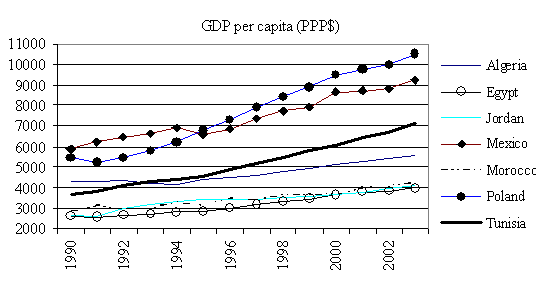
    3. In the coming years, Tunisia should not be content merely to maintain the growth rates posted to date. Indeed, although the performance of the Tunisian economy is one of the best in the Middle Eastern and North African region, the gap in per capita income between Tunisia and the OECD emerging countries (Mexico, Poland) has not narrowed in the last decade. Tunisia is well positioned to attain a higher level of growth and approach the incomes of these countries.


    Chart 1

    4. To achieve this, it will be necessary to transform the Tunisian economy in the context of growing international integration. The imminent expiration of the Multifiber Agreement, which could slow textile exports, makes this transformation all the more necessary. The mission has identified two complementary priorities in the area of economic policies:

    Pursue structural reforms with renewed determination. The objective would be to improve productivity—the true engine of economic growth—and create a business environment in which the private sector can better identify and take advantage of new export opportunities.

    Strengthen macroeconomic policies to bolster the impact of structural reforms. The Tunisian economy will need to rely on external savings to finance investment. The Tunisian authorities are well aware of this need and, to that end, intend to open the capital account gradually. Accordingly, to avoid giving investors implicit exchange rate guarantees and to maintain a degree of monetary policy autonomy, a floating exchange rate regime should be adopted. The flexibility of the dinar will also be an important factor in preserving competitiveness, especially because productivity gains generated by structural reforms could take time to materialize. A flexible exchange rate will in turn necessitate fiscal consolidation and a monetary policy ensuring continued price stability.

    II. Short-Term Economic Outlook

    5. The recovery of the Tunisian economy continues in 2004, driven by strong agricultural output, the return to normal tourism levels, and the positive performance of non-energy exports. Growth is expected to exceed 5½ percent. The external current account deficit is projected at 2½ percent of GDP, ½ percentage point of GDP lower than in 2003. This, together with significant privatization receipts, will enable Tunisia to reduce external debt by 5½ percentage points of GDP (to 59 percent) while maintaining a level of reserves equivalent to three months of imports of goods and services. Although the rate of inflation began to pick up in 2003, it appears to have resulted from adjustments in administered prices and higher prices for certain food products unrelated to demand pressures.

    A. Fiscal Policy

    6. A low buoyancy of tax revenues did not permit further consolidation in 2003. The tax burden shrank from 21.5 percent in 2002 to 20.6 percent in 2003.1 This was caused by the fact that growth was driven by agriculture and exports, which are little taxed. Moreover, customs revenues continued their decline as a percentage of GDP. An increase in revenues (as a percentage of GDP) is not expected in the short term, despite the significant measures adopted to expand the tax base, improve VAT collection, and increase consumption duties. Consequently, the reduction of public debt (61 percent of GDP at end-2003) will proceed at a slower pace in the medium term. For the present, keeping total revenue (excluding grants and privatization receipts) at the level envisaged in the 2004 budget law will only be possible due to substantially larger-than-estimated transfers of the profits of the National Telecommunications Office (ONT). On the expenditure side, the authorities mitigated the impact of higher oil prices on subsidies by adjusting retail prices in early 2004. Nevertheless, if the current trend persists and there are no further adjustments of retail prices, additional subsidies of roughly 0.2 percent of GDP may be needed. In this context, and taking account of unbudgeted onlending projected at 0.2 percent of GDP, the central government deficit (excluding grants and privatization receipts) will amount to approximately 2.8 percent of GDP in 2004, close to the budget law target.

    B. Monetary and Exchange Policy

    7. In 2003, the monetary aggregates grew more slowly than nominal GDP. This decline in the demand for money was attributable to two major factors. First, the reduction of BCT interest rates in the context of limited inflation steepened the yield curve and prompted economic agents to invest in medium- and long-term government securities. In addition, the treasury halted its short-term issues to extend the maturity of its debt. Despite the decrease in the demand for money, the commercial banks were able to contribute to the economic recovery by expanding credit to the economy. The BCT continued its prudent monetary policy of using its key interest rate to manage the short-term liquidity of the banking system. As a result, inflation was kept under control despite higher food prices.

    8. For 2004, broad money growth is projected at 9.3 percent. This acceleration of the money supply reflects an accommodation of the one-off increase in food prices in the second half of 2003. The average inflation rate is expected to fall from 3.8 percent at end-April to 3.5 percent for the year. In this context, the BCT needs not alter its monetary policy and should keep its interest rate policy unchanged. Nonetheless, the BCT should remain vigilant and be prepared to act should inflation persist.

    9. Greater exchange rate flexibility and the appreciation of the euro has led to depreciation of the dinar in real effective terms. This flexibility has improved Tunisia's competitiveness and helped strengthen its external position.

    10. The mission recommends that the authorities continue this policy and complement it with measures aimed at deepening the exchange market. The reduction of the surrender requirements from 50 to 30 percent of foreign exchange receipts was a major step in that direction, and its elimination would likely result in further development of the interbank market. The mission encourages the BCT to overcome as quickly as possible the technical and legal obstacles to eliminating the requirement that banks transfer their end-of-day foreign exchange balances to the central bank to make banks more accountable for the management of their foreign exchange. Moreover, to expand the role of market forces in the determination of the exchange rate, the BCT should no longer post bid/ask spreads for foreign exchange. As noted during the interim mission, such a measure would not prevent the BCT from intervening on the market to implement its exchange policy.

    C. Conditions in the Banking System

    11. The financial indicators of the banking system deteriorated further in 2003. Non-performing loans, as a share of bank assets, increased and the rate of provisioning decreased, although the latter was in part explained by write-offs and transfers of claims to asset management companies. The system's capital adequacy ratio also decreased, and three banks no longer comply with the minimum ratio. These developments reflect difficult economic conditions in certain sectors such as tourism, as well as competitive pressures, which Tunisia is facing in the context of growing openness. This makes it all the more urgent to step up bank supervision and strengthen the financial position of banks to enable them to deal with possible shocks.

    12. The mission congratulates the authorities on the measures adopted recently to strengthen bank supervision, particularly the prohibition against dividend distribution by banks with insufficient levels of provisioning. This measure should be supplemented by less reliance on guarantees in the provisioning policy, in order to reinforce the credit culture within banks. The interest cost of unprovisioned, nonperforming claims was estimated during the FSAP at between 100 and 200 basis points. This drives up the cost of intermediation for weak banks, puts them at a competitive disadvantage, and may encourage them to grant riskier loans that could further weaken their financial position. Moreover, this weakness could hamper monetary policy reform which will necessitate greater interest rate flexibility.

    13. Accordingly, the BCT should use its power to require an increase in the capital of banks that are undercapitalized and/or have insufficient provisions, and thus give bank shareholders a sense of responsibility regarding the necessity of rehabilitating the banking system. Moreover, an effort should be made to implement the recommendations of the 2001 Financial Sector Assessment Program (FSAP) aiming at greater autonomy for the BCT and a withdrawal of the government from the financial sector.

    14. The mission commends the authorities on the entry into force of the consolidation law and the establishment of a unit to monitor the stability of the financial system. These measures will provide a more comprehensive view of the risks in the banking sector and in the financial system as a whole. The mission encourages the authorities to continue the work to overcome the legal obstacles to greater cooperation among financial system supervisory agencies. The IMF stands ready to provide any technical assistance that may be required in this area.

    III. Medium-Term Economic Outlook

    15. In the years ahead, Tunisia should solidify the foundations for strong and sustained growth. Long-term growth rates of more than 6 percent will be necessary to reduce unemployment. In addition, a per capita growth differential of 2-4 percent would be required to catch up with countries like Mexico and Poland (on purchasing power parity terms) within a decade. To accomplish this, it will be necessary to transform the Tunisian economy in the context of growing external openness. The imminent expiration of the Multifiber Agreement and the gradual depletion of oil reserves make this transformation all the more necessary.

    16. This challenge underscores the importance of accelerating structural reforms to improve productivity and the performance of Tunisian exports, with a view to reducing the vulnerability of the external position and promoting growth. At the same time, efforts already under way to strengthen macroeconomic policies should be continued in order to bolster these reforms.

    A. Structural Reforms

    17. Ongoing integration with the European Union (EU) in the context of the new European Neighbourhood Policy provides an opportunity to give new impetus to structural reforms. Accordingly, the mission recommends stepping up efforts to conclude an ambitious program with the World Bank, the African Development Bank, and the European Union in the context of ECAL IV, with the aim of improving the business climate. In addition to the above-mentioned reform of the financial system, the mission wishes to underscore the importance of two structural reform objectives: the liberalization of foreign trade and increased labor market flexibility.

    The liberalization of foreign trade

    18. The expansion of the EU and Tunisia's expected participation in the new Neighbourhood Policy offer opportunities to create new export markets. However, multilateral liberalization of all sectors, both goods and services, is still essential to generate sustained growth through investments and enhanced productivity.

    19. The ongoing efforts to simplify and reduce multilateral customs tariffs are encouraging and should be continued. Considering the high level of the average MFN tariff (32.7 percent for all products, 22.5 percent for industrial products, and 68 percent for agricultural products), the mission suggests that these tariffs be brought closer to those applied to products originating in the EU. The mission welcomes the progress made in simplifying customs procedures through the "Tunisia Trade Net" and the new selective customs inspection system, and encourages the authorities to further reduce nontariff barriers by simplifying technical controls and shortening the time required for customs clearance. This latter measure will also allow for maximizing the benefits of geographic proximity to Europe. The IMF also encourages regional integration and plans shortly to organize a trade facilitation seminar for the Maghreb countries in the context of the Maghreb Funds Initiative.

    Increased labor market flexibility

    20. To facilitate the reallocation of labor in response to structural changes in the economy, it is important to introduce greater flexibility in the labor market. In this regard, the mission believes that measures on hiring (temporary work contracts) have already had a positive impact in terms of reducing the unemployment rate. It also commends the authorities on their active labor market policies in the area of matching labor supply and demand through the National Employment and Self-Employment Agency (ANETI) and through the development of training programs to facilitate adaptation to changing employment needs.

    21. The mission believes, however, that the complex regulations and procedures covering dismissals could hinder the creation of permanent employment. The mission therefore suggests that consideration be given to easing the regulations governing dismissals.

    IV. Strengthening Macroeconomic Policies

    22. To complete the opening of the Tunisian economy, the authorities have prepared a plan for the gradual liberalization of capital flows in close cooperation with Fund staff. The objective is to make better use of external savings to finance a higher level of investment. This liberalization will necessitate parallel changes in the conduct of fiscal, monetary, and exchange policies. Indeed, with no restrictions on capital flows, monetary policy can retain some degree of independence only in the context of a floating exchange rate system. Moreover, a floating exchange rate will require that price stability becomes the primary objective of monetary policy. Finally, a reduction in public debt (particularly foreign currency-denominated debt) relative to GDP is necessary to minimize the vulnerabilities in a context of greater exchange rate flexibility.

    A. Fiscal Consolidation

    23. Although fiscal sustainability is not a concern, it would be desirable to bring down public debt below 50 percent of GDP, in line with other emerging countries with a debt rating similar to Tunisia's. Accordingly, the fiscal deficit should be kept below 3 percent of GDP in 2005 or lower in the event the lower-than-expected nontax revenues continue to exceed forecasts. Significant actions are necessary on both the revenue and expenditure sides to strengthen the medium-term fiscal position.

    24. The low tax revenues in 2003, despite the recovery of economic activity, underscores the importance of stepping up efforts to improve tax buoyancy. The downward trend in revenues will be accentuated by the inevitable reduction of customs revenues as a result of tariff reform, the economy's increasing exports orientation, and the expected drop in nontax revenue in the medium term. As a result, the government should take steps to preserve its tax revenue, particularly by strengthening the VAT system. Accordingly, the introduction in 2003 of the VAT on telecommunications services is an important step. It would also be advisable to phase out tax exemptions and broaden the tax base. The Fund stands ready to provide technical assistance in these areas.

    25. On the expenditure side, the wage bill, at 12 percent of GDP, continues to weigh on government finance and represents a rigidity that limits the scope of fiscal policy. It would therefore be advisable to consider a civil service reform to reduce this burden in the medium term, while maintaining the quality of public services. Moreover, subsidies on the consumption of primary commodities represent an annual cost to the government of approximately ½-1 percent of GDP. The pursuit of price liberalization, in conjunction with well targeted transfers, could produce major savings while preserving a certain level of social protection. The mission would also like to stress that the planned introduction of a performance-based budget system is an important step toward improving the efficiency of public expenditure and could generate savings.

    B. Development of financial markets and the monetary policy framework

    26. Preparations to make monetary policy more dynamic in the context of broad money targeting are at an advanced stage. The BCT has constructed a database that should enable it to fine-tune monthly projections of base money (the operating target). The quantitative tenders of base money at multiple rates recently introduced by the BCT are consistent with the base money targeting strategy. The resulting interest rates will provide important signals which can guide the central bank's policy decisions.

    27. The mission would like to reiterate that base money targeting should be accompanied by a larger role for the money market in the recycling of liquidity. Accordingly, the new law on repurchase agreements should be implemented as quickly as possible to deepen of the interbank market. Deepening of the market will also depend on the availability of government securities, which are the preferred assets for securing money market transactions. Accordingly, maintaining a presence on the securities market (of all maturities, including short-term) would contribute to the development of the financial markets. Moreover, a liquid money market will be a necessary complement to the liberalization of the exchange market and the enhancement of its role in determining the exchange rate.

    C. Exchange policy and the opening of the capital account

    28. Tunisia's strategic decision to gradually open the capital account presents significant advantages. Given the limited access of the private sector to international capital markets, the government has had to finance the balance of payments, resulting in a significant foreign currency-denominated public debt. Allowing the private sector to tap foreign capital will have the double advantage of diversifying balance of payment financing and providing new sources of foreign exchange.

    29. In this regard, medium- and long-term lending to rated enterprises, as well as direct investment, could be liberalized. Opening the capital account further, particularly to short-term flows, should wait until the banking sector is rehabilitated, as free access to short-term foreign borrowing would increase the competitive pressures on weak banks. This further justifies the need to accelerate bank restructuring.

    30. Moreover, allowing nonresidents to hold government securities could help finance the balance of payments and reduce the government's reliance on the international capital markets. To ensure the success of this measure, the authorities should further improve public debt management to make the market more liquid, as well as strengthen the monetary policy framework to ensure the stability of prices and, indirectly, a degree of exchange rate stability, without which nonresident investors would only invest in the short term and possibly for speculative reasons. Exchange rate flexibility would discourage investor expectations of an implicit exchange rate guarantee by creating uncertainty about exchange rate movements.

    V. Other Issues

    31. The mission lauds the authorities efforts to increase the transparency of their economic policy. In particular, it notes with satisfaction the authorities' customary agreement to publish the mission's preliminary findings and the final report on the consultation, and their approval for the mission to hold a press conference.

    32. In addition to the areas mentioned above, Fund staff stand ready to provide technical assistance to the BCT for the revision of multisector statistics and to organize a mission on the "Report on the Observance of Standards and Codes" in the area of statistics, to further improve the quality of Tunisia's statistics and ensure that they are more widely disseminated.

    33. The mission commends the authorities on the promulgation of the law on money laundering and the financing of terrorism, as well as the work accomplished in preparing the implementing regulations.

    34. It was agreed that the next discussions for the Article IV consultations will take place in May-June 2005.


    1 Tax revenues decreased half a percentage point of nonagricultural GDP in 2003.

    Table 1. Tunisia: Selected Economic and Financial Indicators, 2000-04


    2000

    2001

    2002

    Est.
    2003

    Proj.
    2004


    Production and income (percent change)

    Nominal GDP

    8.2

    7.7

    4.0

    7.9

    9.3

    Real GDP

    4.7

    4.9

    1.7

    5.6

    5.6

    GDP deflator

    3.3

    2.7

    2.3

    2.2

    3.5

    Consumer price index (CPI), average

    3.0

    1.9

    2.8

    2.8

    3.4

    Gross national savings (in percent of GDP)

    23.1

    23.5

    21.7

    22.2

    22.0

    Gross investment (in percent of GDP)

    27.3

    27.9

    25.2

    25.1

    24.5

    External sector (percent change)

    Exports of goods, f.o.b. (in $)

    -0.5

    13.2

    3.8

    17.1

    11.0

    Imports of goods, f.o.b. (in $)

    1.0

    11.3

    -0.2

    14.7

    9.8

    Exports of goods, f.o.b. (volume)

    7.3

    15.7

    1.9

    7.2

    0.9

    Import of goods, f.o.b. (volume)

    6.5

    13.6

    -2.4

    3.4

    0.6

    Trade balance (in percent of GDP)

    -11.6

    -12.0

    -10.1

    -9.1

    -8.5

    Current account, excl. grants (in percent of GDP)

    -4.2

    -4.3

    -3.6

    -2.9

    -2.5

    Terms of trade (deterioration -)

    -2.1

    -0.2

    -0.4

    -1.5

    ...

    Real effective exchange rate (depreciation -) 1/

    -1.7

    -2.4

    -1.1

    -4.1

    ...

    Central government (percent of GDP) 2/

    Total revenue, excluding grants

    24.0

    24.0

    24.4

    23.7

    23.4

    Total expenditure and net lending

    27.9

    27.8

    27.9

    27.1

    26.2

    Central government balance, excl. grants and privatization

    -3.9

    -3.8

    -3.5

    -3.5

    -2.8

    Central government balance, incl. grants, excl. privatization

    -3.7

    -3.5

    -3.1

    -3.2

    -2.6

    Total government debt (foreign and domestic)

    60.8

    62.8

    61.6

    60.9

    59.2

    Money and credit (percent change)

    Credit to the economy

    24.2

    11.5

    6.5

    6.2

    7.7

    Broad money (M3) 3/

    14.7

    10.3

    4.5

    6.8

    9.3

    Velocity of circulation (GDP/M3)

    1.882

    1.839

    1.830

    1.849

    1.849

    Interest rate (money market rate, in percent, e.o.p)

    5.88

    5.94

    5.91

    5.00

    ...

    Official reserves

    Gross official reserves (US$ billions, e.o.p)

    1.8

    2.0

    2.3

    3.0

    3.2

    In months of imports of goods & services, c.i.f.

    2.4

    2.3

    2.7

    3.1

    3.0

    Total external debt

    External debt (US$ billions)

    11.5

    11.8

    13.8

    16.3

    16.4

    External debt (in percent of GDP)

    59.1

    59.0

    65.5

    64.9

    59.3

    Debt service ratio (percent of exports of GNFS)

    22.6

    15.6

    17.2

    15.1

    19.0

    Financial market indicators

    Stock market index 4/

    1443

    1267

    1119

    1250

    1330

    Memorandum items:

    GDP at current prices ($ billions)

    19.5

    20.0

    21.3

    25.0

    28.2

    Exchange rate: dinar/US$ (average)

    1.37

    1.44

    1.42

    1.29

    ...


    Sources: Tunisian authorities and staff estimates and projections

    1/ Information Notice System.

    2/ Excludes the social security accounts.

    3/ Deposit money banks

    4/ TUNINDEX. (1000 = 4/1/1998). 2004 from May 19, 2004.


    Table 2. Tunisia: Balance of Payments, 2000-04

    (In millions of U.S. dollars)


    2000

    2001

    2002

    Est.
    2003

    Proj.
    2004


    Current account

    -821

    -863

    -746

    -730

    -701

    Trade balance

    -2,251

    -2,391

    -2,124

    -2,270

    -2401

    Exports

    5,836

    6,606

    6,857

    8,027

    8,909

    Energy

    705

    610

    641

    801

    799

    Non-energy

    5,131

    5,996

    6,215

    7,226

    8,110

    Imports

    -8,087

    -8,997

    -8,980

    -10,297

    -11,310

    Energy

    -874

    -885

    -863

    -1,130

    -1,150

    Non-energy

    -7,214

    -8,112

    -8,117

    -9167

    -10160

    Services and Transfers (net)

    1,430

    1,528

    1,378

    1539

    1700

    Nonfactor

    1,616

    1,550

    1,301

    1,362

    1,617

    o/w Tourism

    1,528

    1,627

    1,422

    1,477

    1,743

    Factor Services and Transfers (net)

    -185

    -22

    77

    177

    83

    o/w Workers' remittances

    796

    927

    1,070

    1,250

    1,359

    o/w Interest payments on external debt

    -515

    -485

    -517

    -572

    -681

    Capital and financial account

    578

    1,123

    886

    1,113

    919

    Excluding grants

    569

    1067

    802

    1047

    815

    Capital account

    3

    53

    76

    59

    96

    Financial account

    575

    1,070

    810

    1,054

    823

    Direct foreign investment (net)

    730

    443

    801

    553

    821

    Medium and long term loans (net)

    223

    883

    766

    806

    178

    Disbursement

    1,596

    1,842

    1,874

    1,874

    1,802

    Amortization

    -1,373

    -959

    -1,108

    -1,068

    -1,624

    Short term capital

    -348

    -231

    -723

    -271

    -176

    Errors and omissions (including financing gap)

    -30

    -24

    -34

    -34

    0

    Overall balance

    -242

    260

    140

    383

    218

    Changes in gross reserves 1/

    465

    -154

    -349

    -653

    -193

    Use of IMF resources

    40

    31

    0

    0

    0

    Other assets, net (increase -)

    425

    -185

    -349

    -653

    -193

    Memorandum items:

    Current account balance/GDP (in percent)

    -4.2

    -4.3

    -3.6

    -2.9

    -2.5

    Reserves (in billions of $)

    1.8

    2.0

    2.3

    3.0

    3.2

    Reserves in months of imports of goods & services

    2.4

    2.3

    2.7

    3.1

    3.0

    External medium- and long-term debt (in billions of $)

    9.9

    10.2

    12.1

    14.3

    14.4

    External medium- and long-term debt/GDP (in percent)

    51.0

    51.3

    57.5

    57.0

    52.2

    External short-term debt (in billions of $)

    1.6

    1.6

    1.7

    2.0

    2.0

    External short-term debt/GDP (in percent)

    8.2

    7.8

    8.0

    7.9

    7.1

    Debt service ratio (as percentage XGS)

    22.6

    15.6

    17.2

    15.1

    19.0

    Real goods export growth (in percent)

    7.3

    15.7

    1.9

    7.2

    0.9

    Nonenergy

    6.3

    19.0

    -0.8

    5.4

    3.3

    Real goods import growth (in percent)

    6.5

    13.6

    -2.4

    3.4

    0.6

    Nonenergy

    7.4

    13.6

    -4.2

    0.6

    1.6


    Sources: Tunisian authorities; and Fund staff estimates and projections.

    1/ Differs from the overall balance because of valuation effects.


    Table 3. Tunisia: Central Government Financial Operations, 2001-2009 1/


    Est.

    Projections

    2001

    2002

    2003

    2004

    2005

    2006

    2007

    2008

    2009


    Total revenue and grants and privatization

    6,994

    7,748

    7,716

    8,670

    8,853

    9,618

    10,473

    11,436

    12,466

    Total revenue

    6,904

    7,290

    7,632

    8,261

    8,644

    9,418

    10,273

    11,236

    12,266

    Tax revenue

    6,222

    6,429

    6,654

    7,177

    7,754

    8,489

    9,304

    10,227

    11,218

    o/w income taxes

    1,828

    2,025

    2,177

    2,364

    2,540

    2,791

    3,067

    3,377

    3,716

    VAT

    1,930

    1,895

    2,006

    2,233

    2,442

    2,720

    3,032

    3,389

    3,774

    trade taxes

    655

    595

    554

    547

    577

    585

    593

    603

    606

    Nontax revenue

    683

    854

    960

    1,075

    890

    929

    968

    1,009

    1,048

    Capital income

    0

    7

    19

    9

    0

    0

    0

    0

    0

    Total expenditure and net lending

    7,988

    8,326

    8,752

    9,246

    9,691

    10,451

    11,286

    12,199

    13,169

    Total expenditure

    7,886

    8,230

    8,622

    9,221

    9,691

    10,451

    11,286

    12,199

    13,169

    Current expenditure

    5,659

    5,997

    6,317

    6,873

    7,123

    7,609

    8,140

    8,712

    9,305

    Wages and salaries

    3,392

    3,645

    3,937

    4,239

    4,544

    4,871

    5,222

    5,598

    6,001

    Goods and services

    623

    627

    658

    638

    687

    749

    818

    893

    976

    Interest payments

    885

    915

    904

    1,000

    1,004

    1,063

    1,136

    1,215

    1,284

    domestic

    396

    380

    359

    400

    409

    450

    512

    564

    606

    external

    489

    535

    546

    600

    595

    613

    624

    651

    678

    Transfers and subsidies

    758

    809

    819

    894

    888

    926

    965

    1,006

    1,045

    Other expenditure (non allocated)

    0

    0

    0

    102

    0

    0

    0

    0

    0

    Capital expenditure

    2,228

    2,233

    2,305

    2,348

    2,568

    2,842

    3,146

    3,487

    3,864

    Direct investment

    1,337

    1,322

    1,335

    1,397

    1,543

    1,724

    1,926

    2,154

    2,408

    Capital transfers and equity

    891

    912

    970

    951

    1,025

    1,118

    1,220

    1,333

    1,456

    Net lending

    102

    96

    130

    25

    0

    0

    0

    0

    0

    Central Govt deficit (-), excl grants and privatization

    -1,084

    -1,035

    -1,120

    -985

    -1,047

    -1,033

    -1,013

    -963

    -903

    Grants

    79

    118

    77

    75

    109

    100

    100

    100

    100

    Privatization Proceeds /2

    11

    339

    8

    334

    100

    100

    100

    100

    100

    Central Govt deficit (-), incl grants and privatization

    -994

    -578

    -1,035

    -576

    -838

    -833

    -813

    -763

    -703

    Financing

    994

    578

    1,035

    576

    838

    833

    813

    763

    703

    Foreign

    1,089

    683

    808

    39

    -47

    -442

    -268

    -100

    -650

    Domestic

    -96

    -105

    227

    537

    885

    1,275

    1,081

    863

    1,353

    Memorandum items:

    Balance of the central Gov. (incl. grants, excl. priv.)

    -1,005

    -917

    -1,043

    -910

    -938

    -933

    -913

    -863

    -803

    Central government primary balance

    -109

    337

    -131

    424

    166

    229

    322

    452

    581

    Central govt primary balance (excl. grants & priv.)

    -199

    -120

    -216

    15

    -43

    29

    122

    252

    381

    General government debt 3/

    18,038

    18,403

    19,661

    20,878

    21,795

    22,668

    23,528

    24,335

    25,079

    o/w domestic

    6,774

    6,715

    7,155

    7,657

    8,415

    9,572

    10,554

    11,338

    12,630

    external

    11,264

    11,688

    12,506

    13,222

    13,380

    13,097

    12,974

    12,997

    12,449

    Nominal GDP

    28,741

    29,890

    32,261

    35,255

    37,994

    41,426

    45,198

    49,394

    53,962

    Nominal nonagricultural GDP

    25,411

    26,804

    28,373

    30,827

    33,582

    36,715

    40,170

    44,031

    48,239

    Total revenue and grants and privatization

    24.3

    25.9

    23.9

    24.6

    23.3

    23.2

    23.2

    23.2

    23.1

    Total revenue

    24.0

    24.4

    23.7

    23.4

    22.8

    22.7

    22.7

    22.8

    22.7

    Tax revenue

    21.7

    21.5

    20.6

    20.4

    20.4

    20.5

    20.6

    20.7

    20.8

    o/w income taxes

    6.4

    6.8

    6.8

    6.7

    6.7

    6.7

    6.8

    6.8

    6.9

    VAT

    6.7

    6.3

    6.2

    6.3

    6.4

    6.6

    6.7

    6.9

    7.0

    trade taxes

    2.3

    2.0

    1.7

    1.6

    1.5

    1.4

    1.3

    1.2

    1.1

    Nontax revenue

    2.4

    2.9

    3.0

    3.1

    2.3

    2.2

    2.1

    2.0

    1.9

    Total expenditure and net lending

    27.8

    27.9

    27.1

    26.2

    25.5

    25.2

    25.0

    24.7

    24.4

    Total expenditure

    27.4

    27.5

    26.7

    26.2

    25.5

    25.2

    25.0

    24.7

    24.4

    Current expenditure

    19.7

    20.1

    19.6

    19.5

    18.8

    18.4

    18.0

    17.6

    17.2

    Wages and salaries

    11.8

    12.2

    12.2

    12.0

    12.0

    11.8

    11.6

    11.3

    11.1

    Goods and services

    2.2

    2.1

    2.0

    1.8

    1.8

    1.8

    1.8

    1.8

    1.8

    Interest payments

    3.1

    3.1

    2.8

    2.8

    2.6

    2.6

    2.5

    2.5

    2.4

    domestic

    1.4

    1.3

    1.1

    1.1

    1.1

    1.1

    1.1

    1.1

    1.1

    external

    1.7

    1.8

    1.7

    1.7

    1.6

    1.5

    1.4

    1.3

    1.3

    Transfers and subsidies

    2.6

    2.7

    2.5

    2.5

    2.3

    2.2

    2.1

    2.0

    1.9

    Other expenditure (non allocated)

    0.0

    0.0

    0.0

    0.3

    0.0

    0.0

    0.0

    0.0

    0.0

    Capital expenditure

    7.8

    7.5

    7.1

    6.7

    6.8

    6.9

    7.0

    7.1

    7.2

    Direct investment

    4.7

    4.4

    4.1

    4.0

    4.1

    4.2

    4.3

    4.4

    4.5

    Capital transfers and equity

    3.1

    3.1

    3.0

    2.7

    2.7

    2.7

    2.7

    2.7

    2.7

    Net lending

    0.4

    0.3

    0.4

    0.1

    0.0

    0.0

    0.0

    0.0

    0.0

    Central Govt deficit (-) (excl. grants & priv.)

    -3.8

    -3.5

    -3.5

    -2.8

    -2.8

    -2.5

    -2.2

    -2.0

    -1.7

    Grants

    0.3

    0.4

    0.2

    0.2

    0.3

    0.2

    0.2

    0.2

    0.2

    Privatization Proceeds /2

    0.0

    1.1

    0.0

    1.0

    0.3

    0.2

    0.2

    0.2

    0.2

    Central Govt deficit (-) (incl. grants & priv.)

    -3.5

    -1.9

    -3.2

    -1.6

    -2.2

    -2.0

    -1.8

    -1.6

    -1.3

    Financing

    3.5

    1.9

    3.2

    1.6

    2.2

    2.0

    1.8

    1.6

    1.3

    Foreign

    3.8

    2.3

    2.5

    0.1

    -0.1

    -1.1

    -0.6

    -0.2

    -1.2

    Domestic

    -0.3

    -0.4

    0.7

    1.5

    2.3

    3.1

    2.4

    1.8

    2.5

    Memorandum items:

    Balance of the central Gov. (incl. grants, excl priv)

    -3.5

    -3.1

    -3.2

    -2.6

    -2.5

    -2.3

    -2.0

    -1.8

    -1.5

    Central government primary balance

    -0.4

    1.1

    -0.4

    1.2

    0.4

    0.6

    0.7

    0.9

    1.1

    Central govt primary balance (excl. grants & priv.)

    -0.7

    -0.4

    -0.7

    0.0

    -0.1

    0.1

    0.3

    0.5

    0.7

    Central government debt 3/

    62.8

    61.6

    60.9

    59.2

    57.4

    54.7

    52.1

    49.3

    46.5

    o/w domestic

    23.6

    22.5

    22.2

    21.7

    22.2

    23.1

    23.4

    23.0

    23.4

    external

    39.2

    39.1

    38.8

    37.5

    35.2

    31.6

    28.7

    26.3

    23.1


    Source: Tunisian authorities and staff estimates.

    1/ Includes special funds, fonds de concours.Does not include the social security system (CSS).

    2/ Privatization in 2002 includes sale of GSM license (US$454 million) and sale UIB (TD 100 million)

    3/ Gross debt: includes debt held by social security funds (CSS); excludes debt of public enterprises.


    Table 4. Tunisia: Monetary Survey, 2000-04 1/


    2000

    2001

    2002

    2003

    2004


    Foreign assets (net)

    1,408

    1,597

    1,909

    2,279

    2,672

    Net domestic assets

    14,226

    15,805

    16,392

    17,175

    18,587

    Domestic credit

    20,576

    22,311

    23,342

    24,313

    25,837

    Credit to the government (net)

    2,773

    2,674

    2,791

    2,758

    2,658

    Credit to the economy

    17,804

    19,637

    20,552

    21,555

    23,179

    Other items (net)

    -6,351

    -6,506

    -6,951

    -7,138

    -7,250

    Money plus quasi-money (M2)

    14,551

    16,052

    16,681

    17,856

    19,513

    Money

    6,128

    6,745

    6,618

    6,988

    7,637

    Currency

    2,228

    2,378

    2,518

    2,663

    2,911

    Demand deposits

    3,899

    4,367

    4,100

    4,325

    4,726

    Quasi-money

    8,423

    9,307

    10,063

    10,868

    11,876

    Long-term deposits

    1,083

    1,350

    1,620

    1,598

    1,746

    Broad money (M3 ) 2/

    15,634

    17,402

    18,301

    19,453

    21,259

    Liquid treasury bills

    815

    265

    54

    0

    0

    Short-term commercial paper

    511

    381

    402

    357

    400

    Liquidity aggregate (M4 ) 3/

    16,960

    18,048

    18,756

    19,810

    21,659

    Foreign assets (net)

    -23.5

    13.4

    19.5

    19.4

    17.3

    Domestic credit

    12.0

    8.4

    4.6

    4.2

    6.3

    Credit to government (net)

    46.5

    -3.6

    4.4

    -1.2

    -3.6

    Credit to the economy

    8.0

    10.3

    4.7

    4.9

    7.5

    Broad money (M3 )

    13.2

    11.3

    5.2

    6.3

    9.3

    Liquidity aggregate (M4 )

    4.5

    6.4

    3.9

    5.6

    9.3

    Foreign assets (net)

    -3.1

    1.2

    1.8

    2.0

    2.0

    Domestic credit

    15.9

    11.1

    5.9

    5.3

    7.8

    Credit to the government (net)

    6.4

    -0.6

    0.7

    -0.2

    -0.5

    Credit to the economy

    9.5

    11.7

    5.3

    5.5

    8.4

    Other items (net)

    0.5

    -1.0

    -2.6

    -1.0

    -0.6

    Memorandum items:

    Velocity (GDP/M2)

    1.83

    1.79

    1.79

    1.81

    1.81

    Velocity (GDP/M3)

    1.71

    1.65

    1.63

    1.66

    1.66

    Velocity (GDP/M4)

    1.57

    1.59

    1.59

    1.63

    1.63

    GDP (in millions of dinars)

    26,685

    28,741

    29,890

    32,261

    35,255

    Nominal GDP growth (percent)

    8.2

    7.7

    4.0

    7.9

    9.3


    Sources: Tunisian authorities; and Fund staff estimates and projections.

    1/ Monetary survey data includes development banks.

    2/ M2 plus long term deposits.

    3/ M3 plus liquid treasury bills (bons cessibles) and short-term commercial paper (billets de trésorerie).


    Table 5. Tunisia : Monetary Survey, 2000-04 1/


    2000

    2001

    2002

    2003

    2004


    (in millions of Tunisia dinars)

    Net Foreign Assets

    1380.7

    1643.7

    1946.4

    2314.7

    2672.4

    BCT

    2295.5

    2663.1

    2995.2

    3515.9

    3968.2

    Banking system

    -914.8

    -1019.3

    -1048.8

    -1201.2

    -1295.8


    Net Domestic Assets

    12796.0

    13986.4

    14387.7

    15136.9

    16399.1

    Domestic credit

    17093.6

    18281.6

    19411.1

    20420.2

    21796.3

    Net credit to government

    1809.5

    1243.2

    1269.1

    1159.8

    1059.8

    Credit to the economy

    15284.1

    17038.4

    18142.0

    19260.4

    20736.5

    Other items net

    -4297.6

    -4295.2

    -5023.4

    -5283.2

    -5397.1


    Broad Money (M3) 2/

    14176.6

    15630.1

    16334.1

    17451.7

    19071.5

    Currency in circulation

    2228.6

    2377.8

    2518.6

    2664.0

    2911.3

    Deposits

    11948.0

    13252.3

    13815.5

    14787.7

    16160.3


    (annual percentage change)


    Net Foreign Assets

    -23.7

    19.1

    18.4

    18.9

    15.5

    Net Domestic Assets

    21.2

    9.3

    2.9

    5.2

    8.3

    Domestic credit

    30.7

    7.0

    6.2

    5.2

    6.7

    Net credit to government

    132.5

    -31.3

    2.1

    -8.6

    -8.6

    Credit to the economy

    24.2

    11.5

    6.5

    6.2

    7.7

    Broad money (M3)

    14.7

    10.3

    4.5

    6.8

    9.3

    Nominal GDP

    8.2

    7.7

    4.0

    7.9

    9.3


    (change in percent of beginning of year broad money)


    Net Foreign Assets

    -3.5

    1.9

    1.9

    2.3

    2.1

    Net Domestic Assets

    18.1

    8.4

    2.6

    4.6

    7.2

    Domestic credit

    32.5

    8.4

    7.2

    6.2

    7.9

    Net credit to government

    8.3

    -4.0

    0.2

    -0.7

    -0.6

    Credit to the economy

    24.1

    12.4

    7.1

    6.9

    8.5

    Other items net

    -14.4

    0.0

    -4.7

    -1.6

    -0.7

    Broad money

    14.7

    10.3

    4.5

    6.8

    9.3


    (in millions of dollars)

    Gross official international reserves

    1792.2

    2011.5

    2304.9

    2947.9

    3225.5


    Source: BCT and Fund staff estimates.

    1/ BCT and deposit money banks.

    2/ Deposits exclude postal deposits (CCP) and enterprises and individuals' deposits at BCT


    Table 6. Tunisia: Central Bank Balance Sheet, 2000-04


    Proj

    2000

    2001

    2002

    2003

    2004


    (in millions of dinars unless otherwise indicated)


    Net Foreign Assets

    2296

    2663

    2995

    3516

    3968

    Assets

    2557

    2935

    3134

    3629

    4087

    Liabilities

    261

    272

    139

    113

    119


    Net Domestic Credit

    369

    490

    222

    -126

    -263

    Domestic credit (net)

    376

    611

    213

    -69

    -33

    Net credit to government 1/

    -73

    -244

    -290

    -504

    -304

    Credit to Banks

    449

    854

    503

    435

    271

    Other items net

    -7

    -121

    8

    -57

    -230


    Reserve Money 2/

    2664

    3153

    3217

    3390

    3705

    Currency in circulation

    2229

    2378

    2519

    2664

    2911

    Currency held by banks

    146

    144

    139

    140

    152

    Bank deposits

    289

    631

    560

    587

    641


    Memorandum items:


    Reserve money growth (12 month percentage change)

    -4.7

    18.3

    2.0

    5.4

    9.3

    M3 money multiplier (deposit money banks)

    5.3

    5.0

    5.1

    5.2

    5.2

    M3 Velocity (deposit money banks)

    1.882

    1.839

    1.830

    1.849

    1.849

    Deposit money banks' reserve to deposit ratio

    2.4

    4.8

    4.1

    4.0

    4.0

    Currency to deposit ratio (in percent)

    18.7

    17.9

    18.2

    18.0

    18.0


    Source: Central Bank of Tunisia and Fund Staff Estimates

    1/ Excludes subscription to IMF/AMF

    2/ Excludes deposits of development banks, other financial institutions, individuals and nonfinancial enterprises


    Table 7. Tunisia: Balance of Payments, 2002-2009


    (In millions of U.S. dollars)

    Est.


    Projections


    2002

    2003

    2004

    2005

    2006

    2007

    2008

    2009


    Current account

    -746

    -730

    -701

    -884

    -963

    -991

    -1,082

    -1,125

    Trade balance

    -2,124

    -2,270

    -2,401

    -2,597

    -2,832

    -3,032

    -3,299

    -3,528

    Exports

    6,857

    8,027

    8,909

    9,160

    9,677

    10,307

    10,998

    11,698

    Energy

    641

    801

    799

    762

    666

    616

    585

    540

    Non-energy

    6,215

    7,226

    8,110

    8,398

    9,011

    9,691

    10,413

    11,158

    Imports

    -8,980

    -10,297

    -11,310

    -11,757

    -12,509

    -13,339

    -14,297

    -15,226

    Energy

    -863

    -1,130

    -1,150

    -1,152

    -1,129

    -1,156

    -1,204

    -1,225

    Non-energy

    -8,117

    -9,167

    -10,160

    -10,606

    -11,380

    -12,183

    -13,093

    -14,001

    Services and Transfers (net)

    1,378

    1,539

    1,700

    1,714

    1,869

    2,041

    2,217

    2,403

    Nonfactor

    1,301

    1,362

    1,617

    1,703

    1,848

    1,999

    2,142

    2,286

    o/w Tourism

    1,422

    1,477

    1,743

    1,853

    2,003

    2,164

    2,332

    2,512

    Factor Services and Transfers (net)

    77

    177

    83

    11

    21

    42

    75

    117

    o/w Workers' remittances

    1,070

    1,250

    1,359

    1,415

    1,479

    1,547

    1,616

    1,687

    o/w Interest payments on external debt

    -517

    -572

    -681

    -836

    -956

    -995

    -1,032

    -1,068

    Capital and financial account

    886

    1,113

    919

    1,023

    1,179

    1,188

    1,408

    1,528

    Excluding grants

    802

    1,047

    815

    906

    1,062

    1,073

    1,293

    1,414

    Capital account

    76

    59

    96

    109

    109

    108

    107

    106

    Financial account

    810

    1,054

    823

    914

    1,070

    1,080

    1,301

    1,422

    Direct foreign investment (net)

    801

    553

    821

    709

    769

    835

    907

    985

    Medium and long term loans (net)

    766

    806

    178

    289

    478

    497

    508

    481

    Disbursement

    1,874

    1,874

    1,802

    1,607

    2,084

    1,983

    2,037

    2,191

    Amortization

    -1,108

    -1,068

    -1,624

    -1,318

    -1,606

    -1,486

    -1,529

    -1,710

    Short term capital

    -723

    -271

    -176

    -84

    -177

    -252

    -114

    -44

    Errors and omissions

    -34

    -34

    -0

    0

    0

    0

    -0

    0

    Overall balance

    140

    383

    218

    140

    215

    198

    325

    403

    Changes in gross reserves 1/

    -349

    -653

    -193

    -153

    -225

    -203

    -328

    -405

    Use of IMF resources

    0

    0

    0

    0

    0

    0

    0

    0

    Other assets, net (increase -)

    -349

    -653

    -193

    -153

    -225

    -203

    -328

    -405

    Memorandum items:

    Current account balance/GDP (in percent)

    -3.6

    -2.9

    -2.5

    -3.0

    -3.0

    -2.9

    -2.9

    -2.7

    Reserves (in billions of $)

    2.3

    3.0

    3.2

    3.3

    3.6

    3.8

    4.1

    4.5

    Reserves in months of imports of goods &services

    2.7

    3.1

    3.0

    3.0

    3.0

    2.9

    3.0

    3.1

    External medium-and long-term debt (in billions of $)

    12.1

    14.3

    14.4

    14.8

    15.4

    15.9

    16.5

    17.0

    External medium-and long-term debt/GDP (in percent)

    57.5

    57.0

    52.2

    50.0

    47.9

    45.8

    43.7

    41.5

    External Short-term debt (in billions of $)

    1.7

    2.0

    2.0

    2.1

    2.2

    2.3

    2.4

    2.5

    External short-term debt/GDP (in percent)

    8.0

    7.9

    7.1

    7.1

    6.8

    6.6

    6.5

    6.2

    Debt Service Ratio (as percent XGS, incl IMF)

    17.2

    15.1

    19.0

    17.1

    19.1

    17.3

    16.7

    17.0

    Real goods export growth (in percent)

    1.9

    7.2

    0.9

    4.6

    5.7

    5.8

    5.7

    5.1

    Non-energy

    -0.8

    5.4

    3.3

    5.2

    7.3

    7.0

    6.6

    6.1

    Real goods import growth (in percent)

    -2.4

    3.4

    0.6

    5.3

    7.1

    6.4

    6.1

    5.4

    Non-energy

    -4.2

    0.6

    1.6

    5.3

    7.3

    6.5

    6.1

    5.4


    Sources: Tunisian authorities; and Fund staff estimates and projections.

    1/ Differs from the overall balance because of valuation effects.


    Table 8. Tunisia: Medium-Term Growth Scenario, 2002-09


    2002

    2003

    2004

    2005

    2006

    2007

    2008

    2009


    (In percent)

    Real GDP growth

    1.7

    5.6

    5.6

    5.0

    5.9

    6.0

    6.4

    6.4

    Agriculture 1/

    -11.0

    21.5

    9.0

    -3.0

    4.0

    4.0

    4.0

    4.0

    Nonagriculture

    3.5

    3.6

    5.1

    6.2

    6.2

    6.3

    6.7

    6.7

    Unemployment rate

    14.9

    14.3

    13.8

    13.8

    13.2

    12.6

    11.7

    10.9

    Inflation

    2.8

    2.8

    3.4

    2.7

    2.5

    2.6

    2.6

    2.5

    Real export growth 2/

    -2.2

    5.6

    2.7

    5.1

    5.8

    5.8

    5.7

    5.3

    (In percent of GDP)

    Gross national savings

    21.7

    22.2

    22.0

    21.6

    21.8

    22.0

    22.3

    22.4

    Consolidated government 3/

    4.7

    4.0

    4.3

    4.7

    5.0

    5.2

    5.6

    5.9

    Rest of the economy

    16.9

    18.1

    17.7

    16.9

    16.8

    16.7

    16.7

    16.6

    Gross investment

    25.2

    25.1

    24.5

    24.6

    24.8

    24.8

    25.1

    25.2

    Consolidated government

    7.5

    7.2

    6.7

    6.8

    6.9

    7.0

    7.1

    7.2

    Rest of the economy

    17.7

    17.9

    17.7

    17.8

    17.8

    17.8

    18.0

    17.9

    Savings-investment gap

    -3.6

    -2.9

    -2.5

    -3.0

    -3.0

    -2.9

    -2.9

    -2.7

    Consolidated government

    -2.8

    -3.2

    -2.5

    -2.1

    -2.0

    -1.8

    -1.6

    -1.4

    Rest of the economy

    -0.8

    0.3

    -0.0

    -0.9

    -1.0

    -1.1

    -1.3

    -1.4

    Memorandum items:

    Balance of the consolidated government

    -2.8

    -3.2

    -2.5

    -2.1

    -2.0

    -1.8

    -1.6

    -1.4

    External current account

    -3.6

    -2.9

    -2.5

    -3.0

    -3.0

    -2.9

    -2.9

    -2.7

    Gross fixed capital formation

    25.2

    23.3

    22.9

    23.5

    23.7

    23.2

    23.9

    24.0


    Source: IMF staff estimates from 2003.

    1/ Based on average growth of agricultural output from 2001 onwards.

    2/ Goods and nonfactor services.

    3/ Includes social security, excludes privatization receipts.


    IMF EXTERNAL RELATIONS DEPARTMENT

    Public Affairs    Media Relations
    E-mail: publicaffairs@imf.org E-mail: media@imf.org
    Fax: 202-623-6278 Phone: 202-623-7100