


IMF Youth Dialog Summary of the Roundtable Discussion at Al Akhawayn University Ifrane, Morocco
Roundtable SummaryMarch 8, 2010
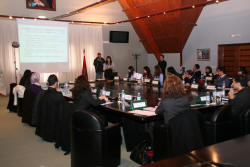
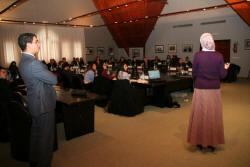 A group of more than 30 students from Al Akhawayn University’s MBA program discussed economic priorities for their country, lessons from the crisis, and whether they felt optimistic or pessimistic about the country’s future. The students expressed concern about education, governance, and the country’s ability to compete in the global economy. Founded in the mid-1990s, Al Akhawayn is Morocco’s first university modeled on the American university system, and the discussions were held in English.
The students identified education and fighting corruption as the country’s top priorities for growth. In the opening presentation, a student noted that the country’s literacy rate stands at 55 percent for the general population, a statistic that must be improved if the country is to reach its full potential. Literacy is important for information access, especially in a globalized world without boundaries, the student stressed, and raising the literacy rate is key to improving the country’s competitiveness.
Linked to the low literacy rate is a whole set of problems with Morocco’s educational system, the students said. These include low funding for educational resources, inadequate educational facilities and overcrowded classrooms, and a hodgepodge of curricula in the schools. There are too many high school systems in Morocco, one student noted, which creates difficulty for those who make it to the post-secondary level and contributes to the high dropout rate in universities.
 Improving the educational system would be a first step toward lowering unemployment, which is currently 9.1 percent. The students talked about the need to provide training and study programs that are better aligned with the labor market’s needs. The government could also take steps to encourage entrepreneurship and develop microfinance projects.
Another obstacle to growth in Morocco is poor governance, the students said. Corruption is a serious problem that impacts democracy and limits the rule of law. It offers a very limited number of people access to the resources and wealth of the country, which creates social inequality.
Increasing trade could also be given higher priority by the government. One student noted the potential for greater trade with Morocco’s neighbors, noting that there is very little at the moment. The trade percentage between Morocco and Algeria is a one-digit number—which is unfortunate, the student said, because Morocco imports products that Algeria exports and vice versa. A trade relationship could be beneficial for both countries.
With regard to the global financial crisis, students noted that Morocco was less affected by the crisis than some other countries because its financial market is less developed and less integrated. Students debated whether this was good or bad, with most recognizing that closing one’s economy off was not a viable solution.
One student talked about the lessons of the crisis, stressing the need for early warning systems and appropriate government regulation of the markets. She also noted that at the root of the crisis was “fancy manipulation” of derivatives and other instruments, along with securitization. Her view was that it would better to go back to basics, back to simpler financial instruments.
Another student disagreed, noting wryly that the country had been saved from crisis by its underdevelopment. “We don’t have financial innovation, and just because we don’t have these products doesn’t mean it’s good,” he said. The capitalist system is not flawed, he continued—it was poor management that took the world into financial crisis, not the concept of capitalism. “Going back to basics doesn’t get us anywhere—we should try to learn from our mistakes and then move forward,” he said.
 On a related topic, students felt it was key to improve Morocco’s competitiveness. “When it comes to protectionism, we should be very careful,” one student said. “What we are doing currently is exchanging our tomatoes and oranges for televisions, so when it comes to protectionism, we are losing. We can start thinking about these matters as soon as we are able to produce our own television, our own refrigerators—our own matches, even.”
The students were divided on whether to be optimistic or pessimistic about Morocco’s economy. Some felt optimistic about new projects that are currently under way in the country—for example, the project for a new TGV (fast train), new laws improving the country’s business environment, and a series of development strategies the government has put forth.
Others disagreed, noting that the country has a long way to go in terms of improving its human development indicators before thinking about grandiose development projects. “Is the TGV the number one priority?” one student asked. “We just talked about education, we talked about governance. I’m not that sure having big projects is the most important thing.”
In the end, the consensus was that it was fine to be optimistic, as long as Moroccans recognized their country’s economic problems and worked to solve them. “It’s not about being optimistic or pessimistic—it’s about working to get things done,” one student said, in summary.