Tariffs Do More Harm Than Good at Home
IMF Blog, September 8, 2016
Source details
- Canonical URL
- Tariffs Do More Harm Than Good at Home
Other formats
Bibliographic details
- Authors: Maurice Obstfeld
- Published: September 8, 2016
Overview and context
- Author: Maurice Obstfeld
- Publication date: September 8, 2016
- Central question: Unilateral import tariffs intended to offset perceived foreign price advantages can harm the imposing country’s economy, even absent retaliation.
Mechanisms and channels
- WTO context:
- The World Trade Organization’s Agreement on Subsidies and Countervailing Measures allows unilateral countervailing duties on imports of subsidized goods.
- Policies that are not strict WTO-defined subsidies (e.g., currency undervaluation) can produce similar downward pressure on export prices.
- Mundell’s insight:
- Robert Mundell identified that a tariff can improve the importer’s underlying balance-of-payments position, causing the domestic currency to strengthen and potentially reducing GDP and employment.
- The contractionary impact is harsher when the home country’s central bank policy interest rate is at or near zero, because monetary policy is more constrained.
- General equilibrium effects:
- Tariffs shift demand toward domestically produced goods and raise prices of competing imports, but can lead to currency appreciation that offsets and potentially reverses expected gains in output and employment.
- Tariffs can “subsidize most imports and tax all exports,” thereby hurting the trade balance, output, and employment.
Quantitative experiment and scenarios
- Model used: IMF’s Global Integrated Monetary and Fiscal model (multi-region, dynamic).
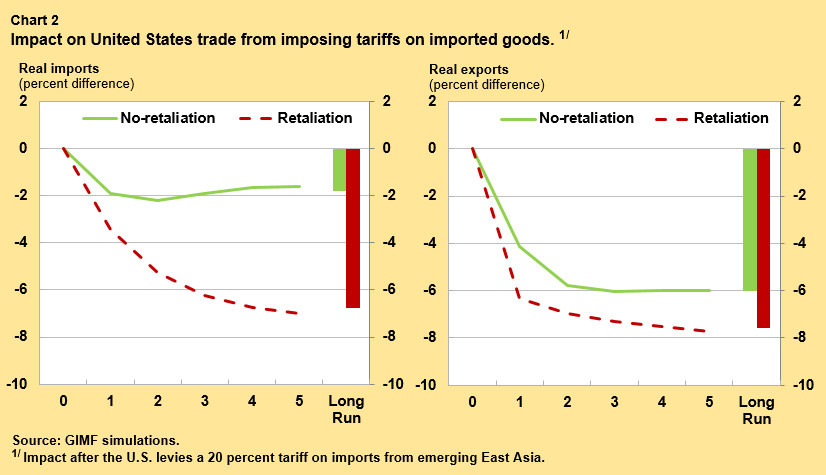
- Policy shock modeled: United States levies a 20 percent tariff on imports from emerging East Asia.
- Key assumptions:
- The Federal Reserve policy interest rate is at zero.
- Emerging East Asia’s policy interest rate is not at zero.
- Two scenarios illustrated:
- No retaliation by emerging East Asia (green line in charts).
- Retaliation by emerging East Asia with its own tariff on U.S. imports (red line in charts).
- Model outcomes (U.S. variables highlighted):
- Under either scenario, real GDP declines.
- The dollar appreciates (is worth more); with retaliation the dollar appreciates by less, but U.S. GDP falls by far more.
- Real investment falls due to lower activity and higher prices of East Asian intermediate imports used in investment goods.
- Exports initially fall by more than imports; importers switch to other countries, and dollar appreciation makes alternative imports cheaper, reinforcing the switch and weighing on U.S. exports.
Distributional effects and who gains or loses
- Gains:
- Domestic consumers may see higher real consumption because the tariff, if not met with retaliation and given U.S. size, raises prices of U.S. exports relative to imports.
- Producers serving the domestic market who compete directly with emerging East Asia are likely to gain.
- Losses:
- Exporters and most other import-competing industries lose.
- Export jobs lost tend to be relatively high paying in the United States.
- With retaliation, the outcome is worse and “everyone loses.”
Policy implications and recommendations
- Unilateral punitive tariffs:
- Can be emotionally or politically gratifying and may temporarily boost specific industries.
- Open the door to industry lobbying based on criteria less objective than measurable financial subsidies.
- May provoke retaliatory tariffs and mutually destructive trade wars.
- Suggested caution:
- Policies aimed at attaining artificial export advantages are legitimate topics for international consultation and peer pressure.
- Those advocating unilateral punitive tariffs should think carefully because such policies can cause wider economic damage at home, even if retaliation does not occur.
Tariffs Do More Harm Than Good at Home — Maurice Obstfeld, September 8, 2016
Content in this bundle
- 关税对本国的影响弊大于利;莫里斯·奥伯斯费尔德,iMFdirect;2016年9月8日
- 関税賦課の自国への利害、害の方が大, モーリス・オブストフェルド, iMFdirect, 2016年9月8日
- Wp1355
- От тарифов стране-импортеру больше вреда, чем пользы; Морис Обстфельд; 8 сентября 2016 года