Widening Gaps: Regional Inequality within Advanced Economies
IMF Blog, October 9, 2019
Source details
- Canonical URL
- Widening Gaps: Regional Inequality within Advanced Economies
Other formats
Bibliographic details
- Authors: John Bluedorn, Weicheng Lian, Natalija Novta, Yannick Timmer
- Published: October 9, 2019
- DOI: https://doi.org/10.1016/B978-0-444-53538-2.00002-2
Overview
- Differences in economic performance between regions within countries can be large and sometimes even larger than between countries.
- Example comparisons in the source:
- Average real GDP per person in the United States is about 90 percent higher than in Slovakia.
- Within the United States, per capita GDP in the state of New York is 100 percent higher than in Mississippi.
- Large and persistent regional gaps can undermine inclusive growth, fuel discontent, and erode social trust and cohesion.
- Chapter 2 of the World Economic Outlook examines gaps between better and worse performing regions in advanced economies and analyzes regional labor market responses to trade and technology shocks.
Measuring regional differences
- 90/10 ratio: real GDP per capita of the region at the 90th percentile divided by that of the region at the 10th percentile within a country.
- Italy: 90/10 ratio is about 2 (Trento about twice as large as Sicily).
- Japan: 90/10 ratio is 1.35.
- Advanced economies (including the United States): 90/10 ratio is now at about 1.7, indicating the 90th percentile region is, on average, 70 percent richer than the 10th percentile region.
- Note: incomes tend to vary much more within regions than between them.
- Rising disparities imply poorer regions in advanced economies are no longer catching up to the rich as fast as they used to.
Definition and characteristics of lagging regions
- Classification of a lagging region:
- Initial real GDP per capita in 2000 is below the country’s median region, and
- The region’s average growth over the period 2000–16 is below the country’s average growth over the same period.
- Typical unfavorable attributes of lagging regions:
- Worse health outcomes: higher infant mortality and lower life expectancy.
- Smaller shares of college-educated workers.
- Smaller shares of people in their prime (considered to be 25 to 54 years old).
- Higher unemployment rates.
- Smaller share of people participating in the labor force.
- Labor productivity gaps (output per worker) in lagging regions across sectors:
- About 5 percent less in public services.
- Around 15 percent less in manufacturing industries and finance and professional services.
- Sectoral specialization:
- Poorer regions tend to specialize in agriculture and manufacturing rather than high productivity service sectors such as information technology and communications and finance.
- Climate change risk:
- Rising temperatures may lower labor productivity in agriculture and heat-exposed industries, often affecting lagging regions more.
Responses to shocks (trade and technology)
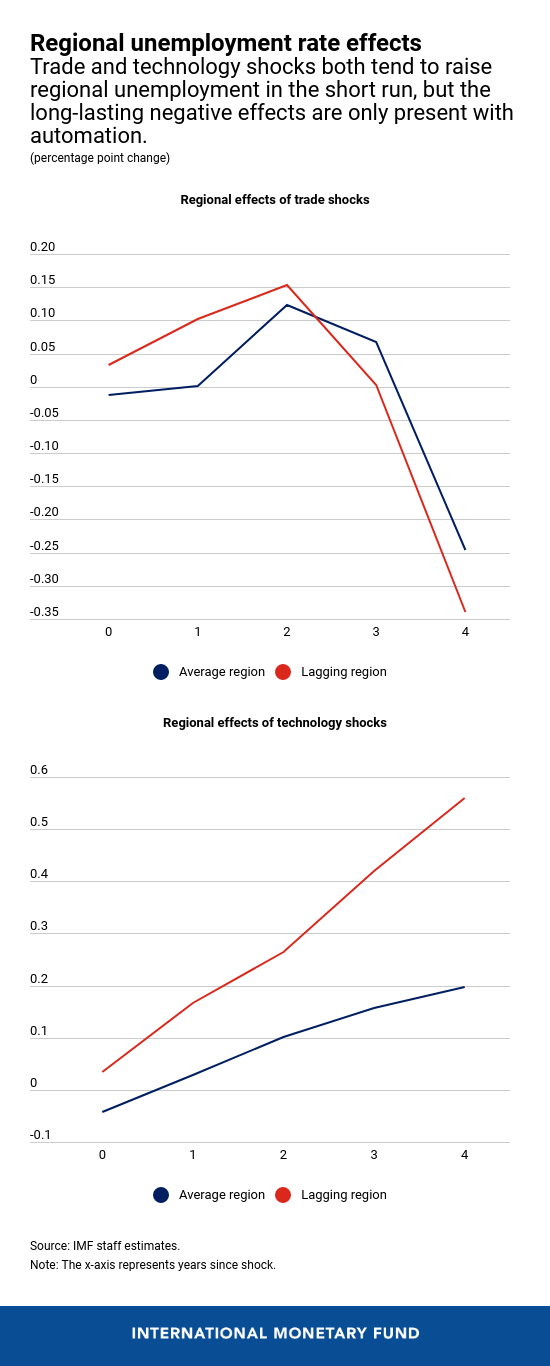
- Trade shocks (increases in import competition in external markets):
- Do not have significant effects on regional unemployment on average, both overall and for lagging regions specifically.
- Tend to reduce labor force participation after one year, but this effect quickly fades.
- Technology shocks (proxied by a decline in the cost of machinery and equipment):
- A negative technology shock raises unemployment in all regions that are more vulnerable to automation, with lagging regions particularly hurt.
- Automation-prone lagging regions experience a statistically significant drop in people leaving after the shock, suggesting workers in these regions find it harder to move out in search of better employment.
- Labour’s adjustment to technology shocks in lagging regions is hampered.
Policy implications and recommendations
- Improve market functioning:
- Reduce distortions and encourage more open and flexible markets to minimize unemployment increases from shocks and improve reallocation of workers and capital.
- Labor market policies:
- Retrain the displaced and speed re-employment, with particular focus on lagging regions.
- Boost educational and training quality to adapt to the changing world of work; this would disproportionately benefit lagging regions where unemployment is higher.
- Product market openness:
- Lower barriers to entry and greater trade openness can facilitate movement of capital to regions and firms where returns are higher.
- Fiscal and place-based policies:
- Target fiscal support to lagging regions and implement programs to ease worker relocation and provide buffers against regional shocks.
- Place-based policies must be carefully designed to help rather than hinder adjustment.
Widening Gaps: Regional Inequality within Advanced Economies — John Bluedorn, Weicheng Lian, Natalija Novta, Yannick Timmer; October 9, 2019.