Equity Investors Must Pay More Attention to Climate Change Physical Risk
IMF Blog, May 29, 2020
Source details
- Canonical URL
- Equity Investors Must Pay More Attention to Climate Change Physical Risk
Other formats
Bibliographic details
- Authors: Felix Suntheim, Jrme Vandenbussche
- Published: May 29, 2020
Overview and key statistics
- Direct damages of climatic disasters over the past decade are estimated to add up to around US$ 1.3 trillion (or around 0.2% of world GDP on average, per year).
- Publication: Felix Suntheim, Jérôme Vandenbussche — May 29, 2020.
- Sample context for historical analysis: around 350 large climatic disasters over the past 50 years in a sample of 68 economies, representing 95 percent of global GDP.
Lessons from past climatic disasters (historical evidence)
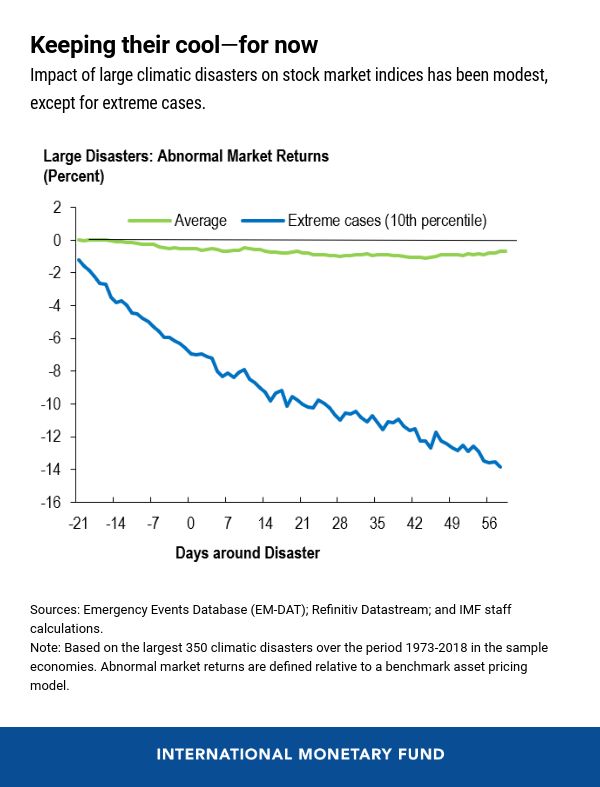
- Average historical market impacts in the sample:
- Drop of 2 percent for banking stocks.
- Drop of 1 percent for the whole market.
- Tail events:
- In ten percent of cases, the impact on the aggregate market has been greater than 14 percent.
- Notable examples:
- Hurricane Katrina, 2005: largest damage in absolute terms in the sample (1 percent of U.S. GDP) — had no discernible impact on the U.S. stock market index.
- 2011 Thai floods: largest damage relative to the economy’s size — caused a 30 percent drop in the stock market over 40 days.
- Factors that mediate impact:
- Countries with more fiscal space can deploy swift financial relief and reconstruction.
- Well-developed risk-sharing mechanisms such as insurance reduce or redistribute losses and limit impacts on domestic equity prices.
Future physical risk and current equity valuations
- Climate change is expected to increase the probability and severity of hazards such as floods, heatwaves and droughts, subjecting economies and financial markets to greater shocks.
- Pricing this increase in physical risk requires investors to estimate:
- The likelihood of various climate scenarios.
- Implications for physical risk at the firm level based on climate science and anticipated mitigation and adaptation actions.
- Longer time horizons than many long-term institutional investors typically contemplate.
- Retrospective finding:
- 2019 equity valuations across countries did not reflect any of the commonly discussed global warming scenarios and associated projected changes in hazard occurrence or incidence of physical risk.
Policy recommendations and measures to strengthen resilience
- Crisis preparedness and resilience are essential, as underscored by the COVID-19 pandemic.
- Expand availability of insurance and strengthen sovereign financial strength to lessen disaster impacts and reduce financial stability risks.
- Develop global mandatory climate change physical risk disclosure standards to provide granular, firm-specific information on current and future exposures and vulnerabilities to climate shocks for lenders, insurers, and investors.
- Implement climate-change stress testing to help financial firms and supervisors understand the size of exposures and associated physical risk.
- Over the past decade, one in five of the IMF’s own Financial Sector Assessment Programs considered physical risks related to climatic disasters.
- Recent example: the assessment published last year for the Bahamas.
- Pursue strong global policy action to reduce greenhouse gas emissions to address the underlying cause of global warming and deliver broad benefits beyond financial stability.
Source: IMF blog post — "Equity Investors Must Pay More Attention to Climate Change Physical Risk" by Felix Suntheim and Jérôme Vandenbussche, May 29, 2020.
References
- https://www.imf.org/ar/News/Articles/2020/05/29/blog-GFSR-Ch5-equity-investors-must-pay-more-attention-to-climate-change-physical-risk
- Global Financial Stability Report
- https://www.imf.org/wp-content/uploads/2020/05/eng-may-26-gfsr-chap-5-blog-chart2.jpg
- the assessment published last year for the Bahamas