
The IMF and Civil Society
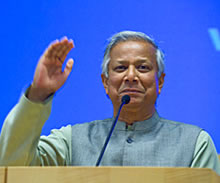
Dr. Muhammad Yunus greets the audience that came to listen to him speak about his visionary ideas about social business.
Yunus - Banker to the Poor Visits the Fund
February 9, 2009
Before a standing room only audience at the IMF, Nobel Peace Prize Laureate Muhammad Yunus presented his vision of “creating a world without poverty.”
Muhammad Yunus, the founder and managing director of the pioneering microfinance institution Grameen Bank, came to the IMF on February 4 to present his latest book Creating a World Without Poverty, speaking to an audience of visitors from NGOs, the private sector, think tanks and the media as well as Fund and Bank staff.
In his introductory remarks, IMF First Deputy Managing Director John Lipsky welcomed the Nobel laureate on behalf of Fund and Bank staff and said that the Fund shares his vision. Lipsky said the Fund supports the view that microfinance can be a useful catalyst for poverty reduction by increasing access to financial services for low-income and underserved groups. “In the context of the current financial crisis, it is important that access to financial services in developing countries is maintained,” Lipsky said.
Before talking about his book, Yunus told the audience about a meeting he had just had with U.S. Federal Reserve Board Chairman Ben Bernanke. He said he asked Bernanke for help in obtaining a U.S. license for one of his latest projects, Grameen America—which would apply the microfinance model to American low-income citizens. Yunus said he also discussed the U.S. financial crisis with the Fed Chairman. He stressed that the real victims of the crisis are the poor and that the bailout package should not only aim at big businesses and enterprises but also help “people at the bottom.” He added that the current financial crisis is also an opportunity to “redo our lives, institutions, and policies” to create an inclusive financial system, not a club for privileged people.
In his book, Creating a World Without Poverty, Yunus introduces the concept of social business, where the creative vision of the entrepreneur is applied to today's most serious problems: feeding the poor, housing the homeless, healing the sick, and protecting the planet.
The book tells the stories of some of the earliest examples of social businesses, including Grameen Bank. Yunus said that poverty is not created by people, but by the system that we build. The idea of social business is based on the conviction that business does not have to focus on profits alone. He said that the human being is complex, and while people can be selfish, they also have selfless aspects, citing philanthropy as one example. But instead of giving money to charity, Yunus proposed to invest it in a business where the money is recycled. The book tells the stories of some of the earliest examples of social businesses, including Grameen Bank. Yunus said that poverty is not created by people, but by the system that we build. The idea of social business is based on the conviction that business does not have to focus on profits alone. He said that the human being is complex, and while people can be selfish, they also have selfless aspects, citing philanthropy as one example. But instead of giving money to charity, Yunus proposed to invest it in a business where the money is recycled.
He told the audience of a recent “social business” cooperation between Grameen and the French company Groupe Danone, where Danone produces and sells very cheaply a highly nutritious yogurt for malnourished children. Danone will not take any dividend beyond its investment. The central question in this particular social business, Yunus said, is not “how much profit can I make by selling yogurt,” but “how many children can I get out of malnutrition?” Yunus encouraged the audience to look at the world not through “profit-maximizing” glasses but to put on “social business glasses.” If this concept takes off, he said, “we can put poverty in the museum.” He told the audience of a recent “social business” cooperation between Grameen and the French company Groupe Danone, where Danone produces and sells very cheaply a highly nutritious yogurt for malnourished children. Danone will not take any dividend beyond its investment. The central question in this particular social business, Yunus said, is not “how much profit can I make by selling yogurt,” but “how many children can I get out of malnutrition?” Yunus encouraged the audience to look at the world not through “profit-maximizing” glasses but to put on “social business glasses.” If this concept takes off, he said, “we can put poverty in the museum.”
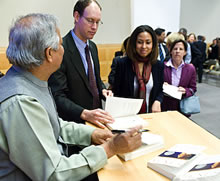
Dr. Yunus signed hundreds of books and interacted with an enthusiastic public.
After the event, Yunus patiently signed hundreds of books for audience members who also had their picture taken with the Nobel laureate. A portion of the book proceeds will be donated by co-organizer Hooks Book Events to the Grameen Foundation in Washington, D.C.
Yunus, a native of Bangladesh, was educated at Dhaka University and was awarded a Fulbright scholarship to study economics at Vanderbilt University. In 1972 he became head of the economics department at Chittagong University in Bangladesh. Yunus and Grameen Bank, which he founded in 1983, were winners of the 2006 Nobel Peace Prize.