
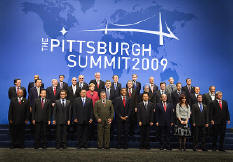
The G20 leaders on September 25, 2009 in Pittsburgh, Pennsylvania. IMF Staff Photo
The IMF and Civil Society
News from G-20 Meeting
November 16, 2009
Finance officials from the world’s 20 leading economies met on November 7 in St. Andrews, Scotland, to discuss how to nurture a global economic recovery. Meanwhile, the G-20 asked the IMF to prepare a study on proposed financial sector taxes.
G-20 finance officials pledged to maintain economic stimulus measures until recovery from the global crisis is assured. They also asked the IMF to assess whether countries were on track to deliver strong, sustainable, and balanced growth that can avoid future problems. “Economic and financial conditions have improved following our coordinated response to the crisis,” the G-20 officials said in a statement.
Avoiding a New Crisis
At their last summit in Pittsburgh in September, G-20 leaders agreed on a framework for peer review, assisted by the IMF, that is designed to ensure that national economic policies are consistent with promoting a balanced global economy. G-20 finance ministers and central bankers committed to a timetable for devising a new system to assess each others' economic policies. By the end of January, G-20 governments would present national and regional plans to support sustainable recovery and job creation.
Officials want to avoid derailing the recovery by withdrawing the stimulus too soon or by leaving it so long that a resulting debt buildup causes investors to push up market interest rates. The IMF outlined in a note to the G20 leaders a series of seven principles to consider for unwinding the stimulus when appropriate.
IMF Managing Director Dominique Strauss-Kahn said this mutual assessment of economic policies will be the main job of the G-20 after this crisis. “We need to see how policies are consistent together or not,” he said.
Financial Sector Tax
The G-20 officials emphasized the need for quick implementation of banking industry reform, saying that stronger standards should be developed by the end of 2010 with the aim of implementation by the end of 2012 as financial conditions improve.
Strauss-Kahn said that the IMF was considering several options related to financial sector taxation for the G-20 to examine. “We can't go on with a system where some individuals take risks that finally all taxpayers, like you and me, have to pay for,” he said. “The financial industry has made such big innovations that it is probably impossible to find a transaction tax that will not be avoidable by potential taxpayers. So it will be based not on transactions but on something else.”
The Fund will examine various options for a tax on the financial sector, with IMF staff preparing an initial report for the G-20 finance ministers by April 2010.
Climate Change
G-20 leaders also committed to take action to tackle the threat of climate change and work towards an “ambitious outcome” at the United Nations Climate Change Conference in Copenhagen next month. Officials are considering a finance package to help poorer nations develop green industries and adapt to climate change. “To deliver this financing, coordinated equitable, transparent and effective institutional arrangements will be needed,” they said.
Opportunity to Change
The G-20 agenda accords closely with the broader international community’s blueprint for the Fund. In his opening address to the 2009 Annual Meetings of the Boards of Governors of the World Bank Group and the IMF in Istanbul, Strauss-Kahn urged countries to seize the opportunity to shape the post-crisis world. “To meet the challenges ahead, we will need to adapt and change—at the country level, at the international level, and at the IMF too,” he said.
In order to reflect the new world reality, the IMF was asked in Istanbul to address four key reforms areas—the IMF’s mandate, its financing role, multilateral surveillance, and governance. These “Istanbul Decisions” Strauss-Kahn said, will be a focal point of IMF activities for the coming year.
He also told the Board of Governors that low-income countries remain economically marginalized and that they too deserve a stake in the global economy. He emphasized that cooperation is needed among all the countries of the world.
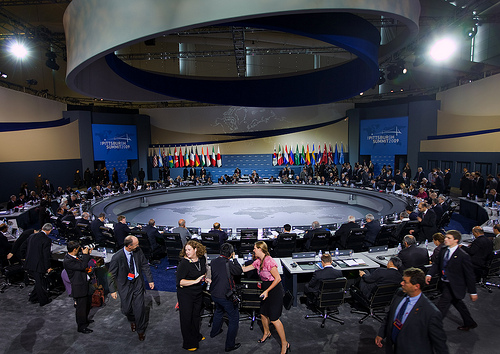
The G20 leaders hold the opening working Plenary session at the Convention Center September 25, 2009 in Pittsburgh, Pennsylvania. International Monetary Fund Photograph/Stephen Jaffe