
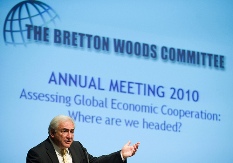
IMF Managing Director Dominique Strauss-Kahn in an address at the 2010 Annual Meeting of the Bretton Woods Committee at the World Bank in Washington, D.C. on February 26, 2010. IMF Staff Photo/Michael Spilotro
The IMF and Civil Society
IMF Seeks Inputs for Revising Its Mandate
March 15, 2010
The IMF is rethinking its role in the post-crisis world to ensure it is working most effectively for its 186 member countries and helping them avoid another global recession—with all that implies for trade, jobs, and living standards.
The October 2009 communiqué of the International Monetary and Financial Committee (IMFC) of the Board of Governors of the IMF asked the Fund “to review its mandate to cover the full range of macroeconomic and financial sector policies that bear on global stability, and to report back to the Committee by the time of the next 2010 Annual Meetings.”
The process calls for the Fund to adopt a more systemic perspective, and for members to support this effort with the requisite data and dialogue that will strengthen the institution’s capacity to help prevent and manage crises. Reconsideration of the institution’s mandate is part of a broader reform effort underway at the Fund, including on governance, which is key to its long-term legitimacy and effectiveness.
As part of the review process, the Strategy, Policy and Review Department (SPR), in coordination with the External Relations Department (EXR), is initiating a broad discussion of background notes on the mandate topic and a public consultation effort requesting views from a range of stakeholders on three key areas: surveillance, financing, and the stability of the international monetary system.
Brainstorming with Stakeholders
“We have initiated a public consultation with various stakeholders, including governments, private sector, academia, think tanks, and civil society organizations, and the wider public”, Reza Moghadam, Director of the SPR Department, expressed. “We expect to receive productive feedback and discussions to enhance the Fund’s mandate review process.”
In a recent blog posting, Moghadam asked key stakeholders to collaborate in the review process. “It goes without saying that wider reform of Fund governance is key to the legitimacy of any mandate, new or old”, he says.
The Fund will provide the public and stakeholders with different venues to facilitate access to the consultation process. In addition to the on-line platform that will allow participants to leave short comments or to submit a more substantial contribution to IMFConsultation.org the Fund will hold a series of meetings and discussions during the upcoming weeks. the Fund will hold a series of meetings and discussions during the upcoming weeks.
The consultation period for the Fund mandate started on March 9, 2010, and will conclude on May 15, 2010, and will have the paper on the mandate as a background document to discuss. The IMF will welcome views on the three key areas of outlined above: surveillance, financing, and the stability of the international monetary system.
The inputs from the consultation process will feed into the final report being prepared for the 2010 Annual Meetings. We expect to make the comments and inputs received in this process available on the IMF website after the process is closed.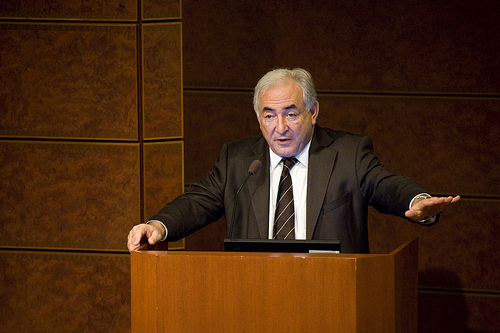
IMF’s Managing Director Dominique Strauss-Kahn speaks to the Tenth Annual Jacques Polak Research Conference at the IMF headquarters in Washington, DC, on November 5, 2009. The conference is intended to provide a forum for discussing innovative research in economics, undertaken both by IMF staff and by outside economists, and to facilitate the exchange of views among researchers and policy makers. IMF Staff Photo/Thomas Dooley.