
The IMF's Civil Society Team welcomes your suggestions and feedback.
Ph: (+1) 202 623-9400
Fax: (+1) 202 623-6220
IMF Contacts, Offices and Directions
Stay Connected
 |
|
 |
|
 |
|
 |
|
 |
|
 |
|
 |
|
 |
|
 |
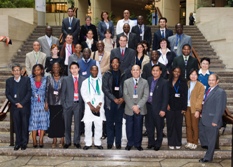
CSO fellows at the IMF headquarters ( Photo: IMF Staff)
The IMF and Civil Society
2010 World Bank and IMF Annual Meetings
October 21, 2010
CSO representatives had a comprehensive agenda of activities that included a revamped town hall meeting with Dominique Strauss-Kahn and Robert Zoellick, a capacity-building session and bilateral meetings with IMF staff.
The 2010 Annual Meetings came to an official end with a clear message from the IMF to global policymakers to work together for economic growth, jobs, and financial sector reform. Many important discussions about poverty eradication, economic development, and aid effectiveness took place during these four-day meetings, and flagship IMF reports like the World Economic Outlook and the Global Financial Stability Report were released.
More than 650 civil society registration applications were processed this year, the majority from the United States and Europe. A record number of 50 sessions at the Civil Society Policy Forum related to the IMF and World Bank were organized, and the ideas and opinions of civil society helped to strengthen and broaden the debate about the world economy. The meetings were very productive and important civil society messages were received.
CSO Fellowship Program
A diverse group of 40 civil society representatives from 35 emerging and developing countries were offered the opportunity to interact with IMF staff and other CSO representatives from many countries. Participants from Bulgaria, Dominican Republic, Kenya, Latvia, Malawi, Nepal, Nigeria, Peru, Philippines, Uruguay, Vietnam, among others were selected from a variety of NGOs worldwide.
The IMF also organized a capacity-building session for the program participants and facilitated contacts with IMF country teams during the meetings.
“I was surprised to find that it is an entire fellowship that involves capacity building arrangements that involves at the same time various numbers of sessions in various topics like gender, employment, environment, climate change, everything” Muhammad Abushaqra from the Youth Employment and Sustainable Development Summit in Egypt said in an interview.
Sponsored CSOs had access to various events like The BBC World Debate, the Program of Seminars, the Per Jacobsson Lecture, including the four-day Civil Society Policy Forum. CSO participants were able to exchange views on topics ranging from the state of the global economy, IMF governance, the Millennium Development Goals, job creation, to IMF social accountability. Town Hall Meeting
This year’s CSO town hall took a different format from previous years. The CSO panelists put questions first to IMF Managing Director Dominique Strauss-Kahn and then to Robert Zoellick, President of the World Bank Group, based on consultations they conducted with participating CSOs. The audience posed questions directly to the panelists and the answers followed. “There has been an important qualitative change at the meeting” said María José Romero from Third World Institute, Uruguay.
The meeting was chaired by Jo Marie Griesgraber from the New Rules for Global Finance Coalition, and the CSO speakers were Dickson Khainga of the Kenya Institute of Public Policy Research Analysis (KIPPRA) and David Zac Niringiye from Uganda’s Anglican Church.
The main questions for IMF were about the global economic recovery and IMF governance. Strauss-Kahn emphasized the world economy needs higher growth. He acknowledged that a man on the street is not interested in growth per se—he’s interested in jobs. He said that growth was the first step but that has it to be translated into something concrete—jobs, higher purchasing power, and ultimately poverty reduction.
Regarding IMF governance, Strauss-Kahn said that the institution in on the process of shifting voting power from advanced to emerging market countries to better represent the reality of membership, and that the goal of the reform is for the IMF to be less dominated by advanced countries and give more voice to the emerging economies to reflect their growing economic power.
Challenges Ahead
Many CSOs still feel that the dialogue between them and the IMF is still one-way. The CSOs appreciated the IFI’s efforts to deepen the engagement, but they still think that the IMF can take on board more of their proposals in their country work. Elizabeth Stuart from Oxfam International said that the IMF needs to understand the impact that it is having on poor people.
In this respect, Strauss-Kahn responded that progress has been made—the IMF is meeting more with labor unions and have a much better relationship with them (as evidenced by our recent joint conference with the ILO). He also said that the IMF needs to go further on governance, human rights, and the fight against corruption.
To know more about the participation of civil society during Annual Meetings, you can also watch the IMF Civil Society video with interviews of CSO fellowship participants that include their impressions and experiences during their week in Washington D.C.
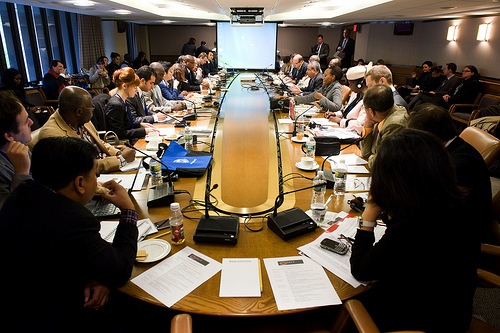
CSO fellows participating at the capacity building session that was part of the agenda of activities during Annual Meetings. ( Photo: IMF Staff)