

Finance & Development, March 2018, Vol. 55, No. 1 PDF version
Book Reviews
The Inevitability of Bailouts
Eric A. Posner
Last Resort: The Financial Crisis and the Future of Bailouts
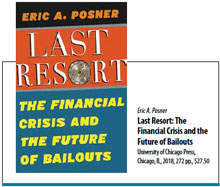 University of Chicago Press, Chicago, IL, 2018, 272 pp., $27.50
Economics says that bailouts are bad because they beget moral hazard—that is, they shield those involved from risk, which encourages recklessness. Politics seems to agree: the no-more-bailouts sentiment was a driving force behind the 2010 massive US financial reform legislation known as the Dodd-Frank Act. The global financial crisis’s 10th anniverary raises the question of whether we are better poised to deal with future crises. Eric Posner’s response is a resounding no.
In Last Resort Posner’s argument rests on three points. First, he argues that much of the response both by the Federal Reserve and the US government to the 2008 subprime crisis was illegal. Second, future crises will inevitably require bailouts or liquidity provision by a lender of last resort (LLR). Third, we still don’t know how to provide an LLR legally and effectively in a crisis. Much space is devoted to the first point, leaving scant opportunity to address the challenge of designing adequate (and fully) legal policy tools.
The 19th century concept of an LLR is all about liquidity for solvent institutions in crisis. But today distinguishing between liquidity and solvency problems is often impossible. It is still a matter of debate whether Lehman Brothers was insolvent or just illiquid in September 2008. Similarly, the legal battles Posner analyzes regarding the insurer AIG and the government-sponsored housing enterprises hinge on the question of insolvency or illiquidity when the government intervened. It is hard to make this distinction, so bailouts are inevitable, and there must be rules for liquidity support. If anything, Dodd-Frank limited the Fed’s ability to react. Other Dodd-Frank provisions may reduce the probability of a crisis, but if there is one, we may be less able to respond.
Posner has no sympathy for the idea that the Fed, operating under extreme conditions, was innovative and creative in its crisis response. He presents a legal brief on why the government intervention to “take” the equity of AIG and of the government-sponsored housing agencies was illegal, as opposed to bailouts of worthless organizations. Not until the last three lines of the book does he acknowledge his work on AIG’s legal case against the government.
In the last chapter, Posner turns to the design of a postmodern LLR. Legislation can never guarantee that crises will not occur, so bailouts will still be needed. Posner would like to see an LLR with broad powers to lend when collateral is unavailable or impossible to value, make capital injections, and direct firms to enter financial transactions. His strengthened LLR could make fiscal or expenditure commitments, crossing the line that separates traditional central banking from the government.
Would any legislator give such extensive authority to an independent financial regulatory body? It is a troubling conclusion: the modern financial system requires an LLR with powers no political structure is likely to grant.
PAUL WACHTEL, Stern School of Business, New York University
Opinions expressed in articles and other materials are those of the authors; they do not necessarily reflect IMF policy.