

Finance & Development, December 2018, Vol. 55, No. 4 PDF version
Moving the Needle
Maurice Obstfeld discusses his tenure as the IMF’s chief economist
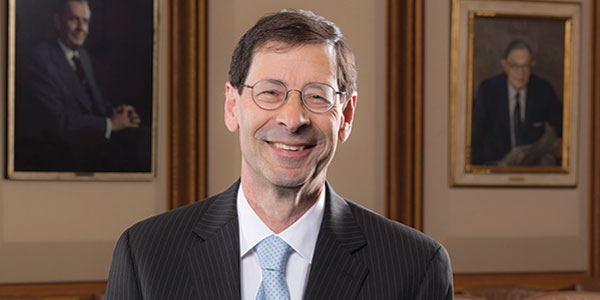
Retiring as chief economist of the International Monetary Fund at the end of 2018, Maurice Obstfeld shares his thoughts on trade tensions, widening inequality, the importance of education, and relations between United States and China in an interview with F&D’s Gita Bhatt. Obstfeld plans to return to the University of California, Berkeley, where he was a prominent academic economist for 24 years and cowrote two leading textbooks on international economics. His successor at the IMF will be Harvard University’s Gita Gopinath.
F&D: What worries you most on the macroeconomic front?
MO: The worries are clearly set out in the World Economic Outlook: trade tensions and adjustment to differential financial conditions in an environment of much higher private and public debt than we had in the past.
Longer term, wage and productivity growth is an issue. How do we spur innovation?
We need a big rethink on educational investments everywhere. Human capital investments very early in life have been shown to be critical to future success. But even later in life, they can promote greater flexibility of workers, prolong working lives, and offset effects of aging populations.
That will also help mitigate some of the adjustment issues that might be related to technology and trade. It will make economies more resilient and better able to deal with the critical, long-term problem that we just haven’t seen working people share in the gains from growth. There is now a sense in a lot of countries that incomes of working people have stagnated, that social mobility is lower, that opportunity is lower, that one’s children will not be better off and may indeed be worse off. These trends poison our politics.
F&D: The United States and China are world’s largest, most dynamic economies. How do you see the economic relations between the two playing out?
MO: Their disagreements go way beyond economics. They go fundamentally to the issue of global leadership. If you are a country like the United States, which has been a global leader and has shaped the global governance structure, how do you manage this relationship, which at once offers opportunities for cooperation but also hazards of conflict?
Moreover, how do you do it dealing with a system that is very, very different from yours politically? If you look at the approach the Obama administration took to the trade relationship with China, one important element was the TPP [Trans-Pacific Partnership agreement], which excluded China but which included the flexibility for countries (including China) to join if they subscribed to the rules. This was a strategy for maintaining US influence and potentially influencing through soft power the way China conducted trade.
Now the relationship seems to have become more confrontational, certainly in trade. I'm not sure confrontation is ultimately going to be productive because it puts front and center the idea that one country has to "win" and be dominant, as opposed to creating a structure within which countries can coexist and conflicts are contained.
F&D: In your three years as the IMF's chief economist, what were some of the more surprising global economic developments?
MO: When I came in, China had recently devalued the yuan and changed its exchange rate regime, and asset markets were in turmoil. It set off a period of worry about China's growth and stability, which affected global asset markets through the first half of 2016.
The next surprise was the Brexit vote, which came in the middle of 2016 at a time when we thought markets were still a bit shaky and we were worried about possible downsides.
Very soon thereafter, we had the US presidential election, the outcome of which was also a surprise and set up a new dynamic, where on one side there was the prospect of more US fiscal stimulus supported by a booming stock market. But, on the downside, there was a lot of noise about trade and possible renegotiation of fundamental trade relationships, which after a bit more than a year turned into action.
This was all happening against the backdrop of the Federal Reserve gradually normalizing monetary policy. In December 2015 the Fed started raising US interest rates, and as it has kept at it, we have gotten into a period of much tighter financial conditions for emerging markets.
F&D: Do you feel the responsibility of your research’s impact on policy?
MO: You always want your research to be as solid and as credible as possible. If that’s the case, then I don't worry about it. One worries more about giving the right advice in a crisis situation, where you might make a severe mistake and a lot of people might suffer as a result.
I first understood this responsibility in August 2015, just before I assumed this role. China devalued its currency that month, and global markets were melting down. Some distinguished economists were putting out alarmed—and alarming—tweets. The chair of the US Council of Economic Advisers, Jason Furman, was on paternity leave, and as a member of the Council, I was therefore the macroeconomist in charge. President Obama called me in to the Oval Office along with the secretary of the treasury, Jack Lew.
The president seemed calm about all of this. He looked at me and asked, "Should I be worried?" I said to myself, "I have never been in this position before, but I will probably be in this position a lot at the Fund." I had a couple of seconds to consider my answer. And I said, "No. The markets will find their footing, and for now I don't think the world is coming to an end."
The president next looked at Secretary Lew. "Jack, what do you think?" He replied, "I agree."
"OK, thanks," the president said. "Can we ask these folks to stop tweeting?" End of meeting.
F&D: We have seen a backlash against globalization and an erosion of trust in experts and institutions. What can we do to regain the trust of institutions?
MO: This comes back to the issue of inclusion. Clearly there are large segments of populations that feel that the sort of economic and political consensus that we thought we had reached by the early 2000s has not worked for them. They feel alienated from the elite power centers.
There is a failure of communication. There must be more of an attempt to communicate, which becomes harder as even the media become more fragmented. I do think, though, policies have to change if trust is to be regained. Specifically, it is going to be easiest to affect labor market outcomes for younger people, and that’s where a lot of effort and investment should go.
F&D: As chief economist, what happens if the new ideas you generate conflict with IMF institutional positions?
MO: Well, our position has to change. And it does. We have a robust process of internal review and discussion and debate. Time and again, our positions have evolved. Good economic research does affect policy here.
We have seen this with capital flows, issues of inequality, issues of fiscal policy, and on financial regulation. We learn from experience, we learn from research, and we do adapt.
F&D: As you go back to academia at Berkeley, will your experience at the IMF perhaps make you reevaluate some of your previous work and conclusions?
MO: I have always felt that you should adapt your conclusions to reality rather than trying to adapt reality to the conclusions you previously reached. I think that my conclusions have evolved here, but they also did even when I was an academic.
As is probably natural for someone as they age, I'll have less patience for purely theoretical debates. It is important for policy economists to be grounded in reality, to question the practical relevance of academic conclusions, and to think more about the nuances and country specificities.
F&D: What advice do you have for incoming chief economist Gita Gopinath?
MO: My advice would be that, just as at Harvard, you will learn from amazing colleagues. There is an unparalleled store of knowledge in the Fund about our member countries, and there is an abundance of wisdom and experience. The opportunities you will have to interact with folks in your travels—whether they are authorities, academics, or other members of civil society—is a real privilege. Be prepared, not only to impart wisdom, but also to receive it in abundance.
F&D: What do you see as the evolving role of the IMF?
MO: We have to incorporate a longer-term perspective into our surveillance. We tend to look intensively at the short or medium term, but there has to be more long-run thinking, so that we can better challenge authorities to think about the distant future, far beyond the political cycle. And that may require us to think somewhat more broadly, too.
We need to realize that we have a unique position as a long-lived institution with a good degree of independence from day-to-day politics. I think we need to keep in mind how special that position is, and learn to exploit it more effectively.
PHOTO: IMF/STEVE JAFFE
Opinions expressed in articles and other materials are those of the authors; they do not necessarily reflect IMF policy.