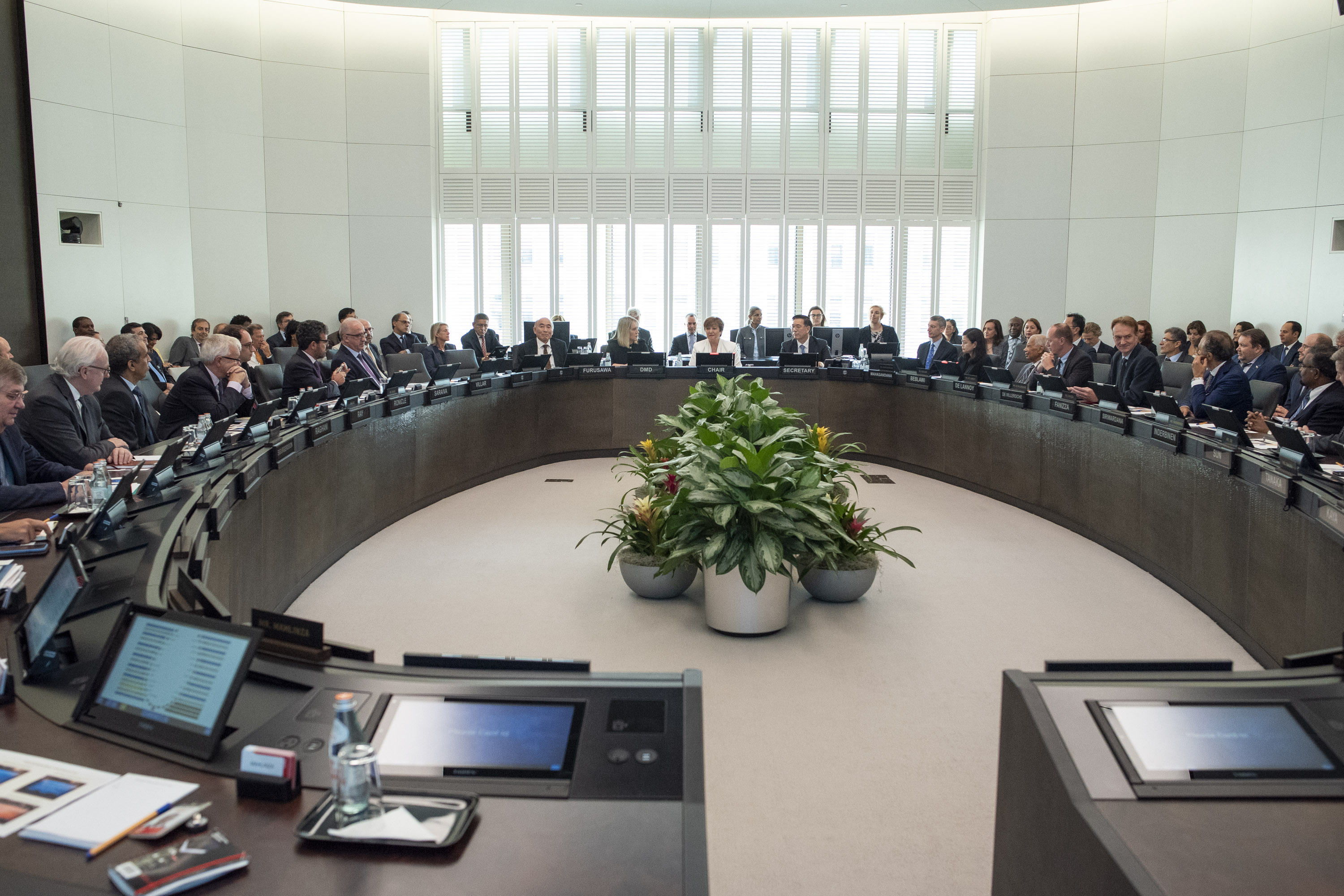
IMF Executive Board Concludes 2018 Article IV Consultation and Completes Fourth Review under the Extended Arrangement Under the Extended Fund Facility with Sri Lanka, Approving US$ 252 Million Disbursement
IMF News, June 1, 2018
Source details
- Canonical URL
- IMF Executive Board Concludes 2018 Article IV Consultation and Completes Fourth Review under the Extended Arrangement Under the Extended Fund Facility with Sri Lanka, Approving US$ 252 Million Disbursement
Other formats
Bibliographic details
- Published: June 1, 2018
Review outcome and disbursements
- Executive Board completed the fourth review of Sri Lanka’s economic performance under the three-year Extended Arrangement under the Extended Fund Facility (EFF) on June 1, 2018.
- Completion of the review enables the disbursement of the equivalent of SDR 177.774 million (about US$ 252 million).
- Total disbursements under the arrangement to date amount to the equivalent of SDR 715.23 million (about US$ 1,014 million).
- Sri Lanka’s three-year extended arrangement was approved on June 3, 2016, in the amount of about SDR 1.1 billion (about US$1.5 billion, or 185 percent of quota).
Major achievements cited
- Launch of the new Inland Revenue Act.
- Important steps in energy-pricing reforms.
- Progress towards flexible inflation targeting.
- Approval of an automatic fuel pricing formula described as a major achievement toward reducing fiscal risks from state-owned enterprises (SOEs).
IMF assessment (Mr. Mitsuhiro Furusawa, Acting Chair and Deputy Managing Director)
- “Sri Lanka has made important progress under its Fund-supported program. The authorities’ efforts to improve the policy mix through fiscal consolidation, prudent monetary policy, and landmark structural reforms are supporting the economic recovery, despite recent shocks.”
- Continued reform momentum is critical given:
- “the still sizable public debt and low external buffers,” and
- the need “to set the foundation for strong and inclusive growth.”
Policy priorities and recommendations
- Fiscal policy
- Further progress with revenue-based fiscal consolidation, supported by the new Inland Revenue Act, is needed to help safeguard important social and infrastructure spending, including in response to natural disasters.
- Adopt a robust fiscal rule and medium-term debt management strategy to help place debt firmly on a downward path.
- State-owned enterprises (SOEs)
- Implement the recently approved automatic fuel pricing formula.
- Implement an automatic pricing formula for electricity.
- Carry out a restructuring plan for Sri Lankan Airlines.
- Further strengthen SOE governance and transparency.
- Mitigate impacts on the vulnerable by strengthening social safety nets.
- Monetary policy and external resilience
- The Central Bank of Sri Lanka should continue to manage monetary policy prudently in the face of price shocks and market volatility.
- Sustain efforts to build up international reserves, with exchange rate flexibility as the first line of defense in response to volatile global capital flows.
- Upgrade the central bank law to be instrumental for the new inflation targeting framework.
- Monitor closely continued credit growth in the real estate sector despite stable financial soundness indicators.
- Structural reforms and inclusiveness
- Step up implementation of structural reforms with a focus on:
- Fostering gradual trade liberalization and the investment climate.
- Developing a natural disaster risk financing framework.
- Promoting gender equality in the labor market together with well-targeted social safety nets.
Procedural note
- The Executive Board also concluded the 2018 Article IV consultation with Sri Lanka on June 1, 2018; a separate press release will be issued shortly.
Press Release No. 18/212 — June 1, 2018 — IMF Communications Department