The economic and financial situation in the Central African Economic
and Monetary Community (CEMAC)—Cameroon, Central African Republic, Chad, Equatorial Guinea, Gabon, and the Republic of Congo—has improved over the last year, but the
outlook remains fragile. Even as some progress in reforms has been
achieved, growth remains well below potential, and there is still a
need to further reduce the imbalances that built up following the
decline in oil prices in 2014.
The IMF’s
latest economic assessment
of the CEMAC looks at how the region can overcome some of these challenges.
Joel Toujas-Bernate heads the team of IMF economists who wrote the report,
and IMF Country Focus sat down with him to discuss their findings.
What is the economic outlook for the CEMAC region?
CEMAC’s economic situation has improved, but remains fragile. According to
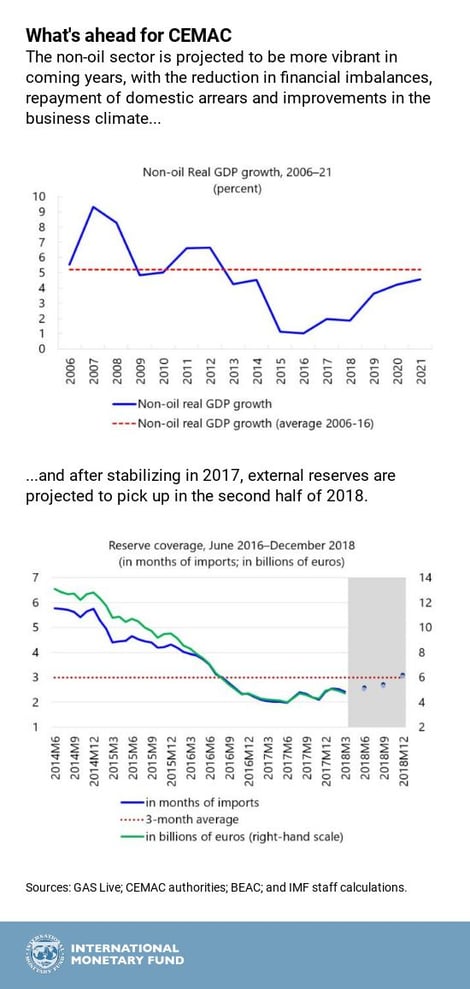
the IMF’s latest projections, growth is expected to increase to about 2¾
percent in 2018 from just under 1 percent in 2017. This increase would
mainly result from a rebound in oil production (6 percent in 2018 after minus 3
percent in 2017); non-oil sector growth would remain relatively low (at
about 2 percent).
At the same time, the region’s fiscal and external
imbalances have been reduced through fiscal consolidation efforts, rising
oil prices, and the central bank’s tighter monetary policy and stricter
enforcement of regulations.
However, despite the higher growth and significant improvement in the
current account deficit, CEMAC’s external position remains weak. After
having stabilized in 2017, regional external reserves fell short of targets
in 2018 despite higher oil prices.
Looking ahead, further improvement in the economic and financial situation
is expected, but this assumes full implementation of policy commitments by
CEMAC member states and regional institutions.
Fast Facts: CEMAC
- Member states: Cameroon, Central African Republic, Chad, Equatorial Guinea, Gabon, and Republic of Congo
- Population: 49 million (2017)
- Currency: Central African Communauté Financière Africaine (CFA) franc
- Average annual economic growth:
0.9% (2017)
- Main resources:
Petrol, gas, wood, gold, manganese, and diamonds
What are the risks to this outlook?
This outlook is subject to significant risks. For instance, there has been
weaker fiscal reforms in the face of political pressures (notably in the
countries holding elections this year). A reversal in oil prices would put
additional pressure on fiscal and external balances (though that risk has
subdued in the current context of higher oil prices).
The deterioration in
the security situation could also negatively affect economic activity.
Security conditions have already worsened in the Central African Republic,
and could be exacerbated by the challenging economic and social situation.
In addition, lower-than-projected external budget support is a risk factor.
To make sure that this risk does not materialize, the national authorities
will have to ensure that the conditions for receiving external aid continue
to be met without delay.
Shouldn’t the recent rise in oil prices help?
Yes, but the recent increase in oil prices should not lead to complacency.
Given the substantial risks to the outlook and the still fragile financial
situation of the region, the additional government revenue resulting from
higher oil prices should be mostly saved and used to reduce debt and boost
reserves and/or to repay domestic arrears.
Isn’t the adjustment hurting the poor—for example, some governments
have decided to reduce salaries?
The Fund-supported programs in the CEMAC region are designed to restore
macroeconomic stability and to create space to increase spending on
investment and priority social areas that help to reduce poverty, including
spending on health and education. At the same time, wages in many CEMAC
countries are often higher than in comparator countries. It is therefore
critical for governments to contain the wage bill to a reasonable level
consistent with each government’s resources, to allow space for spending on
public investment and priority social areas.
What are the policy recommendations going forward for the CEMAC region?
Efforts to strengthen countries’ fiscal positions need to continue as
planned, while protecting social spending. The IMF is encouraged by the
fact that authorities have committed to correct recent fiscal slippages
observed in some countries. Going forward, it will be also important to
strengthen the regional convergence framework to ensure lasting fiscal
sustainability.
The Bank of Central African States (BEAC) must be ready to act alongside
national authorities, including by tightening monetary policy, should
reserves continue to fall short of targets. Member states need to support
the regional institutions’ efforts to strengthen and better enforce foreign
exchange regulations. Higher compliance with these regulations, including
foreign exchange repatriation by extractive industries, is key to
rebuilding an adequate level of international reserves.
What is the IMF doing to help address issues of governance and
corruption in the region?
IMF-supported programs in the CEMAC region are designed to help maintain
macroeconomic stability and support inclusive growth. Within this context,
programs emphasize measures that will increase transparency and good
governance, including in the accounting of oil revenues, the elimination of
extra budgetary spending, following proper spending procedures, and the
transparent disclosure of information.
But, the ultimate responsibility to ensure good governance and transparent
government practices rests on the countries themselves, not just the
government but also Parliament, civil society, and the judicial system.