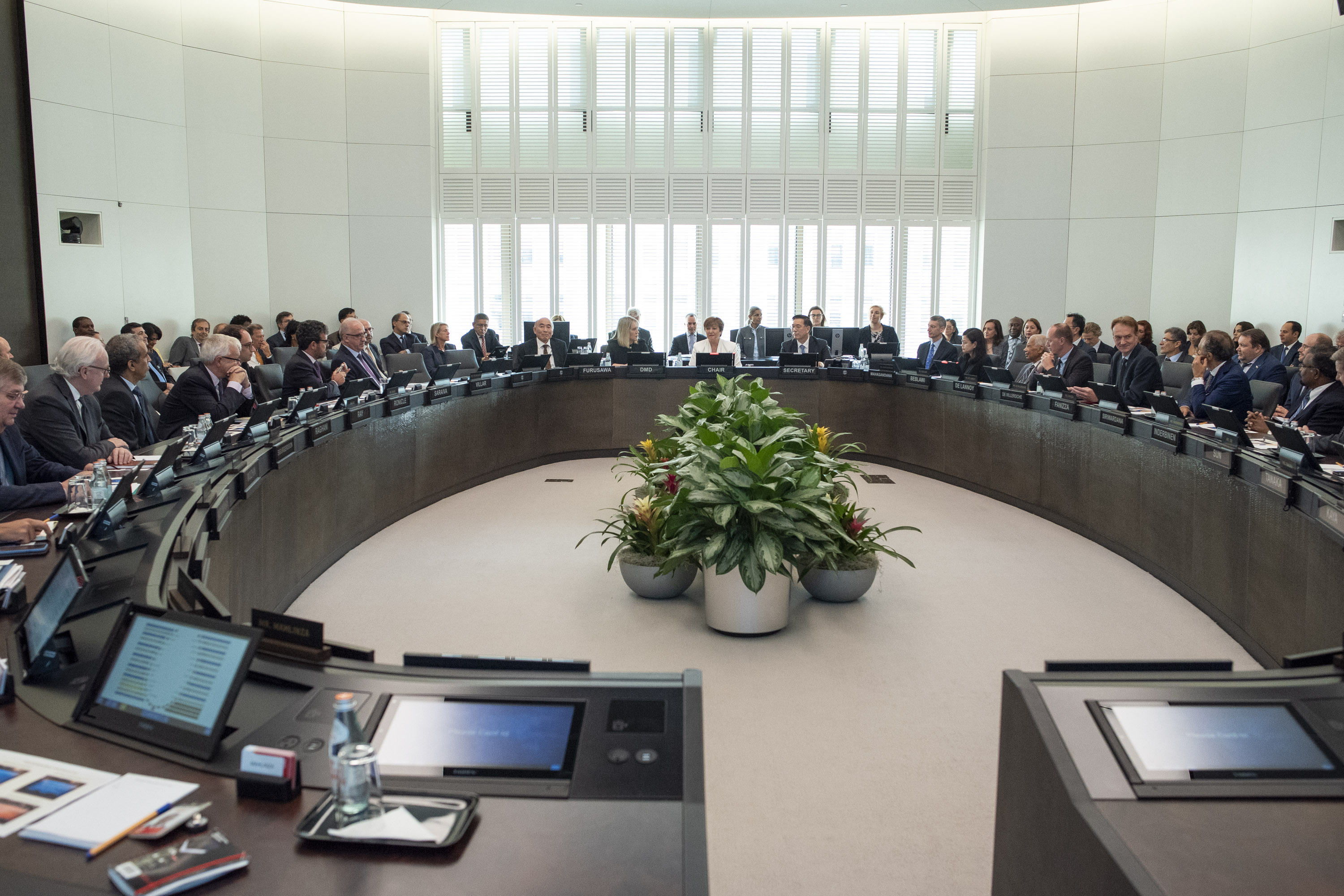
IMF Executive Board Approves the Extension of Increased Access Limits Under the Rapid Credit Facility and Rapid Financing Instrument
IMF News, October 5, 2020
Source details
- Canonical URL
- IMF Executive Board Approves the Extension of Increased Access Limits Under the Rapid Credit Facility and Rapid Financing Instrument
Other formats
Bibliographic details
- Published: October 5, 2020
Decision summary
- On September 28 the IMF Executive Board approved a six-month extension of the temporary increase in access limits under its emergency financing instruments, through April 6, 2021.
- Annual and cumulative access limits remain at 100 percent of quota and 150 percent of quota, respectively, through April 6, 2021.
- The extension applies to the regular window of the Rapid Financing Instrument (RFI) and the exogenous shocks window of the Rapid Credit Facility (RCF).
- The temporary suspension of the procedures for high access RCF requests was extended through April 6, 2021.
Background and rationale
- In April 2020 the IMF approved a temporary increase in access limits under the RFI (available to all members) and the RCF (available only to low-income countries eligible for concessional financing).
- The limits on annual access were raised from 50 to 100 percent of quota, and the limits on cumulative access were increased from 100 to 150 percent of quota, for the six-month period through October 5, 2020.
- The increases responded to urgent balance of payments needs resulting from the coronavirus pandemic.
Usage statistics as of August 31, 2020
- Sixty-nine members have received financial support through the Fund’s emergency financing instruments since the onset of the pandemic.
- Three-quarters of those members received support at the higher levels made possible by the increase in the access limits.
Executive Board assessment and views
- Directors welcomed the review of enhanced access limits under the Fund’s emergency financing instruments.
- There was broad agreement that the extension was justified to provide the Fund with flexibility to support urgent balance of payments needs in the context of persistent pandemic‑related economic disruptions.
- Many Directors emphasized the importance of implementing appropriate governance safeguards to mitigate the misuse of emergency financing, and welcomed staff’s guidance encouraging commitments related to audits and procurement.
- Most Directors underscored that it will be important for countries to increasingly seek financial assistance under Upper Credit Tranche Fund arrangements rather than emergency financing, in line with discussions of the Lending Strategy and as the immediate economic impact of the pandemic abates.
- Directors concurred that the temporary increase in access limits under emergency financing will be assessed as part of the wider review of the temporary changes in annual access limits in the GRA and PRGT introduced since the onset of pandemic, which is expected to be considered by the Executive Board by end‑December 2020.
- Some Directors also called for a review of cumulative access limits.
Procedural note
- At the conclusion of the discussion, the Managing Director, as Chairman of the Board, summarizes the views of Executive Directors, and this summary is transmitted to the country's authorities.
- An explanation of any qualifiers used in summings up can be found here:http://www.IMF.org/external/np/sec/misc/qualifiers.htm.
IMF Communications Department — Press Release No. 20/305, October 5, 2020