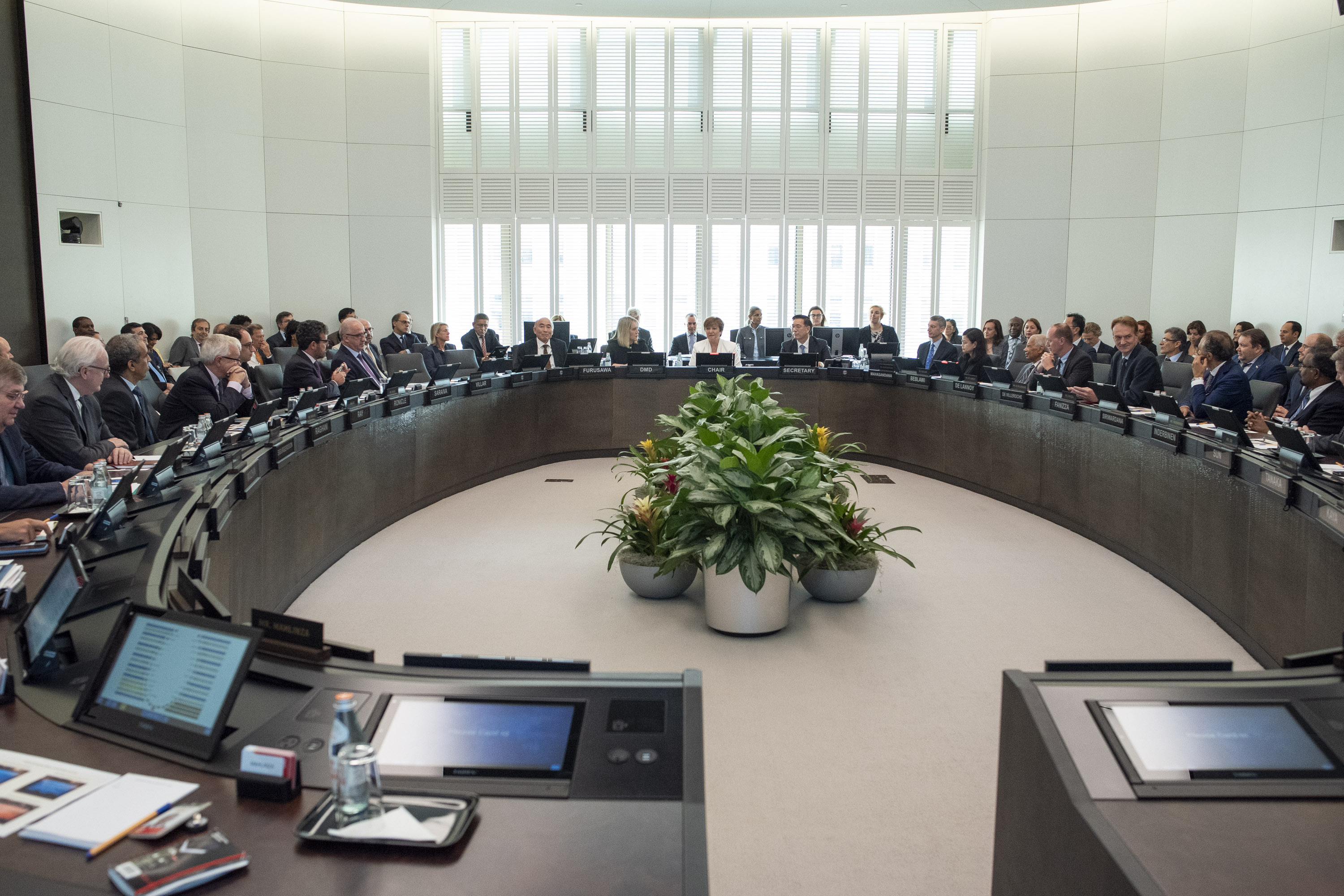
IMF Executive Board Discusses the Fund’s Strategy on Anti-Money Laundering and Combating the Financing of Terrorism
IMF News, December 5, 2023
Source details
- Canonical URL
- IMF Executive Board Discusses the Fund’s Strategy on Anti-Money Laundering and Combating the Financing of Terrorism
Other formats
Bibliographic details
- Published: December 5, 2023
Overview
- Event: Executive Board discussion of the staff report “Review of the Fund’s Strategy on Anti-Money Laundering and Combating the Financing of Terrorism (AML/CFT).”
- Date of discussion: November 20, 2023.
- Press Release No.: 23/415.
- Publication date of landing page: December 5, 2023.
- Media contact: PRESS OFFICER: Pavis Devahasadin; Phone: +1 202 623-7100; Email: MEDIA@IMF.org.
Staff report scope and analytical approach
- The report:
- Takes stock of implementation of the Fund’s AML/CFT program adopted in 2018.
- Identifies lessons learned.
- Proposes the way forward for the Fund’s AML/CFT strategy.
- Workstreams analyzed: surveillance, financial sector assessment programs (FSAPs), Fund-supported programs, AML/CFT assessments, and capacity development (CD).
- Emphasis on coordination: describes integration of AML/CFT across other Fund policies and close coordination with other stakeholders to leverage synergies and avoid duplication.
Key findings on coverage and methodological developments
- Since the 2018 review, coverage of financial integrity issues has increased across all workstreams.
- Staff enhanced its understanding of ML/TF risks and the macroeconomic impact of financial crimes using a wide range of quantitative and qualitative data.
- Surveillance and related conditionality in Fund-supported programs show increased coverage of AML/CFT issues.
- Staff provided input on AML/CFT in every FSAP, making use of flexibility in scope and depth.
- Regional, multi-country, and thematic CD projects increased, providing assistance to a broader range of countries with greater targeted flexibility.
- Staff participation in AML/CFT assessments by the FATF Global Network contributed to assessment efforts and to training assessors and assisting countries preparing for assessments.
Current assessment practice and policy
- Current policy: conduct one to two assessments per year.
- Actual delivery: policy has allowed staff to deliver one assessment per year given the length of these exercises.
- Staff increased participation in review of the quality and consistency of draft assessment reports prepared by other assessor bodies.
- Staff participated in an assessment led by a FATF-style regional body pursuant to the policy endorsed by the Board in 2020.
Executive Board assessment and guidance
- Directors’ general views:
- Stressed that addressing ML, TF, and proliferation financing risks is integral to the Fund’s mandate to support integrity and stability of the international financial system and member countries’ economies.
- Welcomed staff’s stocktaking and lessons learned.
- Agreed with continuing to enhance staff’s understanding of financial integrity risks and focus on assessing and mitigating negative macroeconomic impacts.
- Supported reliance on a multipronged approach and synergies across Fund workstreams.
- Surveillance:
- Directors supported staff putting greater focus on linkages between financial integrity issues and fiscal, financial sector, and structural priorities.
- Coverage to continue under current principles of engagement; deepen coverage in an evenhanded manner, commensurate with risks, mandatory when issues are macro-critical and voluntary when requested by the member.
- FSAPs:
- Directors concurred that mandatory coverage of AML/CFT issues with flexibility in scope and depth remains appropriate.
- Supported greater emphasis on the nexus between financial integrity and financial stability.
- Fund-supported programs:
- Directors agreed staff will continue to use its judgment in designing financial integrity and AML/CFT conditionality, aligned with program objectives and principles of criticality, parsimony, and avoiding cross conditionality.
- Noted importance of understanding political economy constraints and need for flexibility and technical support for members with capacity weaknesses; some Directors preferred tailored CD support.
- Capacity Development (CD):
- Directors welcomed CD activities and agreed staff should continue to provide comprehensive CD support with greater flexibility and deepen support for other Fund workstreams.
- Noted that better understanding of ML/TF risks will allow CD program development in line with evolving risks such as digital money, laundering of the proceeds of corruption, tax evasion, and environmental crimes.
- Reiterated need to coordinate with other technical assistance providers to maximize efforts and avoid duplication.
- External engagement:
- Directors supported deepening engagement with a broader range of external stakeholders, including international and regional organizations and civil society, and leveraging global and regional partnerships while focusing on the Fund’s comparative advantage.
Assessments, resourcing, and medium-term planning
- Directors highlighted the importance of continued engagement in AML/CFT assessments with a focus on quality and consistency.
- General support or openness to staff’s proposal to increase assessment-related work gradually:
- Proposed target from FY 2028 onward: deliver two Fund-led assessments and participate in one FSRB-led assessment per year.
- Any increase subject to: reallocation of resources to enable the increase and without prejudice to other core workstreams.
- Some Directors considered the current pace of assessments broadly adequate.
- Directors requested consideration of the proposal to increase assessments in the context of the medium term budget process.
Way forward and next review
- The paper proposes deeper integration of financial integrity issues into the Fund’s core functions with enhanced focus on AML/CFT issues that have macroeconomic impact.
- Directors agreed staff should continue to integrate financial integrity issues in other Fund policies.
- Timing of next review: expected to be completed within the next five years.
Source: IMF Executive Board Discusses the Fund’s Strategy on Anti-Money Laundering and Combating the Financing of Terrorism, Press Release No. 23/415 (December 5, 2023).