IMF Staff Statement
Dili, December 9-10, 2002
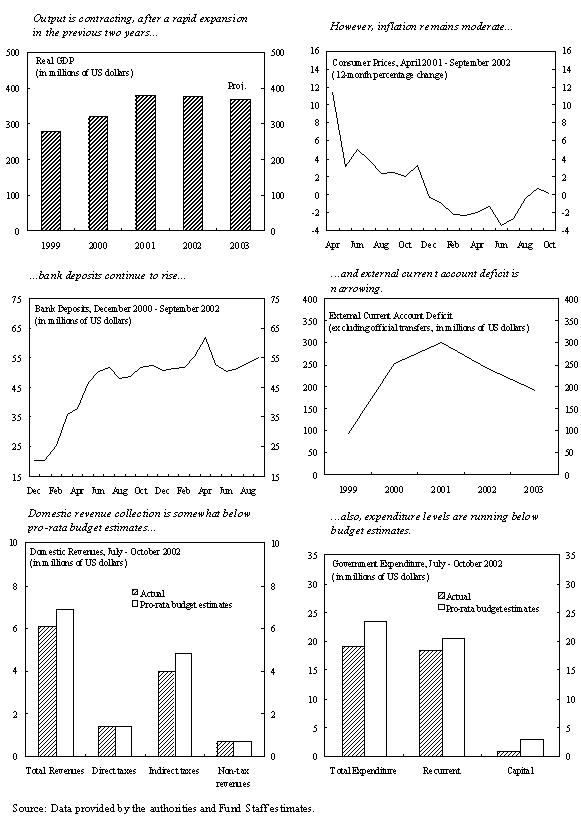
1. When we met here in Dili last May, Timor Leste (East Timor) was only days away from independence. Since then, historic steps have been taken in the process of nation-building, including securing the long-awaited independence and joining the global community of nations, in particular the UN and the Bretton Woods institutions. This occasion provides the first opportunity to look back on initial steps taken by the new nation over the last six months toward establishing the foundations of a stable and prosperous economy. Against this background, and building on the assessment we presented last May, this statement will update recent economic developments and address immediate policy issues facing the new government, as well as touch upon issues relating to institution and capacity building essential for sound economic management in the country.
I. Recent Developments
2. Economic activity has slowed down considerably since May, reflecting the winding-down of the international presence. Anecdotal information and available indicators suggest that the slowdown has been especially notable in the services and construction sectors. The impact of the reduced international presence has been exacerbated by weaker-than-expected public investment, largely due to a low level of CFET capital expenditure and a sluggish execution of bilateral donor projects owing partly to a delay in concluding new country agreements. Although agricultural production is estimated to expand further, aided by the increased availability of seeds and the restoration of farming equipment, real GDP is projected to contract by about 1 percent in 2002 (Table 1 and Figure 1).
3. Inflation remains modest, notwithstanding a pick-up in recent months. CPI inflation was limited to 0.2 percent in October (on a year-on-year basis), reflecting the improved availability of basic goods, and is projected at no more than 1 percent for the year. The labor market has shown signs of slackening, with reduced work hours, lay-offs, and gradual downward wage adjustments. Nonetheless, the overall wage level still remains relatively high in comparison with neighboring countries, constraining Timor Leste's external competitiveness.
4. As a result of successful public campaigns by the Banking and Payments Authority (BPA), backed by strong political support, dollarization has been largely completed. Progress has been made in implementing the BPA regulation toward fostering its financial and institutional autonomy. This includes the recent appointment of three East Timorese (subject to a review of their eligibility) as an initial step to fill the four vacant positions on the Governing Board. Bank deposits showed a steady recovery, after a temporary contraction in May-June. Nevertheless, financial intermediation remains limited; the bulk of bank deposits continue to be invested abroad, mainly due to the lack of viable domestic lending opportunities and an underdeveloped legal framework.
5. Budget execution (core budget) in the first four months of FY 2002/03 (fiscal year: July-June) was marked by lower-than-expected revenue collection and substantial underspending. The former reflected a low level of domestic revenues, especially indirect taxes which were adversely affected by lower-than-projected imports. The latter is attributable to a slow recruitment of civil servants, line ministries' unfamiliarity with the new procurement system, and a delay in the preparation of capital projects. Total pledges for budgetary support for FY 2002/03 made at the May 2002 Dili donors' meeting are now estimated at $29.3 million, of which financing agreements have been signed for about $22 million, with the remainder expected to be finalized early next year.
6. The financial position of the Power Authority (EDTL) remains a source of concern. Total collection of user fees during the first four months of FY2002/03 was less than half the official target. This outcome reflects limited managerial capacity, a dysfunctional billing system, and non-payment by many users. To address these problems, a decision was made by the government in October to place the Power Authority under external management.
II. Economic Outlook and Key Policy Issues
Economic growth and private sector development
7. Real GDP is projected to decline by about 2 percent in 2003, as the reduced international presence exerts its full impact on the economy. This outlook is subject to substantial downside risks. Agricultural production may be seriously affected if the current drought conditions persist. Also, investment may prove lower than projected, especially if the execution of public capital projects continues to be hampered by weak project planning and implementation and a further delay in resolving impediments to new country agreements for bilateral donor projects. Given this risk, it is important that efforts be stepped up to strengthen the government's capacity for executing capital projects and to conclude new country agreements as soon as possible.
8. A rapid increase in private investment is also critical for Timor Leste's growth prospects, especially to realize an acceleration of growth to 5 percent over the medium term, as envisaged in the National Development Plan. A key step to this end will be the swift development of a legal and regulatory framework for business activity. It is encouraging that progress has been made in preparation for key economic legislation, including the commercial code, the investment law, and a basic law for land ownership. Building on this, the authorities should move forward to secure their early parliamentary approval. Maintenance of a liberal business environment, underpinned by the free market mechanism, is also critical for private sector development. In this regard, the authorities are encouraged to refrain from introducing administrative measures, such as price controls and a minimum wage scheme, so as to allow prices and wages to adjust flexibly in response to changing market conditions.
Revised budget for FY2002/03
9. An immediate policy challenge for the authorities is the effective execution of the FY2002/03 budget to contain expenditures within available fiscal resources, while accelerating expenditure execution to ensure the provision of essential administrative and public services. The mid-year budget review conducted by the authorities aimed at addressing these issues, resulting in a revised budget for FY2002/03 which is to be submitted to parliament in mid-December.1
10. Under the revised budget, which merits strong support, total expenditure is to be reduced by $3.5 million (1 percent of GDP) in response to projected funding shortfalls; total revenue is estimated to be broadly in line with the original estimate, as projected shortfalls in domestic revenue are offset by higher oil/gas revenues (Table 2). The bulk of the funding shortfall is to be borne by supplementary budget expenditure, which is reduced from the original estimate of $7 million to $4 million (1.1 percent of GDP). About half of the revised estimate is accounted for by capital expenditure for the introduction of a pre-paid meter system in the power sector (see¶12).
11. The size of core budget expenditure is to be kept broadly unchanged at the original estimate. This requires a major improvement in budget execution during the remainder of the year, as recognized by the authorities. The composition of core budget expenditure, however, is to undergo some changes to accommodate an increase in current transfers to the Power Authority (see ¶12) and higher capital expenditures, all together estimated to total about $4 million (1.1 percent of GDP). About half of the increase is to be offset by underspending in salaries and wages during the first half of FY2002/03, and the remainder by cuts in expenditures on goods and services (excluding those relating to health and education). The bulk of these cuts will need to be identified at the time of a budget execution review scheduled for early 2003 in order to contain overall expenditure within the revised budget.
Power sector issues
12. The government's decision to introduce an external management contract marks a major step toward improvement in the financial position of the Power Authority. A key prerequisite for the success of a new management system is the installment of prepaid meters, which is indispensable for improving electricity bill collection. It will be critically important for the authorities to move forward expeditiously with the early implementation of this step. Despite the reform program, current transfers to the Power Authority in FY2002/03 (excluding capital expenditure mentioned in ¶10) are estimated to exceed the budget estimate by $2.5 million (0.7 percent of GDP), as a new management team is not expected to take over the Power Authority before mid-2003 at the earliest. In the interim, it is important for the Power Authority to step up efforts to improve revenue collection, while containing current expenditures (mainly fuel purchases) within the revised budget limit, so as to avoid a further deterioration in its financial position.
Medium-term fiscal outlook
13. The fiscal position over the next two years is expected to be tighter than earlier projected, reflecting recent revisions of oil/gas revenues and a less sanguine outlook of domestic revenues. The revised estimates of oil/gas revenues, which reflect changes in production schedules and operating costs, show that total revenues over the project's 20 year-life span will not differ substantially from earlier estimates. However, those available for budget financing over the next two years will be 8 percent lower than earlier projected, with the downward revision principally relating to FY2004/05. Domestic revenues are also expected to be lower than earlier projected, partly as a result of the revisions made for FY2002/03.
14. Under a tentative scenario, which assumes unchanged total expenditures from those presented at the Dili donors' meeting and a more cautious assessment of donor budget support, the total financing gap for FY2003/04-FY2004/05 is now projected to more than triple to $27 million (7.5 percent of GDP). This outlook suggests that the authorities need to find ways to narrow the financing gap, including through a downward adjustment of expenditures and other options, such as a review of the current saving policy for oil/gas revenues. These issues will have to be addressed in depth at the time of preparation for the FY2003/04 budget. We would like to note that any change in the current saving policy for oil/gas revenues should be made in tandem with the establishment of a petroleum fund on which technical assistance has recently been provided by the IMF.
III. Institution and capacity building
15. A further strengthening of institutions and local capacity remains an important prerequisite for East Timor's economic development. This is especially crucial for economic institutions, including the Ministry of Planning and Finance (MoPF), the BPA, and the Statistics Division of the MoPF. A major challenge for the MoPF is the early implementation of the medium-term capacity development program worked out with the assistance of a recent IMF/World Bank technical assistance mission. Major tasks will include the appointment of key personnel, organizational and functional changes, and the establishment of a fully functioning human resources management unit. With regard to the BPA, the early appointment of the remaining Board members remains essential for its development toward a full-fledged central bank. Improvement in the compilation of macroeconomic data is critical for effective monitoring of economic developments and the adoption of appropriate and timely policy measures. With a draft statistical law finalized for submission to the Council of Ministers, the authorities are encouraged to secure its parliamentary approval.
IV. Concluding remarks
16. With the support of the international community and the commitment of the Timor Leste government, progress has been made in fostering the conditions for economic growth and stability, but much remains to be done. A critical challenge for the authorities will be to maintain fiscal stability and promote an environment conducive to private sector development. Further strengthening the economic institutions and local capacity is another important task. The IMF will continue to support Timor Leste's efforts, especially through the continued provision of technical assistance, training, and policy advice.
1The annual budget law for FY 2002/03 set total expenditure at about $78 million, consisting of core ($71 million) and supplementary (up to $7 million) expenditures. However, because of uncertainty about the amount of donor assistance at the time of budget preparation, the budget law set out appropriations only for core budget expenditure, leaving the level and composition of supplementary budget expenditures to be finalized at the time of the mid-year budget review.
|
Table 1. Timor Leste: Selected Economic Indicators |
| |
1999 |
2000 |
2001 |
|
2002 |
2003 |
2004 |
2005 |
2006 |
| |
Est. |
|
Proj. |
| |
(In millions of U.S. dollars) |
|
GNP (at current prices) |
270 |
326 |
402 |
|
391 |
374 |
427 |
457 |
481 |
|
GDP |
270 |
321 |
389 |
|
369 |
345 |
357 |
381 |
414 |
|
Oil income |
0 |
5 |
13 |
|
22 |
30 |
70 |
76 |
67 |
| |
|
|
|
|
|
|
|
|
|
| |
(Annual percentage change) |
| |
|
|
|
|
|
|
|
|
|
|
GNP growth (at constant prices) |
-35.4 |
17.3 |
21.1 |
|
1.3 |
1.1 |
16.7 |
4.4 |
1.8 |
|
GDP |
-35.4 |
15.4 |
18.3 |
|
-1.2 |
-2.3 |
1.3 |
3.2 |
5.0 |
|
Oil income |
... |
... |
198.4 |
|
61.9 |
51.4 |
166.2 |
8.6 |
-9.3 |
| |
|
|
|
|
|
|
|
|
|
|
Inflation1 |
140 |
3 |
-0 |
|
1 |
2 |
2 |
3 |
3 |
| |
|
|
|
|
|
|
|
|
|
| |
(In percent of GDP) |
|
Investment-saving balance |
|
|
|
|
|
|
|
|
|
|
Gross investment |
21 |
29 |
25 |
|
21 |
20 |
19 |
18 |
17 |
|
Gross domestic savings |
-13 |
-50 |
-49 |
|
-39 |
-29 |
-12 |
-8 |
-8 |
|
External savings |
34 |
79 |
74 |
|
61 |
48 |
30 |
25 |
25 |
| |
|
|
|
|
|
|
|
|
|
|
Money and credits |
|
|
|
|
|
|
|
|
|
|
Broad money |
48 |
... |
... |
|
... |
... |
... |
... |
... |
|
Currency |
9 |
... |
... |
|
... |
... |
... |
... |
... |
|
Bank deposits2 |
38 |
6 |
13 |
|
15 |
... |
... |
... |
... |
|
Net domestic assets2 |
47 |
-4 |
-4 |
|
-7 |
... |
... |
... |
... |
| |
|
|
|
|
|
|
|
|
|
| |
(In millions of U.S. dollars) |
|
External sector |
|
|
|
|
|
|
|
|
|
|
Current account excl. official transfers |
-92 |
-255 |
-299 |
|
-233 |
-192 |
-156 |
-152 |
-135 |
|
Current account incl. official transfers |
6 |
53 |
-6 |
|
-59 |
-42 |
-26 |
-43 |
-45 |
|
Trade balance |
-67 |
-200 |
-234 |
|
-165 |
-137 |
-136 |
-136 |
-137 |
|
Merchandise exports3 4 |
52 |
5 |
4 |
|
5 |
6 |
7 |
8 |
9 |
|
Merchandise imports3 |
-119 |
-205 |
-238 |
|
-170 |
-143 |
-143 |
-144 |
-146 |
|
Overall balance |
0 |
16 |
8 |
|
-8 |
-1 |
22 |
7 |
12 |
|
Change in net foreign assets (increase -) |
0 |
-16 |
-8 |
|
8 |
-4 |
9 |
-3 |
12 |
|
Financing gap |
0 |
0 |
-0 |
|
-0 |
3 |
13 |
11 |
0 |
| |
|
|
|
|
|
|
|
|
|
| |
(In percent of GDP) |
| |
|
|
|
|
|
|
|
|
|
|
Current account excl. official transfers |
-34 |
-79 |
-77 |
|
-63 |
-56 |
-44 |
-40 |
-33 |
|
Current account incl. official transfers |
2 |
16 |
-2 |
|
-16 |
-12 |
-7 |
-11 |
-11 |
|
Trade balance |
-25 |
-62 |
-60 |
|
-45 |
-40 |
-38 |
-36 |
-33 |
|
Overall balance |
0 |
5 |
2 |
|
-2 |
-0 |
6 |
2 |
3 |
|
Change in net foreign assets (increase -) |
0 |
-5 |
-2 |
|
2 |
-1 |
2 |
-1 |
3 |
|
Financing gap |
0 |
0 |
-0 |
|
-0 |
1 |
4 |
3 |
0 |
|
|
|
|
|
|
|
|
|
|
|
Sources: Data provided by the Timor Leste authorities; and IMF staff estimates. |
1Rupiah-based CPI for Dili through 2000 and, thereafter, U.S. dollar-based CPI for Dili.
2Figures for 2002 refer to end-September.
3Figures after 2000 excude unrecorded border trade.
4Excludes oil/gas revenues, which are recorded under the income account (royalties) and transfers (tax revenues). |
|
Table 2. Timor Leste: Fiscal Accounts of the Consolidated Fund for East Timor (CFET)1 |
| |
|
|
|
|
|
|
|
|
|
|
|
|
|
|
| |
FY2001/02 |
|
FY2002/03 |
|
FY2003/04 |
|
FY2004/05 |
|
FY2005/06 |
| |
Budget |
Revised |
|
Budget |
Revised |
|
Budget2 |
Revised3 |
|
Budget2 |
Revised3 |
|
Budget2 |
Revised3 |
| |
|
|
|
|
|
|
|
|
|
|
|
|
|
|
| |
(In millions of U.S. dollars) |
| |
|
|
|
|
|
|
|
|
|
|
|
|
|
|
|
Revenue |
31.0 |
31.3 |
|
42.6 |
42.3 |
|
53.4 |
67.0 |
|
98.8 |
79.7 |
|
101.9 |
85.8 |
|
Domestic revenue |
19.0 |
20.5 |
|
20.8 |
17.5 |
|
20.1 |
17.5 |
|
21.3 |
18.5 |
|
22.9 |
19.7 |
|
Direct taxes |
2.0 |
5.4 |
|
4.3 |
4.0 |
|
4.3 |
4.0 |
|
4.6 |
4.2 |
|
5.0 |
4.6 |
|
Indirect taxes |
15.0 |
12.7 |
|
14.3 |
11.5 |
|
13.7 |
11.6 |
|
14.5 |
12.2 |
|
15.3 |
12.9 |
|
Non tax revenue |
2.0 |
2.4 |
|
2.2 |
2.0 |
|
2.1 |
2.0 |
|
2.2 |
2.1 |
|
2.6 |
2.2 |
|
Timor Sea revenue4 |
12.0 |
10.8 |
|
21.8 |
24.8 |
|
33.3 |
49.5 |
|
77.5 |
61.3 |
|
79.0 |
66.1 |
|
Tax revenues |
6.0 |
6.5 |
|
20.5 |
23.8 |
|
26.1 |
36.2 |
|
52.2 |
35.5 |
|
54.1 |
38.2 |
|
Royalties and interest4 5 |
6.0 |
4.3 |
|
1.3 |
1.0 |
|
7.2 |
13.3 |
|
25.3 |
25.8 |
|
24.9 |
27.9 |
| |
|
|
|
|
|
|
|
|
|
|
|
|
|
|
|
Expenditure |
65.0 |
53.1 |
|
77.7 |
74.2 |
|
83.1 |
83.1 |
|
96.6 |
96.6 |
|
101.4 |
101.4 |
|
Core budget |
... |
... |
|
70.6 |
70.2 |
|
... |
... |
|
... |
... |
|
... |
... |
|
Recurrent expenditure |
53.5 |
41.5 |
|
61.6 |
59.9 |
|
68.2 |
68.2 |
|
71.3 |
71.3 |
|
71.8 |
71.8 |
|
Wages and salaries |
22.4 |
18.9 |
|
26.0 |
23.9 |
|
28.0 |
28.0 |
|
28.9 |
28.9 |
|
29.5 |
29.5 |
| Goods and services |
31.1 |
22.6 |
|
35.6 |
36.0 |
|
40.3 |
40.3 |
|
42.4 |
42.4 |
|
42.3 |
42.3 |
| Capital expenditure |
11.5 |
11.6 |
|
9.0 |
10.3 |
|
14.9 |
14.9 |
|
25.3 |
25.3 |
|
29.6 |
29.6 |
|
Supplementary budget |
... |
... |
|
7.1 |
4.0 |
|
... |
... |
|
... |
... |
|
... |
... |
| |
|
|
|
|
|
|
|
|
|
|
|
|
|
|
|
Overall balance |
-34.0 |
-21.8 |
|
-35.1 |
-31.9 |
|
-29.7 |
-16.1 |
|
2.2 |
-16.9 |
|
0.5 |
-15.6 |
| |
|
|
|
|
|
|
|
|
|
|
|
|
|
|
|
Financing |
34.0 |
21.8 |
|
3.8 |
31.9 |
|
19.1 |
10.6 |
|
0.1 |
-4.4 |
|
-0.5 |
15.6 |
|
Donor support (grants) |
33.9 |
22.7 |
|
0.0 |
30.9 |
|
26.3 |
23.9 |
|
25.4 |
21.4 |
|
0.0 |
0.0 |
|
Pledges made at the Dili meeting6 |
... |
... |
|
... |
29.3 |
|
26.3 |
21.3 |
|
25.4 |
18.6 |
|
... |
... |
|
Other7 |
... |
... |
|
... |
1.5 |
|
0.0 |
2.6 |
|
0.0 |
2.8 |
|
... |
... |
|
Change in CFET balances (increase -) |
6.1 |
3.3 |
|
5.1 |
2.0 |
|
0.0 |
0.0 |
|
0.0 |
0.0 |
|
0.0 |
0.0 |
|
Timor Sea savings (savings -)4 |
-6.0 |
-4.3 |
|
-1.3 |
-1.0 |
|
-7.2 |
-13.3 |
|
-25.3 |
-25.8 |
|
-0.5 |
15.6 |
|
Financing gap |
-0.0 |
0.0 |
|
31.3 |
0.0 |
|
10.6 |
5.5 |
|
-2.3 |
21.3 |
|
0.0 |
0.0 |
| |
|
|
|
|
|
|
|
|
|
|
|
|
|
|
| |
(In percent of GDP) |
| |
|
|
|
|
|
|
|
|
|
|
|
|
|
|
|
Revenue |
8.2 |
8.2 |
|
11.9 |
11.8 |
|
15.2 |
19.1 |
|
26.7 |
21.6 |
|
25.5 |
21.4 |
|
Domestic revenue |
5.0 |
5.4 |
|
5.8 |
4.9 |
|
5.7 |
5.0 |
|
5.8 |
5.0 |
|
5.7 |
4.9 |
|
Timor Sea Revenue |
3.2 |
2.8 |
|
6.1 |
6.9 |
|
9.5 |
14.1 |
|
20.9 |
16.6 |
|
19.7 |
16.5 |
|
O/w: Tax revenues |
1.6 |
1.7 |
|
5.7 |
6.7 |
|
7.4 |
10.3 |
|
14.1 |
9.6 |
|
13.5 |
9.5 |
|
Expenditure |
17.1 |
14.0 |
|
21.7 |
20.7 |
|
23.7 |
23.7 |
|
26.1 |
26.1 |
|
25.4 |
25.4 |
|
Recurrent expenditure |
14.1 |
10.9 |
|
17.2 |
16.7 |
|
19.4 |
19.4 |
|
19.3 |
19.3 |
|
18.0 |
18.0 |
|
Capital expenditure8 |
3.0 |
3.0 |
|
4.5 |
4.0 |
|
4.2 |
4.2 |
|
6.9 |
6.9 |
|
7.4 |
7.4 |
|
Overall balance |
-8.9 |
-5.7 |
|
-9.8 |
-8.9 |
|
-8.5 |
-4.6 |
|
0.6 |
-4.6 |
|
0.1 |
-3.9 |
|
Financing |
9.0 |
5.7 |
|
1.1 |
8.9 |
|
5.4 |
3.0 |
|
0.0 |
-1.2 |
|
-0.1 |
3.9 |
|
Financing gap |
-0.0 |
0.0 |
|
8.8 |
0.0 |
|
3.0 |
1.6 |
|
-0.6 |
5.8 |
|
0.0 |
0.0 |
| |
|
|
|
|
|
|
|
|
|
|
|
|
|
|
| |
(In millions of U.S. dollars) |
|
Memorandum items: |
|
CFET balances (end of period) |
2.1 |
5.8 |
|
0.7 |
3.8 |
|
3.0 |
3.9 |
|
3.0 |
3.9 |
|
3.0 |
3.9 |
|
Timor Sea Account (end of period) |
9.1 |
7.4 |
|
8.7 |
8.4 |
|
17.8 |
21.7 |
|
43.1 |
47.5 |
|
43.4 |
32.2 |
|
Appropriations for the Power Authority |
6.8 |
6.8 |
|
4.0 |
8.4 |
|
3.0 |
3.0 |
|
2.6 |
2.6 |
|
0.0 |
0.0 |
|
|
|
|
|
|
|
|
|
|
|
|
|
|
|
Source: Data provided by the Timor Leste authorities; and Fund staff estimates and calculations.
1Fiscal year: July-June.
2Budget estimates represent those made in connection with budget preparation for FY02/03, presented at the May 2002 Dili donors' meeting.
3The revised projections are tentative, based on the assumption that expenditures remain unchanged at the May 2002 Dili projections; their full revisions will be made in connection with budget preparation for FY03/04. These projections differ from those presented in the mid-year budget update which incorporate reductions mainly relating to EC-funded health sector expenditures.
4Under the current policy, royalties (first tranche petroleum revenues) and interest income are automatically saved in the Timor Sea account until FY04/05, and only tax revenues are available for budget financing.
5Figures for FY02/03-05/06 include 40 percent of roylaties to be transferred to Timor Leste following the ratification of the Timor Sea Treaty.
6The budget estimates refer to pledges made at the May 2002 Dili donors' meeting, while the revised estimates represent those anticipated to be realized.
7The revised estimates for FY03/04 -FY04/05 refer to EC assistance (non-budgetary) for health sector projects. The assistance is included in the CFET budget for presentational convenience, as expenditures on these projects constituted part of the original CFET budget.
8The figures for FY02/03 include supplementary budget expenditure. |
|





