




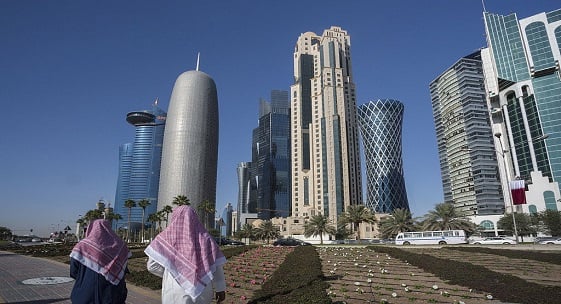
Two men walk by the West Bay Skyline in Doha, Qatar. Oil-exporting countries in the region should continue with economic diversification plans, says the IMF (photo: JTB Photo/UIG via Getty Images)
For Middle East and North Africa Region, Reforms Can Refuel Growth Engines
May 2, 2017
Growth is slightly improving in the countries of the Middle East and North Africa region, largely driven by higher oil prices and improved export prospects, says the IMF's latest regional economic assessment.
But civil conflict and high unemployment continue to weigh on the region’s outlook.
The IMF’s Regional Economic Outlook for the Middle East and Central Asia, released on May 2 in Dubai, emphasizes that countries will need to continue with plans to diversify their economies and implement policies that support jobs and productivity, like education and infrastructure reforms.
“This more favorable global environment, together with some firming of commodity prices, is providing some welcome breathing space for the region after what has been a difficult period,” said IMF Middle East and Central Asia Department Director Jihad Azour at the report’s launch in Dubai.
“However, our projections indicate that growth will be too low to create enough jobs or improve living standards. Many countries—especially oil importers—are also carrying high levels of debt.” Both oil exporters and importers are therefore “facing two critical policy imperatives: fiscal consolidation and structural reforms,” he emphasized.
Growth is picking up
Headline growth rates for the region’s oil importers are projected to increase from 3.7 percent (see table) in 2016 to 4 percent in 2017—thanks in large part to policies that have reduced fiscal deficits and improved the business climate, as in Morocco and Pakistan. In the region’s oil exporters, non-oil growth is projected to accelerate as well from 0.4 percent in 2016 to 2.9 percent in 2017, although production cuts following the OPEC+ agreement will temporarily reduce overall growth.
The expected increase in growth for the region’s oil-importing countries will not be enough to make a serious dent in the region’s high unemployment rate—at about 12%. For the region’s oil-exporting countries, policy adjustments, such as reductions in public spending, will continue to constrain economic activity. Conflicts are also likely to continue to weigh on the region.

Deficits improving
Even though fiscal deficits narrowed in oil exporters, deficit-reduction efforts need to continue, building on the progress already achieved in reducing spending, like in Algeria and Saudi Arabia. According to the report, fiscal deficits are expected to decrease from 10 percent of GDP in 2016 to less than 1 percent in 2022, a significant improvement which will help build resilience.
Fiscal positions have also improved for oil importers. For the broader region, average fiscal deficit fell from 9 ¼ percent of GDP in 2013 to about 7 percent of GDP in 2016, thanks in large part to reduced fuel subsidies (Egypt, Morocco, Sudan) and efforts to increase revenue and strengthen tax collection (Pakistan).
But, public debt remains high, with some oil-importing countries’ debt-to-GDP ratio exceeding 90 percent. Debt servicing costs (which are particularly high in Egypt, Lebanon, and Pakistan) are likely to increase in line with anticipated higher global interest rates. High debt levels also deter investors and add to financial stability risks.
Higher debt servicing costs will put further pressure on fiscal positions, reducing the scope for public spending—like on infrastructure and education—to support growth. Continued fiscal adjustment is needed, supported by efforts to strengthen tax revenue by broadening the tax base, and complete subsidy reforms.
Implement reforms to jumpstart job creation
The region’s oil exporting economies need to continue diversifying away from hydrocarbons into non-oil sectors to ensure consistent and sustainable growth. The United Arab Emirates and Saudi Arabia’s strategic visions show a strong commitment toward diversifying investments and finding new revenue engines. These plans would need to be complemented by policies to boost the role of the private sector—like the recently opened Kuwait Business Center—and to attract more foreign investment.
For oil importers, growth rates are still too low to reduce unemployment. And with little room for spending, governments are constrained. To promote private sector activity and boost jobs, governments can provide education and training opportunities, increase female labor force participation (such as through gender budgeting in Morocco) and upgrade investor protection regulations, as in Jordan and Mauritania.
Cost of conflict
Ongoing regional conflicts—which have led to a large number of refugees and internally displaced people—continue to exact not only a high humanitarian cost, but also significant economic consequences, both for countries directly impacted by conflict and their neighbors.
“We know that conflicts remain a serious concern for countries in the Middle East and North Africa region; it’s a concern that we share at the IMF,” Azour said.
Together with other international partners, the IMF is helping countries affected by conflict to cope with the immediate adverse economic consequences, and stands ready to support rebuilding efforts once the conflicts ease. For example, the Fund is providing extensive technical assistance in Somalia and has extended financial support to Afghanistan and Iraq.
“Improving the humanitarian and economic situation in the parts of the region affected by conflicts is not the merely the responsibility of the countries themselves; it is a global imperative,” he emphasized.