




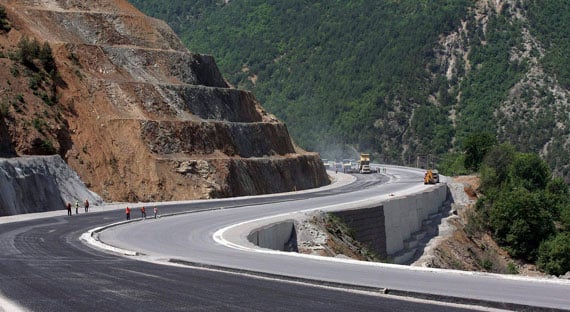
Roadwork in Albania. Improvements of transportation, energy, and telecommunications networks could speed up the catching up of the Western Balkans with the European Union (photo: Arben Celi/Reuters/Newscom)
Public Infrastructure in the Western Balkans: A Highway to Higher Income
February 8, 2018
Western Balkan countries (Albania, Bosnia and Herzegovina, Kosovo, Former Yugoslav Republic of Macedonia, Montenegro, and Serbia) have underdeveloped transport, power, and telecoms networks, compared with the European Union (EU) average. Closing the public infrastructure gap will help the region catch up with Western European living standards. But where will the money come from? Increased financing will be needed both from domestic and foreign sources. Better planning and implementation of public investment projects is also a must, a recent report says.
Related Links
Income convergence toward EU levels has slowed significantly in the Western Balkans since the global financial crisis. The region’s economic development is progressing slowly. If the countries are to close the gap in living standards with the EU, they will need to find a way to re-energize economic growth.
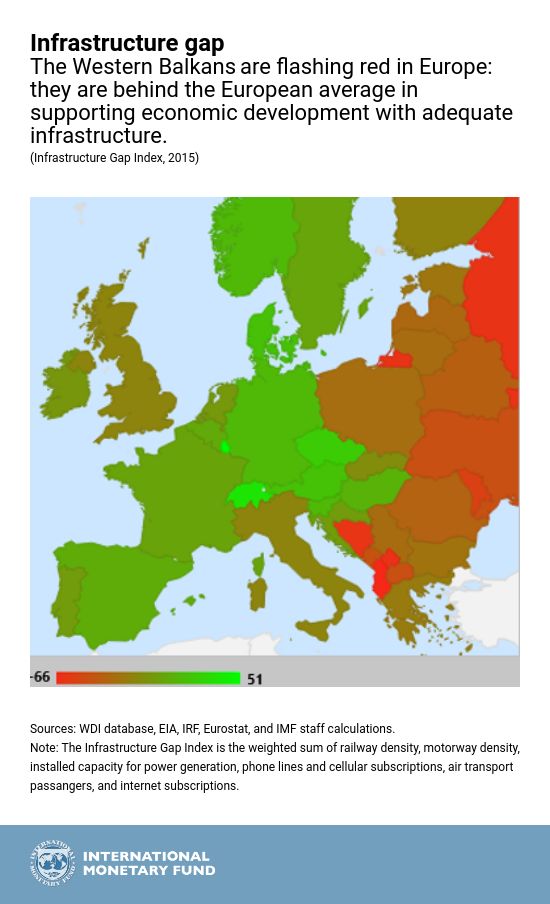
The IMF has identified the region’s missing core public infrastructure as a significant obstacle for higher economic growth. Better transportation, energy, and telecommunications networks would help Western Balkan countries raise productivity, integrate deeper into the bloodstream of global trade, and improve the region’s attractiveness for foreign investment. The analysis shows that a regionally coordinated public infrastructure push, coupled with better management of actual projects, could significantly increase per capita income. The long-term gain of real GDP per person could be as high as a 3-4 percentage points.
But catching up with the EU in infrastructure levels is hard: public investments require ample budget resources and strong institutional frameworks governing the selection, execution, and monitoring of projects. These two conditions are largely missing in the Western Balkans. Most countries in the region already have high levels of public debt, and some also have high budget deficits. The difficulty of tapping international capital markets constrains liquidity. Management of public investment is also weak.
Despite the obstacles, the potential gains of improving infrastructure clearly point to the need for Western Balkan countries to invest in modernizing their transport arteries and energy and telecom infrastructure. The IMF recommends the following actions:
- “Investing in investing”: bolstering the capacity to plan, select, and carry out infrastructure projects would ensure that available resources are put to better use and would improve the region’s ability to absorb available donor financing. Importantly, infrastructure projects should not fall victim to politicization. Countries can avoid that by establishing public investment schedules based on concrete, quantifiable goals and transparent assessment methodologies.
- Many infrastructure networks stretch over borders. For this reason, better regional coordination of investment projects will be essential.
- Countries should consider saving on their recurring expenses to find resources for costly projects. Governments could create further room for maneuver by broadening their tax base (by eliminating exemptions and tax incentives) and strengthening tax compliance, both of which result in more revenues collected.
- External financing should play a larger role in public infrastructure development in the Western Balkans, leaving domestic financial resources to serve the needs of the private sector. Official donor, multilateral and bilateral financing on concessional terms will have to play a dominant role, especially in countries with high public debt.
- Last but not least, countries should not endanger their overall macroeconomic stability by overambitious or poorly executed public infrastructure projects. Trade-offs between economic growth, inflation, and external current account deficits should be a key element of any policy discussion on scaling up public infrastructure in the region.