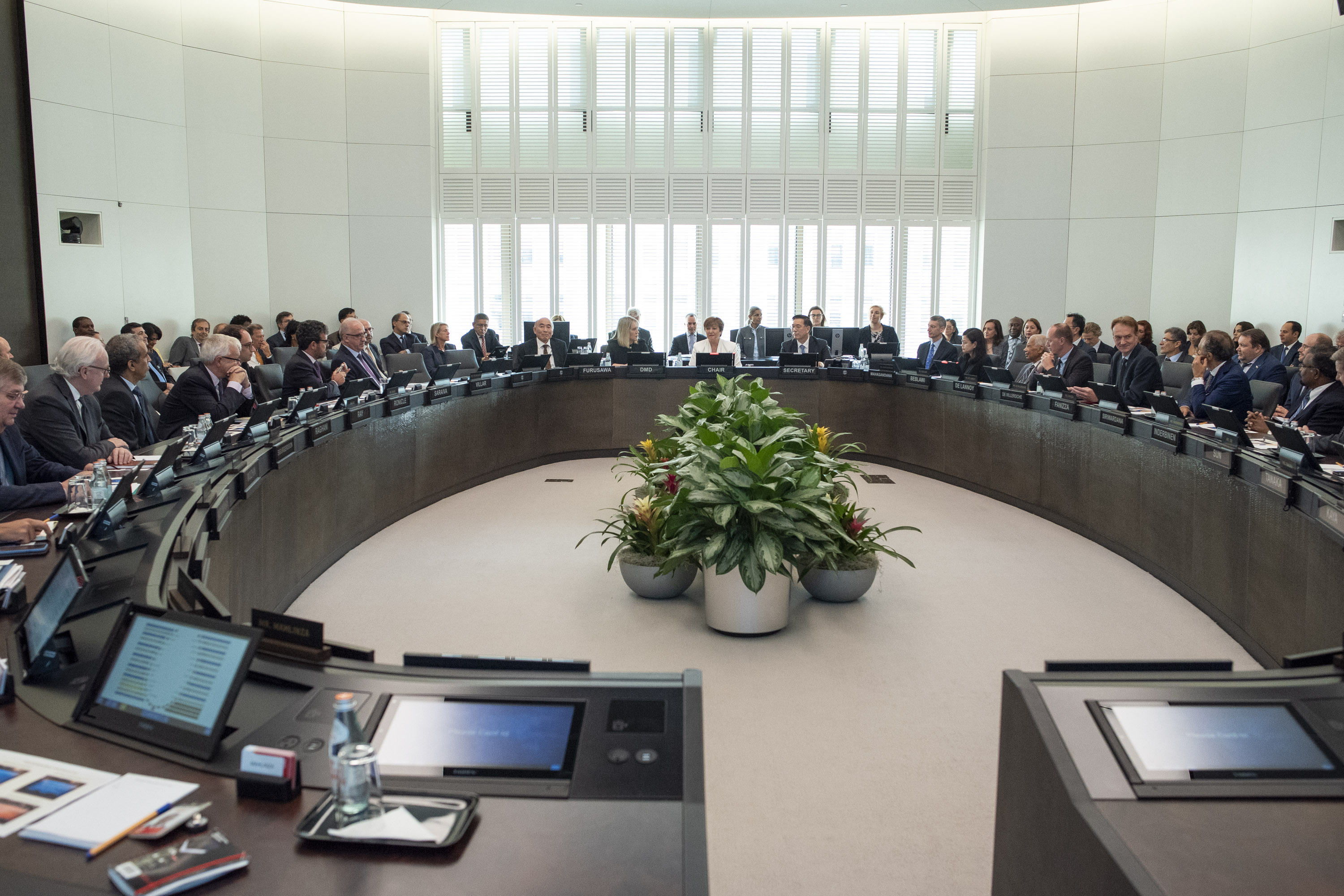
IMF Executive Board Discusses a Strategy to Help Members Address Climate Change-Related Policy Challenges
IMF News, July 30, 2021
Source details
- Canonical URL
- IMF Executive Board Discusses a Strategy to Help Members Address Climate Change-Related Policy Challenges
Other formats
Bibliographic details
- Published: July 30, 2021
Background and purpose
- Press Release No. 21/238; July 30, 2021.
- On July 16, 2021, the Executive Board discussed a paper proposing a strategy to help members address climate change-related policy challenges.
- The paper highlights macro-critical climate-related policy challenges that will confront all IMF members in the coming years and decades, including impacts on productivity, growth, fiscal positions, debt trajectories, asset valuations, financial stability, income redistribution, trade patterns, and exchange rate valuations.
- The paper argues the IMF needs to assist members in addressing these challenges and can play a role in facilitating policy coordination between countries to mitigate climate change.
Stocktake of IMF engagement to date
- The Fund has stepped up engagement on climate significantly in recent years, reflecting member demand.
- Engagement has emphasized policy papers and flagship reports, accompanied by some discussion of climate change-related policy challenges in bilateral country reports.
- The paper calls for a systematic and strategic integration of macro-critical aspects of climate change into the IMF’s core activities.
Proposed scope and coverage
- Comprehensive coverage of climate change-related policy challenges in Article IV consultations, aiming at discussing such challenges with all members every 5-6 years.
- More frequent Article IV coverage for the largest emitters of greenhouse gases and countries particularly vulnerable to climate change.
- Expanded coverage of climate risk in all Financial Sector Assessment Programs (FSAPs) where climate may pose financial stability risks.
- Substantial scaling up of climate-related capacity development (CD) activity in line with member demand.
- Continued cooperation and partnership with other institutions to leverage complementarities.
Executive Board assessment — key messages from Directors
- Directors concurred that climate change is a global existential threat posing critical macroeconomic and financial policy challenges for the whole Fund membership in the coming years and decades.
- Directors broadly agreed the Fund has an important role, within its mandate, in supporting members through surveillance (when macro-critical) and through CD activities.
- Article IV consultations:
- Supported more comprehensive coverage where macro-critical.
- Agreed that coverage of climate change mitigation in Article IV consultations would be strongly encouraged for the largest emitters of greenhouse gases; some Directors stressed this means such coverage would be voluntary.
- Supported regular coverage of adaptation and resilience building policies for the most vulnerable countries, including options to attract climate financing.
- Saw a need to cover management of transition risks, including for fossil fuel exporters, while taking into account each country’s circumstances.
- FSAPs:
- Agreed FSAPs should have a climate component where climate change may pose financial stability risks, to assess pressure points from physical shocks and transition to a low-carbon economy.
- A few Directors emphasized alignment of this climate component with standards being developed by relevant international standard-setting bodies for consistent policy advice.
- Capacity development and conditionality:
- Supported expanding climate-related CD efforts given rising member demand.
- Generally supported complementing Fund CD resources with donor-funded activities.
- A number of Directors noted the Fund could consider using program conditionality to support borrowing countries to increase resilience to climate change shocks and ensure macroeconomic sustainability, provided conditionality is in line with the Fund’s lending mandate and policies.
- A few Directors cautioned against using climate-related conditionality.
- Analytical work, data, and tools:
- Policy papers and multilateral surveillance reports should remain critical outlets for disseminating analytical and policy work on climate, especially for multilateral topics requiring policy coordination (e.g., mitigation policies or climate financing).
- Directors underscored that reliable climate data are a critical foundation for macro-climate analysis and encouraged further work in this area.
- Directors stressed the importance of developing models and standardized toolkits to support multilateral and bilateral surveillance, while being mindful of potential limitations due to specific country circumstances.
- Partnerships and institutional coordination:
- Stressed importance of partnering with other institutions, including the World Bank Group, and called for a more systematic approach to collaboration to leverage expertise, minimize overlap, and maximize value for the membership.
- Institutional organization and credibility:
- Took note of the proposal for gradually adding 95 Full-Time Equivalents to implement the proposed climate strategy.
- Directors looked forward to assessing this, together with other funding requests, during discussion of the Fund’s overall budget.
- Generally agreed some internal re-organization would be needed to facilitate efficient delivery, including establishing climate hubs in functional departments and reinforcing area departments as necessary.
- A few Directors stressed that greening the Fund’s own operations and reducing its carbon footprint will be key for the institution’s credibility.
Implementation priorities and estimated costs
- The paper proposes:
- Systematic integration of macro-critical climate issues into Article IV consultations with a cadence of every 5-6 years for all members and more frequent engagement for largest emitters and vulnerable countries.
- Expanding FSAP climate coverage and scaling up climate-related CD in line with demand.
- Leveraging partnerships with other institutions to complement IMF work.
- The paper also estimates the cost of implementing the strategy and proposes staffing increases (95 Full-Time Equivalents) to support gradual implementation; Directors will assess these proposals alongside other budget requests.
Italicized summary transmitted at the conclusion of the Board discussion by the Managing Director, Chairman of the Board.