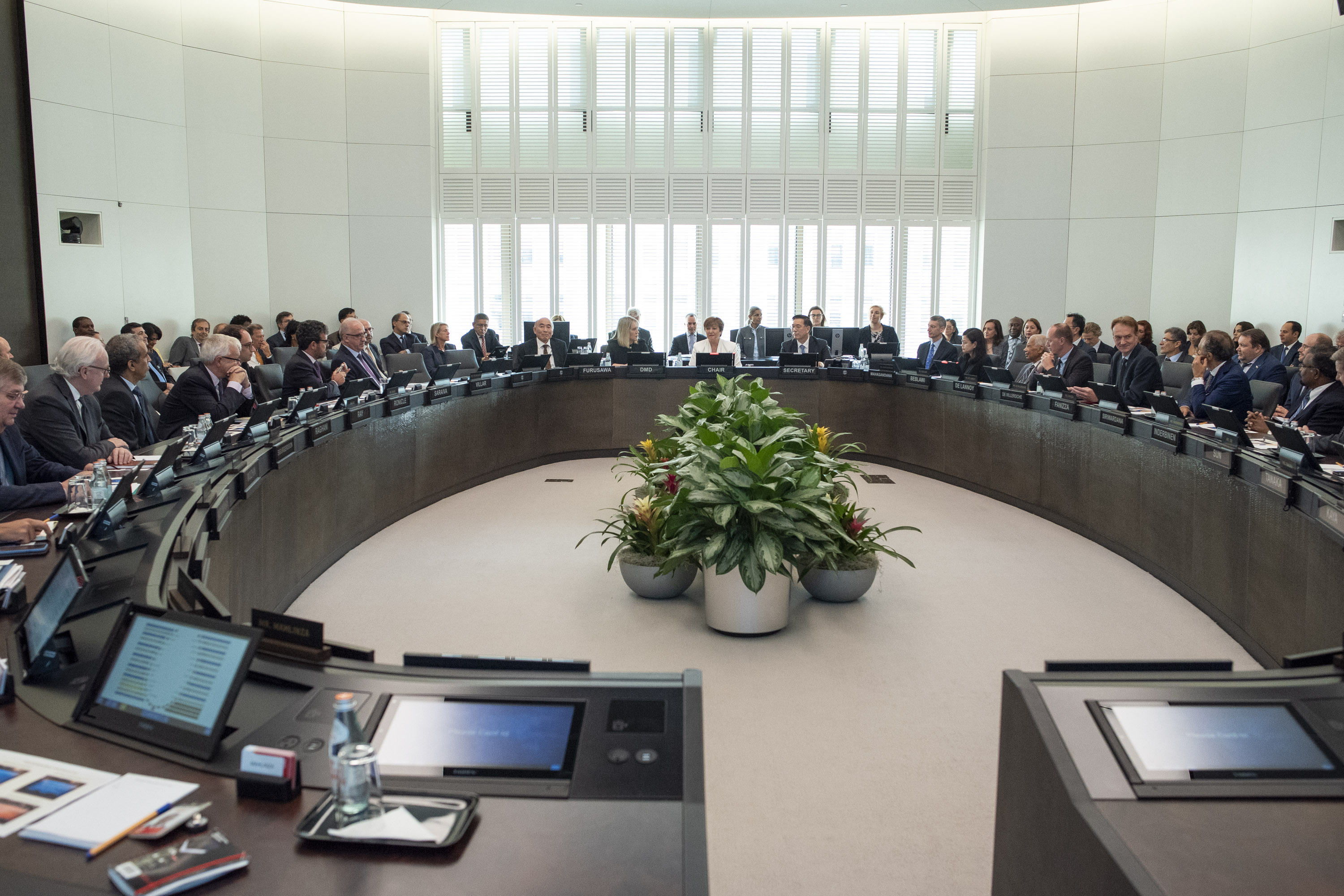
IMF Executive Board Concludes the 2023 Article IV Consultation with the Republic of Kazakhstan
IMF News, February 7, 2024
Source details
- Canonical URL
- IMF Executive Board Concludes the 2023 Article IV Consultation with the Republic of Kazakhstan
Other formats
Bibliographic details
- Published: February 7, 2024
Outlook and Macroeconomic Assessment
- The Executive Board concluded the 2023 Article IV consultation with the Republic of Kazakhstan.
- 2024 growth forecast: "Kazakhstan’s economic growth is expected to slow to 3.1 percent" in 2024, mostly due to delays in expanding the Tengiz oil field.
- Inflation: "inflation, which is still well above the authorities’ target, would continue to decline."
- Current account: "A current account deficit of 3.9 percent of GDP is projected for 2024."
- Medium-term projections (assuming accelerated reform implementation):
- "non-oil GDP growth would stabilize at around 3½ percent"
- "inflation would ease gradually to reach 5 percent by 2026–27"
- Structural context:
- "With slow structural reform implementation in recent years, the state’s footprint in the economy remains large."
- A "recently adopted climate strategy prioritizes the development of renewable energy sources to help reduce carbon emissions from currently high levels."
- Macroeconomic policy stance in 2023:
- "The National Bank of Kazakhstan maintained tight monetary policy throughout 2023."
- Authorities "remain committed to medium-term fiscal consolidation" and "have undertaken significant efforts to increase trade diversification and address governance and corruption vulnerabilities."
Risks to the Outlook
- Downside risks (tilted to the downside):
- "delayed reform implementation"
- "oil price declines"
- "further delays in the Tengiz field expansion, and disruptions to oil exports through the Caspian Pipeline Consortium (CPC) pipeline"
- "slow growth in trading partners"
- "spillovers from the war in Ukraine and geo-economic fragmentation"
- "increased social tensions"
- Upside risks:
- "accelerated reform implementation"
- "higher oil prices"
- "higher-than-expected foreign investment in new sectors"
Financial Sector Findings and FSAP Conclusions
- Financial Sector Assessment Program (FSAP) findings:
- "the banking system appears well-capitalized in aggregate."
- "Kazakhstan is exposed to transition risk from domestic and global climate policies."
- "Banking supervision has become more risk-based, but related party transactions remain challenging to monitor and consolidated supervision is still incomplete."
- "there remain gaps in the financial safety nets and crisis management arrangements."
- Executive Directors’ response to FSAP:
- Welcomed "the overall soundness of the financial sector and progress in risk-based supervision."
- Supported FSAP recommendations to "continue strengthening financial resilience and policy frameworks."
- Suggested focus on "closing data gaps, upgrading the bank resolution and crisis management framework, and reinforcing the independence, powers, and resources of the resolution authority, supported by capacity development."
Policy Recommendations and Authorities’ Actions
- Fiscal policy:
- Directors "welcomed the authorities’ commitment to fiscal consolidation which would support disinflation and help preserve buffers."
- The planned introduction of "new tax and budget codes is an opportunity to enhance non-oil revenues and public financial management."
- Directors "welcomed the reinstatement of the fiscal rules in 2024" and recommended that "the rules should be simplified and better enforced, including through the creation of an independent fiscal council and stronger escape clauses."
- "Swift implementation of the recommendations from the recent Fiscal Transparency Evaluation would enhance public data quality."
- Monetary policy and central bank governance:
- Directors urged the National Bank of Kazakhstan (NBK) "to continue to maintain a cautious and data dependent approach by keeping monetary policy tight until inflation is close to target and inflation expectations are well anchored."
- Recommended "strengthening the credibility and effectiveness of the monetary policy framework, including by improving the NBK’s governance and independence."
- Encouraged "a careful analysis of the macro-financial implications and governance requirements of the Digital Tenge before its full public launch."
- Structural reforms and governance:
- Directors encouraged accelerating structural reforms to "boost competitiveness, promote diversification and sustain stronger long-term economic growth."
- Key priorities listed by Directors:
- "downsizing the state footprint in the economy and improving public sector governance"
- "reducing corruption-related vulnerabilities"
- "addressing infrastructure gaps and removing trade distortions"
- Climate-related policy:
- Emphasized "the importance of accelerating reforms to strengthen climate resilience and meet the authorities’ carbon emission targets by 2030."
- Called for "close monitoring of climate-related risks in the financial sector."
Selected Economic Indicators, 2021–25 (as reported)
- Output
- Real GDP growth (%): 2021: 4.3; 2022: 3.2; 2023 (est.): 4.8; 2024 (proj.): 3.1; 2025 (proj.): 5.7
- Real oil: 2021: -0.6; 2022: -1.7; 2023 (est.): 7.1; 2024 (proj.): 0.1; 2025 (proj.): 14.4
- Real non-oil: 2021: 5.5; 2022: 4.7; 2023 (est.): 4.2; 2024 (proj.): 3.9; 2025 (proj.): 3.4
- Crude oil and gas condensate production (million tons): 2021: 85.7; 2022: 84.2; 2023 (est.): 90.0; 2024 (proj.): 90.3; 2025 (proj.): 103.0
- Employment
- Unemployment (%): 2021: 4.9
- Prices
- Inflation (%, eop): 2021: 8.4; 2022: 20.3; 2023 (est.): 9.8; 2024 (proj.): 7.7; 2025 (proj.): 6.2
- General government finances
- Revenue (% GDP): 2021: 17.1; 2022: 21.8; 2023 (est.): 23.1; 2024 (proj.): 20.7; 2025 (proj.): 20.6
- Oil revenue: 2021: 8.0; 2022: 6.4; 2023 (est.): 5.3; 2024 (proj.): 5.4
- Non-oil revenue: 2021: 12.9; 2022: 13.8; 2023 (est.): 16.7; 2024 (proj.): 15.4; 2025 (proj.): 15.1
- Expenditures (% GDP): 2021: 22.1; 2022: 21.7; 2023 (est.): 22.9; 2024 (proj.): 21.5
- Fiscal balance (% GDP): 2021: -5.0; 2022: -1.2; 2023 (est.): -0.9
- Non-oil fiscal balance (% GDP): 2021: -9.3; 2022: -7.9; 2023 (est.): -6.3; 2024 (proj.): -6.4
- Gross public debt (% GDP): 2021: 25.1; 2022: 23.5; 2023 (est.): 22.7; 2024 (proj.): 23.0
- Net public debt (% GDP): 2021: -3.0; 2022: -1.0; 2023 (est.): -0.4; 2024 (proj.): -0.1
- Money and credit
- Broad money (% change): 2021: 20.8; 2022: 13.9; 2023 (est.): 16.4; 2024 (proj.): 17.3; 2025 (proj.): 14.0
- Credit to the private sector (% GDP): 2021: 24.4; 2022: 17.0; 2023 (est.): 18.2
- NBK policy rate (%, eop): 2021: 16.8; 2022: 15.8; 2023 (est.): …
- Balance of payments
- Current account (% GDP): 2021: -1.4; 2022: -3.5; 2023 (est.): -3.9; 2024 (proj.): -2.3
- Net foreign direct investments: 2021: -3.6; 2022: -3.4; 2023 (est.): -3.3
- NBK reserves (in months of next year's imports of G&S): 2021: 6.9; 2022: 5.9; 2023 (est.): 6.0; 2024 (proj.): 5.8
- NFRK assets (% of GDP): 2021: 28.1; 2022: 24.7; 2023 (est.): 23.7; 2024 (proj.): 23.4; 2025 (proj.): 25.2
- External debt (% GDP): 2021: 83.3; 2022: 71.7; 2023 (est.): 65.6; 2024 (proj.): 61.7; 2025 (proj.): 58.7
- Exchange rate (y-o-y percent change; Tenge per U.S. dollar; eop): 2021: 2.6; 2022: 6.8; 2023 (est.): -1.6
Executive Directors’ Assessment
- Directors "agreed with the thrust of the staff appraisal" and "positively noted Kazakhstan’s economic resilience in the face of multiple external shocks and welcomed the strong growth in 2023."
- Given downside risks, Directors "called for continued prudent macroeconomic policies and accelerated implementation of structural reforms to maintain strong and resilient growth."
IMF Executive Board Concludes the 2023 Article IV Consultation with the Republic of Kazakhstan — Press Release No. 24/42 (February 7, 2024).