




Middle East Copes with Legacy of Global Economic Crisis, a commentary by Masood Ahmed, Director, Middle East and Central Asia Department
June 15, 2010
A Commentary by Masood Ahmed, Director, Middle East and Central Asia Department, International Monetary Fund
Published June 2010 in MEED Middle East Economic Review
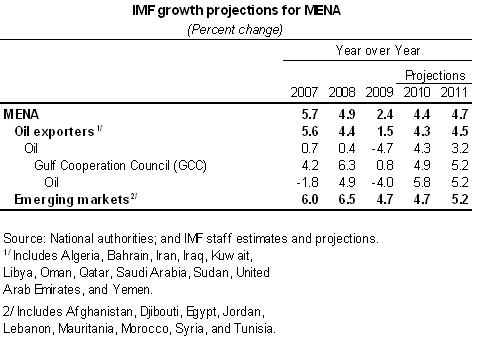
With the global economy gaining momentum, so too have economic prospects for the Middle East and North Africa. Aided by the pickup in oil prices and capital inflows and a resurgence in domestic consumption, output for the region is forecast to expand by 4.4 percent in 2010, up from 2.4 percent in 2009. But this positive outlook is clouded by some stress in the banking systems and sluggish credit activity across the region.
The region’s oil exporters—Algeria, Bahrain, Iran, Iraq, Kuwait, Libya, Oman, Qatar, Saudi Arabia, Sudan, the United Arab Emirates, and Yemen—were hit hard in 2009. Crude oil prices fell to $40 a barrel, real estate and asset prices plunged, and external financing dried up. The combined current account surplus of these countries fell to $53 billion in 2009, after having risen to $362 billion in the previous decade. Overall oil GDP contracted by 4.7 percent.
But continued government spending, along with central bank liquidity support and capital injections into the banking sector, helped mitigate the impact of the global economic downturn. As a result, non-oil economic activity expanded by some 3.6 percent in 2009.
These countries are now emerging from the crisis, thanks to a resumption of capital inflows and a rebound in crude oil prices to over $80 a barrel. Higher oil prices and output are projected to boost the current account surplus to $140 billion and oil-GDP growth to 4.3 percent. Non-oil sector activity is also forecast to grow by 4.1 percent. However, this is still heavily dependent on continued fiscal stimulus, since private investment—and credit to the private sector—remain sluggish.
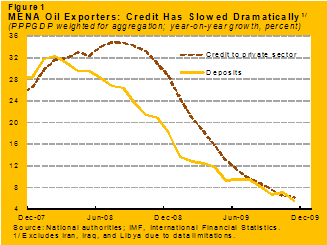
Following an extended period of high growth through mid-2008, credit in these countries slowed by an average of almost 30 percentage points by end-2009 (Figure 1). In addition, losses on nonperforming loans have yet to be fully recognized and this is also contributing to banks’ reluctance to extend credit.
Policymakers must now balance the goal of reactivating credit with the need to strengthen financial regulation and enhance supervision, particularly in countries where excessive risk-taking occurred. Over the medium term, they also face a delicate task of unwinding financial sector support and phasing out fiscal stimulus once a solid recovery is achieved.
The region’s emerging markets—Afghanistan, Djibouti, Egypt, Jordan, Lebanon, Mauritania, Morocco, Syria, and Tunisia—fared relatively well in 2009. Their limited financial and trade ties—combined with positive spillovers from fiscal expansions in neighboring oil exporters—helped offset the impact of the global slowdown. Overall growth fell fairly modestly to 4.7 percent in 2009, from 6.5 percent in 2008.
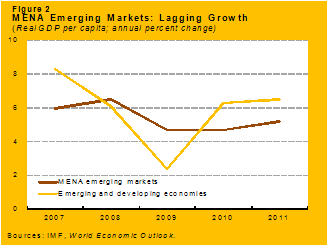
Output growth in these countries is projected to stay flat at 4.7 percent in 2010, but with trade rebounding and investment and bank credit beginning to pick up, it is projected to increase to 5.2 percent in 2011. These growth rates, however, fall short of that in other emerging markets and remain below the levels needed to combat high rates of unemployment (Figure 2).
The main challenge for these countries will be to improve their competitiveness to raise growth and generate much-needed employment for a rapidly expanding workforce.
With continued weakness in European demand and competition from other emerging markets, sustaining robust export-led growth will require a sharper focus on macroeconomic and structural reforms to raise productivity. Amongst these, an improved business climate and reorienting education and training to equip new workers for the demands of today’s marketplace will feature highly on the agenda for most MENA countries.
IMF EXTERNAL RELATIONS DEPARTMENT
| Public Affairs | Media Relations | |||
|---|---|---|---|---|
| E-mail: | publicaffairs@imf.org | E-mail: | media@imf.org | |
| Fax: | 202-623-6220 | Phone: | 202-623-7100 | |