|
Thursday, January 11
|
|
9:00-
|
Registration
|
|
9:25-9:45
|
Welcome and Opening Remarks
Mr. Chikahisa Sumi, Director, IMF OAP
Mr. Shohei Hara, Head, Office for Global Issues and Development Partnership, Operations Strategy Department, JICA
|
|
9:45-10:45
|
SESSION I: Overview of the IMF and Its Partnership with Japan
|
|
9:45-10:05
|
Introduction of the Macroeconomist Training Program and the IMF
An IMF staff member will explain the objective of the Macroeconomist Training Program. The session will also give a brief introduction of the role of the IMF and its regional office for Asia and the Pacific.
|
|
10:05-10:45
|
The Role of the JBIC
A JBIC staff member will explain how the JBIC utilizes the IMF analysis when they consider loans to recipient countries. Brief explanation will also be given about how the JBIC has collaborated with the IMF.
|
|
10:45-11:00
|
Coffee Break
|
|
11:00-17:30
|
SESSION II: IMF’s Macroeconomic Framework
|
|
11:00-12:30
|
A. Overview of the IMF's Macroeconomic Framework
PRESENTATION
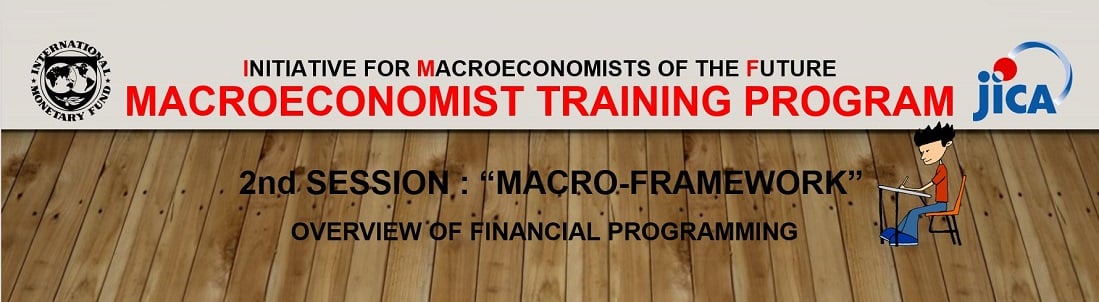
This session will provide an overview of the ways in which the IMF analyzes and projects macroeconomic developments and policies. The lecture will discuss the IMF's financial programming tool, and describe how it is used to understand linkages between macroeconomic variables and to make projections that are both internally consistent and sensible. The role of financial programming in identifying necessary policies and quantitative targets in IMF-supported program will also be explored.
Recommended Online course after the session:
- Financial Programming and Policies, Part 1: Macroeconomic Accounts & Analysis (FPP.1x)
- Financial Programming and Policies, Part 2: Program Design (FPP.2x)
- Macroeconomic Forecasting (MFx)
- Macroeconomic Diagnostics (MDSx)
Discussion
|
|
12:30-13:30
|
Lunch
|
|
13:30-15:00
|
B. IMF Surveillance: Case Study of Korea
PRESENTATION
This session will utilize a country case to explain the role of IMF surveillance and illustrate how financial programming is utilized to analyze a country economy. In particular, the class will explore how to use economic data to make projections, identify risks, and develop policy recommendations. A recent IMF staff report will serve as the basis of this lecture.
Recommended Online Course After the Session:
- Debt Sustainability Analysis (DSAx)
- Financial Market Analysis (FMAx).
- Macroeconomic Diagnostics (MDSx)
Discussion
|
|
15:00-15:30
|
Coffee Break
|
|
15:30-17:00
|
C. IMF-Supported Programs: Case Study of Mongolia
PRESENTATION
This session will discuss the role of, and process behind, an IMF-supported program. A case study of a recent program will be utilized to provide concrete examples of key concepts introduced during the day, and to explore trade-offs faced in program design.
Discussion
|
|
17:00-17:30
|
D. Introduction of Group Assignment
In this brief session, the group assignment will be explained and material will be distributed. There will also be an opportunity for participants to ask questions based on the day’s material.
|
|
Friday, January 12
|
|
10:00-14:30
|
SESSION III: Participants’ Presentations
|
|
10:00-12:30
|
E. Participants’ Presentations
In this session, participants will analyze some tables from an IMF staff report to give a diagnosis of the country and will present their findings.
|
|
12:30-13:30
|
Lunch
|
|
13:30-14:30
|
F. Post-Presentation Feedback
In this session, the lecturer will comment on the key themes that emerged in the participants’ presentations.
Discussion
|
|
14:30-15:00
|
Coffee Break
|
|
15:00-16:00
|
SESSION IV: Application of the IMF’s Macroeconomic Framework to Japan’s Policy Implementation
|
|
15:00-16:00
|
G. Case from JICA
The lecture by a JICA staff member will provide hands-on experience in describing how the JICA works with the IMF.
Discussion
|
|
16:00-16:30
|
H. Awarding of Certificates to Participants
|
|
16:30-
|
Reception
Photo Session
Closing Remarks
|





 at American University.