AlUla Conference for Emerging Market Economies
AlUla, Saudi Arabia
February 16-17, 2025
The AlUla Conference for Emerging Market Economies is an annual economic policy conference, held in AlUla, Saudi Arabia, organized by the Ministry of Finance of Saudi Arabia and the IMF Regional Office in Riyadh. This year's conference convened a select group of emerging markets’ ministers of finance, central bank governors, and policymakers, as well as public and private sector leaders, international institutions, and academia. It offered a unique platform to exchange views on domestic, regional, and global economic developments and discussed policies and reforms to spur inclusive prosperity and build resilience supported by strong international cooperation.
Rewatch the events: Day 1 and Day 2
Agenda
Day 1: February 16, 2025
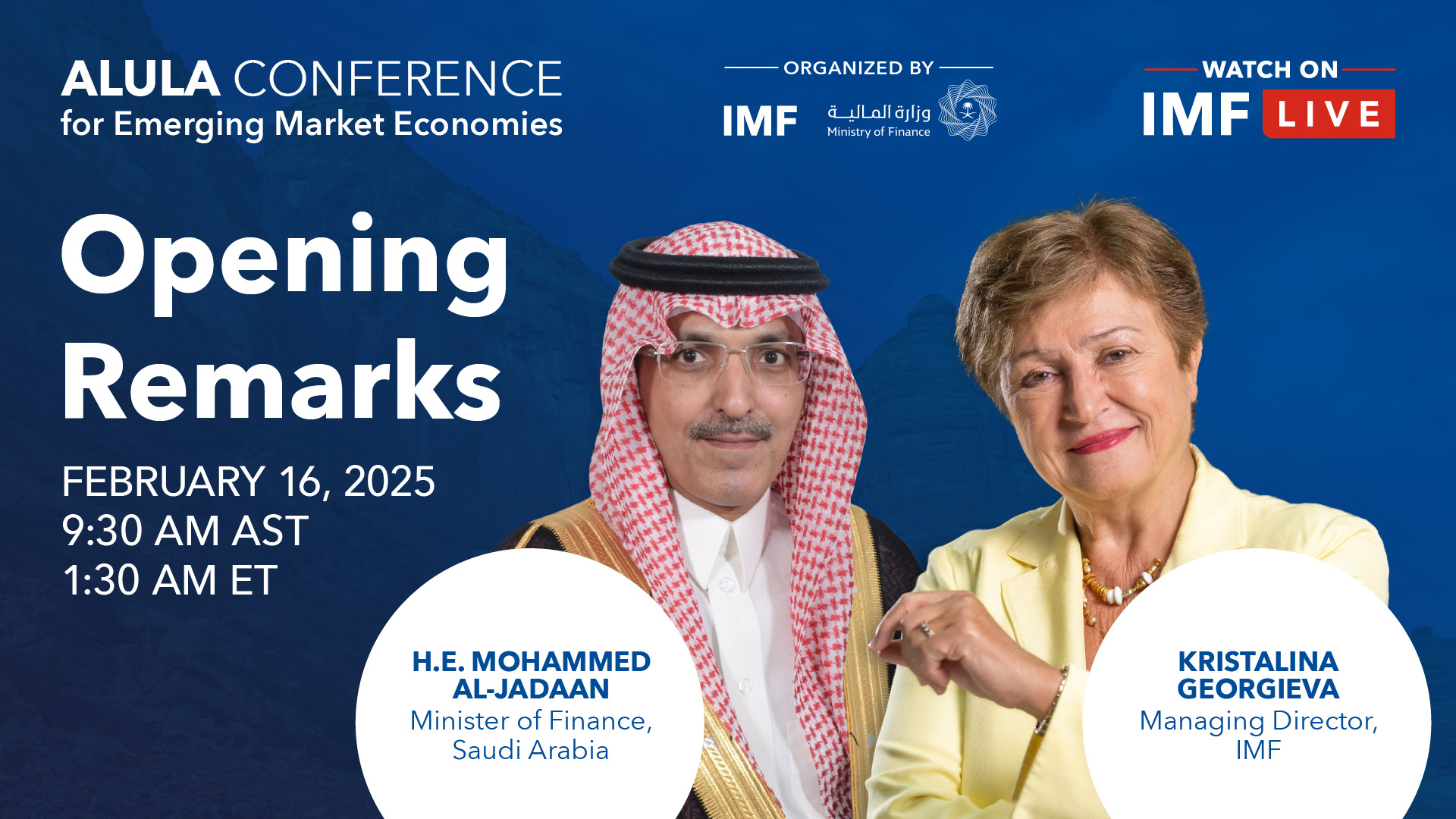
09:30-09:40 - Opening remarks by H.E. Mohammed Al-Jadaan (Minister of Finance, Saudi Arabia) and Kristalina Georgieva (Managing Director, IMF)
09:40-10:00 - Keynote Lecture: Emerging Markets Amid Structural Shifts in the World Economy
The keynote address will discuss global trends and their potential implications for emerging markets and developing economies (EMDEs), as well as the role of international cooperation.
- Keynote Address: H.E. Pan Gongsheng (Governor, PBOC)
10:00-10:50 - Emerging Markets: Policy Challenges Amid Structural Shifts in the World Economy
The panel will delve into EMDEs’ policy challenges in the context of the rising uncertainty and the changing global economic landscape. Specifically, it will cover the implications for EMDEs of (i) more frequent external shocks; (ii) elevated uncertainty; and (iii) structural challenges in the context of high debt, weak growth, energy transitions, and new technologies.
- Moderator: Jihad Azour (Director, Middle East and Central Asia Department, IMF)
Panelists:
- H.E. Olayemi Cardoso (Governor, Central Bank of Nigeria)
- José De Gregorio (Dean, School of Economics and Business, University of Chile)
- H.E. Ali bin Ahmed Al Kuwari (Minister of Finance, Qatar)
- Jin Liqun (President, Asian Infrastructure Investment Bank)
10:50-11:10 - Coffee break
11:10-12:10 - High Debt-Low Fiscal Space—Fiscal Consolidation and Multilateral Solutions to Debt Restructuring
Maintaining or restoring debt sustainability in EMDEs is a challenging task in the context of elevated debt, higher interest rate and weak potential growth, as well as significant spending pressures (e.g., related to sustainable development goals, defense, energy transitions, and economic diversification). The panelists will discuss the pace of the ongoing pivot towards fiscal consolidation and ways to garner support for politically difficult reforms. Potential debt restructuring mechanisms from both creditor and debtor perspectives will also be highlighted.
- Moderator: Ryadh Alkhareif (IMFC Deputy, Saudi Arabia)
Panelists:
- H.E. Mohammed Al-Jadaan (Minister of Finance, Saudi Arabia)
- Mauricio Cárdenas (Professor, Columbia University, former Minister of Finance, Colombia)
- H.E. Situmbeko Musokotwane (Minister of Finance and National Planning, Zambia)
- H.E. Anton Siluanov (Minister of Finance, Russia)
12:10-13:00 - Lunch
13:00-14:00 - Monetary Policy and Capital Flows Amid Elevated Uncertainty
The session will discuss the path of future monetary policy in EMDEs, considering the spillovers from monetary policy in advanced economies and potential swings in global market sentiment, as well as the uncertainty around the implications for inflation, the neutral rate, and capital flows of the changing economic landscape.
- Moderator: Pierre-Olivier Gourinchas (Economic Counsellor, Director of the Research Department, IMF)
- Author: Hélène Rey (Professor, London Business School)
Discussants:
- H.E. Fatih Karahan (Governor, Central Bank of the Republic of Türkiye)
- H.E. Sethaput Suthiwartnarueput (Governor, Bank of Thailand)
14:00-15:00 - Resilience of the Financial System in Emerging Markets
The panel will focus on the implications of the changing global landscape for financial stability in emerging markets, as well as the policy priorities.
- Moderator: Tobias Adrian (Director, Monetary and Capital Markets Department, IMF)
Panelists:
- H.E. Sheikh Bandar bin Mohammed bin Saoud Al Thani (Governor, Qatar Central Bank)
- H.E. Taleh Kazimov (Governor, Central Bank of Azerbaijan)
- H.E. Andriy Pyshnyi (Governor, National Bank of Ukraine)
- H.E. Fahad M. Alturki (Director General Chairman, AMF)
19:30-21:30 - Dinner hosted by the Ministry of Finance of Saudi Arabia
Day 2: February 17, 2025
09:00-10:00 - Navigating Trade Tensions and Uncertainties
Against the backdrop of mounting risks and uncertainty, the session will discuss (i) how geoeconomic fragmentation and geopolitical risks are affecting trade and investment globally and in EMDEs; (ii) how EMDEs can adapt to these developments and mitigate risks; (iii) what policies to enhance trade and investment flows; and (iv) what changes to the current global trade system to respond to EMDEs’ needs.
- Moderator: Indermit Gill (Chief Economist, World Bank Group)
Panelists:
- H. E. Adebayo Olawale Edun (Minister of Finance, Nigeria)
- H.E. Nadia Fettah (Minister of Economy and Finance, Morocco)
- H.E. Sergii Marchenko (Minister of Finance, Ukraine)
10:00-11:00 - Productivity in EMDEs: Challenges and Opportunities
Compared with the pre-pandemic period, the medium-term growth outlook has worsened significantly, including in EMDEs. The projected slowdown jeopardizes income convergence and could also lead to widening income inequality within countries. Against this backdrop, the session will take stock of EMDEs’ growth outlook, including the main headwinds, and discuss the potential challenges and opportunities from shifts in the economic landscape (e.g., AI).
- Moderator: H.E. Muhammad Al Jasser (President, Islamic Development Bank)
- Author: Leslie Teo (Director, AI Products, AI Singapore; Former chief economist and head of investment strategy, GIC Singapore)
Discussants:
- H.E. Faisal F. Alibrahim (Minister of Economy and Planning, Saudi Arabia)
- Santiago Levy (Senior Fellow, Brookings)
- H.E. Federico Sturzenegger (Minister of Deregulation and State Transformation, Argentina)
11:00-11:20 - Coffee break
11:20-12:20 - Closing Panel: A Path for Emerging Market Resilience
The concluding panel will focus on (i) how EMDEs should deal with shocks in the short term, taking into consideration the persistence of some global shocks; (ii) identifying the main trade-offs for fiscal and monetary policymakers to build resilience, maintain stability and spur growth (“rise strong”); and (iii) how the underlying concerns behind “anti-globalization” pressures can be addressed to revitalize global economic integration.
- Moderator: Kristalina Georgieva (Managing Director, IMF)
Panelists:
- H.E. Muhammad Aurangzeb (Minister of Finance, Pakistan)
- H.E. Rania Al-Mashat (Minister of Planning, Economic Development and International Cooperation)
- H.E. Mehmet Şimşek (Minister of Finance, Türkiye)
- H.E. Fernando Haddad (Minister of Finance, Brazil)
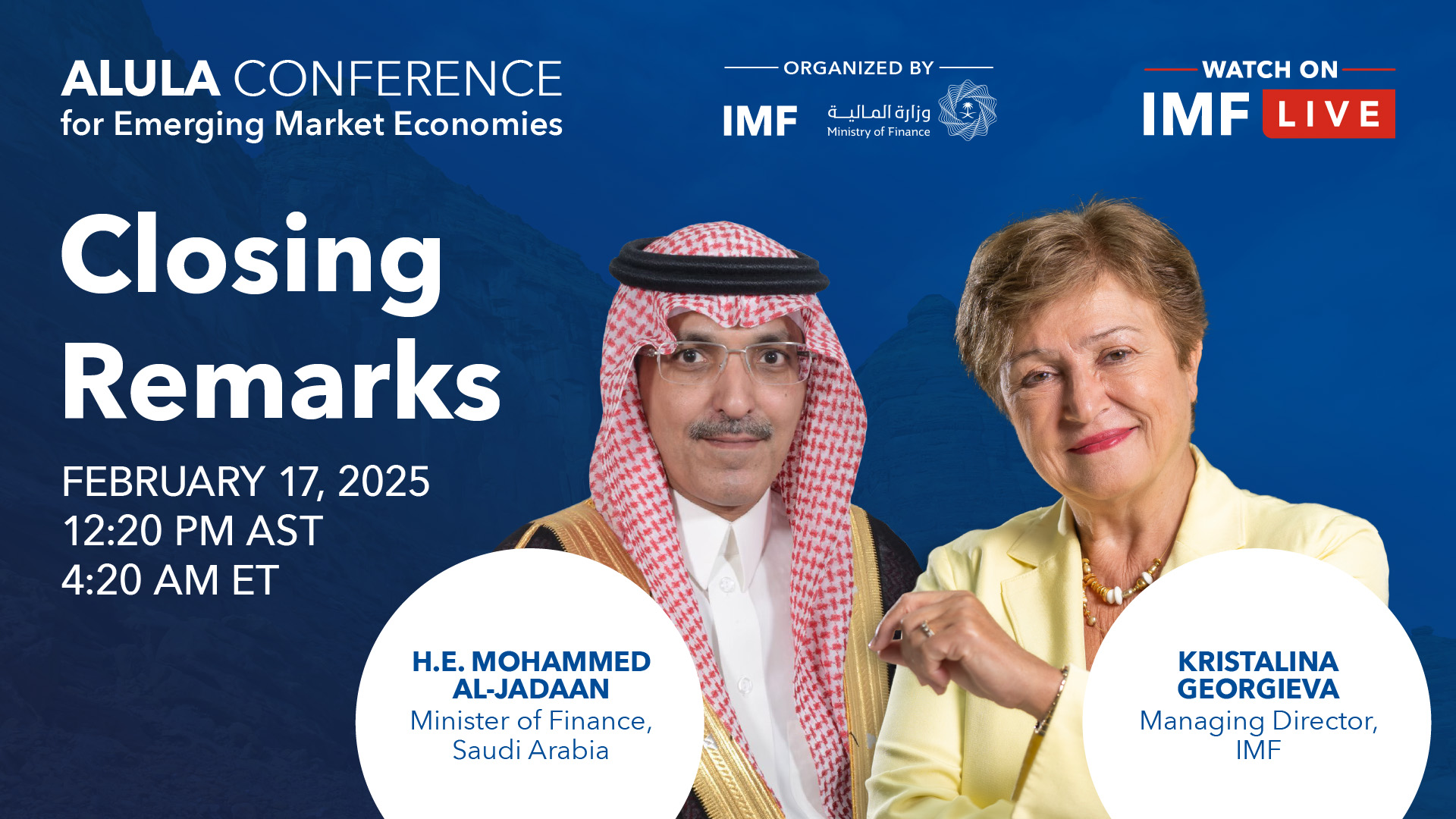
12:20-12:40 - Closing remarks by H.E. Mohammed Al-Jadaan (Minister of Finance, Saudi Arabia) and Kristalina Georgieva (Managing Director, IMF)