

Finance & Development, June 2019, Vol. 56, No. 2 PDF version
The Specter of Versailles
The conference that ended World War I was followed by an inward turn that has parallels today
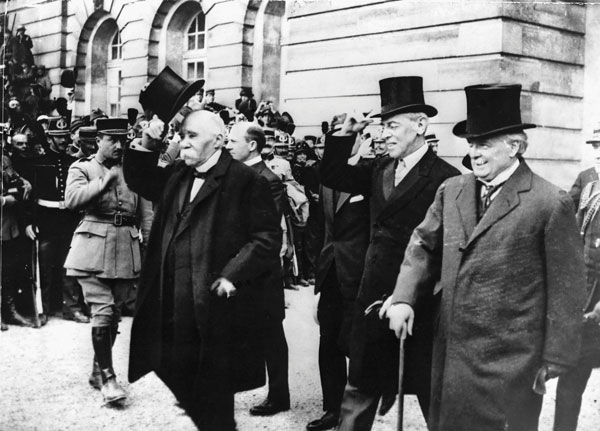
on June 29, 1919, a century ago, the Treaty of Versailles was signed, officially ending World War I. This centennial is no cause for celebration, given how dismally the treaty failed at achieving its aims. It did not seal an enduring peace. It did not inaugurate an era of prosperity in Europe or worldwide. It did not create an effective institutional framework for governing international economic and political relations.
Indeed, it failed so utterly that an entirely different approach was taken after World War II, one that entailed more forceful US leadership and the construction of encompassing institutions in Europe and globally. The result, in the third quarter of the 20th century, was economic growth in the industrialized countries at a pace never seen before.
But memories fade, and it is not too strong to say that we are repeating the mistakes of Versailles. Back then, the United States was a party to treaty negotiations, but it largely washed its hands of the results. It refused to join the League of Nations. It was not an active participant in the 1922 Genoa Conference intended to strengthen the international monetary and financial system. It did not support the League’s efforts to negotiate a tariff truce and provocatively raised import duties in 1923 and 1930. It did not forgive the war debts owed by its European allies, thereby compounding the German reparations mess.
Entanglements shunned
This inward turn was a reassertion of a long-standing isolationist strand in American political thought that stretches back to Thomas Paine’s influential tract Common Sense, published in 1776, which argued against entangling alliances. That the country was separated from Europe by more than 2,000 miles of ocean allowed its leaders to believe that they could avoid becoming enmeshed in that continent’s affairs. The United States entered World War I only after German U-boat attacks on American ships rendered the established policy of neutrality untenable. After the war, the country shunned these entanglements, not only erecting new tariffs but also adopting restrictive immigration laws.
The parallels with the current, inward-looking tariff and immigration policies of the United States are unmistakable.
The parallels extend also to the factors feeding the country’s isolationist tendencies. The 1920s, like the early 21st century, were a period of rapid economic change, and it was tempting for those who felt left behind to blame foreigners and urge recourse to tariffs. In the 1920s this meant American farmers, grain growers in particular, who suffered from the expansion of acreage under cultivation in Argentina, Canada, and elsewhere. The Smoot-Hawley Tariff of 1930 was initially conceived as a measure to protect US farmers from cheap imports. The reality was that the tractor, not import competition, was the more important explanation for low US farm-gate prices. But it was easier to blame foreigners than to turn back technological progress.
Today, declining manufacturing rather than agricultural employment is the source of angst, and the culprit is robotics rather than motorized farm equipment. But the political reaction is no different.
Immigrant quotas
Then as now, there was also an identity-politics strand in the isolationist turn. Earlier immigrants from the British Isles and Scandinavia, often Protestants, were disquieted by immigration from the countries of southern and eastern Europe, whose populations were heavily Catholic. The sensational 1921 trial and conviction on murder charges of Nicola Sacco and Bartolomeo Vanzetti, two Italian-born anarchists, symbolized this suspicion of so-called new immigrants. Revealingly, the Immigration Act of 1924 based immigrant quotas not on current population shares but on the shares of various immigrant groups in 1890, before much of this new immigration. Hostility toward darker-skinned immigrants who spoke a different language and practiced a different religion was reinforced by hard economic times, notably in the period of the Mexican Repatriation from 1929 through 1936, when as many as 2 million Mexicans and Mexican-Americans were targeted for deportation.
Thus, isolationist tendencies in the American body politic are always present, but they are most powerful when fueled by a combination of economic dislocation and identity concerns, which is to say in the 1920s and today.
The other fundamental mistake at Versailles was to deny the rising powers a seat at the table. Germany was excluded from the League of Nations until 1926. It faced indefinite restrictions on its military. Its economic autonomy was limited, notably by a prohibition against forming a customs union with Austria. These impositions fueled the destructive nationalism that ultimately resulted in the collapse of the Weimar Republic.
Separate peace
A weakened Russia had negotiated a separate peace with Germany in 1918. Although representatives of the anti-Bolshevik Russian Provisional Council attended the Versailles negotiations, the Bolsheviks were excluded. Hence, when the Soviet Union came into existence in 1922, it was in no position to participate in the reconstruction of the international system. The new Soviet state did finally join the League of Nations—temporarily—in 1934. By this time, however, the USSR was effectively kept out of Western economic and financial arrangements, setting the stage for the bifurcation of the world economy, and the world, into Soviet and Western blocs.
Today China is actively seeking to carve out a position on the global stage. The question is whether it will exert its influence through existing multilateral institutions, such as the International Monetary Fund and the World Bank, or through vehicles that China itself designs to project its economic and political influence globally, such as the Asian Infrastructure Investment Bank and the Belt and Road Initiative. If it invests and provides assistance through the IMF and World Bank, it will be subject to existing institutional constraints, and its influence can be counterbalanced by other members. If not, it will be freer to do as it pleases. The reluctance of the United States and other countries to give China a greater voice in the Bretton Woods institutions heightens this last danger.
The failure of the Treaty of Versailles is a reminder of the indispensability of leadership by the dominant power in crafting and sustaining stabilizing alliances and institutions. It is a reminder of the need to incorporate rising powers constructively into those arrangements. These are lessons that the United States seems to have forgotten for the moment. But there have been isolationist turns in US politics before. The question is whether this fit of forgetfulness will prove temporary or enduring.
BARRY EICHENGREEN is a professor of economics and political science at the University of California, Berkeley. He is the author, most recently, of The Populist Temptation: Economic Grievance and Political Reaction in the Modern Era.
PHOTOS: GETTY IMAGES / HULTON-DEUTSCH COLLECTION; ISTOCK / MALIJA
Opinions expressed in articles and other materials are those of the authors; they do not necessarily reflect IMF policy.