
The COVID-19 pandemic is a blow to an already fragile global economic
outlook. The health crisis, sharp downturn in activity, and turmoil in
global financial markets caught emerging market and developing economies at
a bad moment. The past decade has seen the largest, fastest, and most
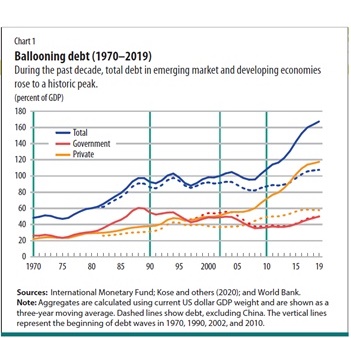
broad-based increase in debt in these economies in the past 50 years. Since
2010, their total debt rose by 60 percentage points of GDP to a historic
peak of more than 170 percent of GDP in 2019 (see Chart 1). Although China
accounted for the bulk of this increase—in part due to its sheer size—the
debt buildup was broad-based: in about 80 percent of these economies, total
debt was higher in 2018 than in 2010. Even excluding China, debt rose by 20
percentage points of GDP, to 108 percent, in 2019. As these economies
respond to the pandemic, their debt will only increase.
The current global recession is unusual in its severity. Like previous
crises, it is testing the resilience of heavily indebted countries and
companies.
What policies do highly indebted emerging market and developing economies
need to implement to mitigate the damage of the pandemic and support a
durable recovery? History can give policymakers some useful pointers.
Debt waves
As documented in our recent study, Global Waves of Debt, before
the current period, emerging market and developing economies experienced
the following three waves of broad-based debt accumulation between 1970 and
2009:
1970–89:
A combination of low real interest rates and a rapidly growing syndicated
loan market through much of the 1970s encouraged governments in Latin
America and low-income countries, especially in sub-Saharan Africa, to
borrow heavily—culminating in a series of financial crises in the early
1980s. A prolonged period of debt relief and restructuring followed—through
the Brady Plan, the Heavily Indebted Poor Countries Initiative, and the
Multilateral Debt Relief Initiative (the latter two with IMF and World Bank
support)—yet this was still a lost decade for growth and poverty reduction.
1990
–
2001:
Financial and capital market liberalization enabled banks and businesses in
east Asia and the Pacific and governments in Europe and central Asia to
borrow heavily, particularly in foreign currencies—ending with a series of
crises during 1997–2001 once investor sentiment soured. Resolution of
private debt required large-scale bank and corporate bailouts, often with
assistance from the World Bank and the IMF.
2002–09:
A run-up in private sector borrowing in Europe and central Asia from
EU-headquartered megabanks followed regulatory easing—when the global
financial crisis disrupted bank financing during 2007–09—and tipped several
of these economies into recession. Debt resolution was a pan-European
effort and, again, required bank bailouts and international assistance.
The three historical waves of debt had several things in common. They all
began during periods of low real interest rates and were often facilitated
by financial innovations or changes in financial markets that promoted
borrowing. The waves ended with widespread financial crises and coincided
with global recessions (1982, 1991, 2009) or downturns (1998, 2001). These
crises were typically triggered by shocks that resulted in sharp increases
in investor risk aversion, risk premiums, or borrowing costs, followed by
sudden stops of capital inflows and deep recessions. The financial crises
were usually followed by reforms designed to lower vulnerabilities
(including greater reserve accumulation) and strengthen policy frameworks.
Many emerging economies introduced inflation targeting, greater exchange
rate flexibility, fiscal rules, or more robust financial sector supervision
following financial crises.
The first three waves also differed in important ways. The financial
instruments used for borrowing evolved as new instruments and financial
actors emerged. The first wave saw rapid debt accumulation by emerging
economy sovereigns, whereas the subsequent two waves were mostly about
borrowing by the private sector (although during the Asian crisis, many
companies were quasi sovereign). The severity of the economic damage varied
among financial crises and across regions. Output losses were particularly
large and protracted in the wake of the first wave, when most of the debt
was accumulated by governments. Meanwhile, in many economies, better policy
frameworks after the first two debt waves helped mitigate the damage of the
global financial crisis that marked the end of the third wave.
Fourth wave
During the current debt wave—which began in 2010—debt has reached record
highs, and private sector debt has risen particularly fast. Among commodity
exporters, public sector debt increased substantially following the 2014–15 commodity price plunge. The current
wave shows some interesting similarities and differences compared with
previous waves. Echoing some of the historical cases, global interest rates
have been very low since the global financial crisis, and—until the
pandemic hit—the ensuing search for yield by investors contributed to
narrowing spreads for emerging economies. Until recently, some major
changes in financial markets again boosted borrowing, including through a
rise in regional banks, growing appetite for local currency bonds, and
increased demand for emerging market and developing economy debt from the
expanding nonbank financial sector. As during the earlier waves,
vulnerabilities have mounted in these economies with the advance of the
current wave amid slowing economic growth.
There are also key differences. The average annual increase in debt since
2010 of almost 7 percentage points of GDP for this category of countries is
significantly larger than during each of the previous three waves. In
addition, whereas previous waves were largely regional, the fourth wave has
been widespread, with total debt rising in almost 80 percent of these
economies and by at least 20 percentage points of GDP in more than 45
percent. Following a steep decline during 2000–10, debt also rose in
low-income countries, to 65 percent of GDP in 2019, up from 47 percent of
GDP in 2010. Last, debt has risen in the nonbank financial system, which
appears to be more lightly supervised and less resilient than the banking
system, which was thoroughly restructured after the global financial
crisis.
Emerging market and developing economies have endured periods of volatility
during the current wave of debt accumulation, but widespread and severe
financial stress emerged only after the COVID-19 pandemic hit. These
economies’ ability to withstand financial stress is further complicated by
other weaknesses, such as growing fiscal and current account deficits and a
shift toward riskier debt. The share of government debt held by nonresident
investors climbed to 43 percent in 2018, and foreign-currency-denominated
corporate debt rose from 19 percent of GDP in 2010 to 26 percent of GDP in
2018. Among low-income countries, more than half of government debt is on
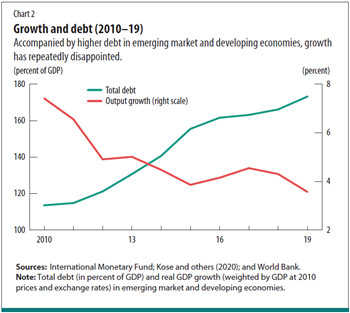
nonconcessional terms. A mounting stock of debt and riskier debt
composition have accompanied a decade of repeated growth disappointment
(see Chart 2).
The pandemic has brought an abrupt end to financial market tranquility and
is now testing the resilience of the economies, institutions, and policies
of emerging economies. They are facing an unfolding global recession in a
much more vulnerable position than when the 2009 crisis hit. Recent
developments may tip some of them into the widespread debt distress that
marked the end of previous waves. This is all the more likely given, first,
the exceptional severity of the current recession, which is reaching into
every corner of the global economy, and second, poorer prospects for a
robust rebound amid possible repeat outbreaks and mounting backlash against
globalization.
Surfing the wave
Right now, tackling the health crisis is paramount, whatever the fiscal
cost. Fiscal deficits in these economies are expected to widen by about 5
percentage points of GDP, on average, in 2020 (IMF 2020). Investors are
more likely to accept these precarious fiscal positions, including high
debt and large deficits, if countries introduce mechanisms and institutions
today that will restore fiscal sustainability once the recovery gets
underway.
The experience of past waves of debt points to the critical role of policy
choices in determining the outcomes of debt waves. While external shocks
typically triggered financial crises, the impact on individual economies
was heavily influenced by domestic policy frameworks and choices. Specific
policy priorities ultimately depend on country circumstances, but—based on
our analysis—there are four broad strands of policy that can help emerging
economies weather the current global recession despite high debt:
Sound debt management and transparency:
Countries are in dire need of financing, and sound debt management and debt
transparency are critical to ensure that today’s debt can be repaid
tomorrow and that borrowing costs are kept in check, debt sustainability is
eventually restored, and fiscal risks are contained. If central banks
contribute to fiscal financing, frameworks ensuring a return to
pre-pandemic monetary policy can encourage investor confidence. Creditors,
including international financial institutions, can spearhead efforts in
this area by promoting common standards.
Good governance:
Even with large-scale fiscal stimulus to support today’s plunging activity,
money must still be spent wisely. In several previous crisis cases, it
became apparent after the fact that borrowed funds went toward purposes
that did not raise export proceeds, productivity, or potential output.
Especially in light of the dramatic economic disruption in the current
global economy, sound bankruptcy frameworks are needed to help prevent debt
overhangs from weighing on investment for prolonged periods.
Effective regulation and supervision:
While temporary regulatory easing is appropriate in the current context,
proactive financial sector regulation and supervision can help policymakers
identify and act on emerging risks. As the recovery gets underway, deeper
financial markets can help mobilize domestic saving, which may be a more
stable source of financing than foreign borrowing.
Robust macroeconomic policies:
Robust monetary, exchange rate, and fiscal policy frameworks can safeguard
emerging market and developing economies’ resilience in a highly fragile
global economic environment. Current market pressure limits foreign
currency exposure, but flexible exchange rates can soften some of the blow
on the domestic economy in the short term; longer term, flexible rates can
discourage the buildup of substantial balance sheet mismatches and ward off
large exchange rate misalignments. Amid today’s financing pressures,
revenue and expenditure policies must be adjusted to expand fiscal
resources for priority spending on health and support for vulnerable
groups. Invoking escape clauses to fiscal rules during the crisis may be
necessary, but it is these rules that will help restore fiscal
sustainability when recovery gets underway. Once the recovery gets going,
though, fiscal rules and frameworks that ensure the eventual unwinding of stimulus and return to fiscal sustainability are essential.
Only time will tell whether the current debt wave will end as its
predecessors did, with a string of financial crises. The nature and
magnitude of the shock imposed by the pandemic will stretch even the most
resilient economies. Global cooperation and support are more critical than
ever. But we must remember the number one lesson of previous debt waves:
domestic policies are essential when it comes to fending off financial
crises.