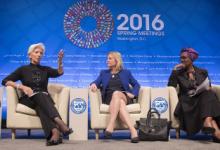
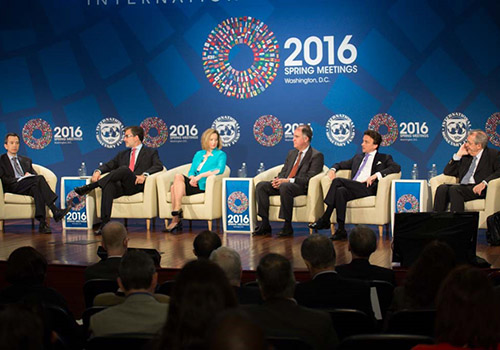
IMF Managing Director Christine Lagarde, Sweden’s Finance Minister Magdalena
Andersson, and Oxfam’s Executive Director Winnie Byanyima in a Spring Meetings
panel (photo: IMF)
2016 IMF-World Bank Spring Meetings
The meetings brought together a variety of stakeholders and opinions—over
8,700 this year—ranging from finance ministers, central bank governors, to
financial sector participants, parliamentarians, civil society organizations and
journalists, representing the IMF’s 189 member countries.
Leveraging these diverse perspectives, the wide-ranging program of seminars provided an opportunity for opinion
makers to share their views on ways to approach and address these multifaceted challenges.
Below is a glimpse of the rich discussions on some of the key topics of the day.
Conference on economic development in low-income countries #IMFonLICs
Low-income developing countries need to diversify their economies, promote inclusion,
and close infrastructure gaps by tapping both domestic resources and foreign funding
to sustain growth: these are the main lessons drawn from the conference on low-income
countries. Panelists at the three-part session agreed that public infrastructure
investments must continue in these countries for efficient growth and for reaching
longer-term sustainable development goals.
“The prospects of Africa becoming the largest continent in terms of population,
and aspirations of the growing middle class, make us committed to find solutions
to implement much needed infrastructure investment to support growth while maintaining
debt sustainability,” said Alamine Ousmane Mey, Cameroon’s Minister
of Finance.
Read more in the Survey story and watch the webcast.
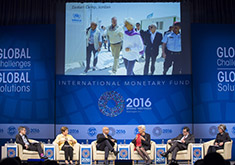
Panelists discuss the economic and political challenges of hosting refugees (photo:
IMF)
Conflicts and the refugee crisis #IMFonRefugees
“This is not just a humanitarian challenge, it’s a development and economic
challenge. We need longer-term thinking about how to incorporate these refugees
into national development plans, and how to integrate them into the long-term economic
course of the host countries and communities,” said Kyung-wha Kang, a UN Assistant-Secretary
General at this seminar. With proper policies in place, rapid labor market integration
can reduce the short-term fiscal costs associated with absorbing the influx of asylum
seekers. Panelists, including Jordanian Minister of Planning Imad Fakhoury, agreed
that security and hosting refugees is a public good that should be strengthened
through capacity building efforts and inclusive policies.
Watch the discussion and read the Survey story.
Women, work and the global economy #IMFGender
Making the economic case for gender equality as the key to progress was the focus
of this seminar on women’s opportunities in the workplace. The global economy
is still in many ways “rigged against women,” panelists said, citing
access to finance, tax policy, and legal barriers to equality. Berkeley Haas Business
School professor Laura Tyson emphasized that at the current rate of change it would
take 85 years to eliminate the gender gap. “That's progress? I don't think
so. That’s too slow. I am impatient for progress,” said Oxfam’s
Winnie Byanyima. She noted that 75 percent of women in Asia and Africa work in the
informal sector. “We need to recalculate a new measure of economic wellbeing
and progress that counts and values all this labor that is now unpaid and unmeasured.”
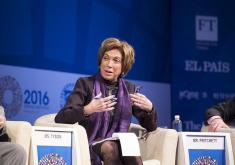
“I am delighted that much more attention is being placed on addressing gender
inequality, including at the IMF,” Professor Laura Tyson (photo: IMF)
The goal should be to make the economic case so convincingly that it makes sense
to all involved to take action, widening opportunities to women across the spectrum,
panelists said. “The IMF can't change social attitudes, but we can show the
benefits when countries do change and then see if others will emulate that,”
said IMF’s First Deputy Managing Director David Lipton.
Watch the webcast and read the blog from International Women’s Day. Visit the
IMF’s
Gender page.
The role of capacity development #IMFCapDev
Panelists at this seminar, who represented donors, recipient countries, and thought
leaders, saw a growing demand for capacity development for revenue mobilization
across all countries, and called for enhanced partnerships through cooperative arrangements
as many developing countries seek to increase their fiscal space. Panelists also
noted that efficiency in tax collections through strong tax compliance promotes
economic growth and equity. “If developing countries across the board raise
their tax income by one percent, they will raise one trillion dollars per year––ten
times more than global overseas development assistance,” said panelist Klaus
Rudischhauser from the European Commission.
Read the Survey story and watch the seminar.
Political economy of structural reforms #BoostGrowth
Panelists tackled the rigors of implementing tough reforms in the face of rising
populism in a number of countries, including the United States, at this seminar.
With global growth too low, commodity prices falling, monetary policy losing steam,
and very few countries with ready cash lying around to spend, many have to look
inward to make their economies more productive. “To reinforce democracy,
we need to deliver economic success,” said Tunisian Member of Parliament Olfa
Soukri Cherif.
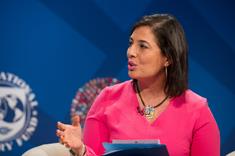
“You can’t reap what you sow the same day; these reforms are for long-term
economic development,” said Tunisian parliament member Olfa Soukri Cherif.
(photo: IMF)
Panelists agreed that governments should undertake structural reforms sooner rather
than later––before they are desperately needed––and to tackle
the toughest ones first. “It’s not true that governments that implement
structural reforms lose elections,” said Luis de Guindos, Spain’s Minister
of Economy and Competitiveness.
IMF Survey article on structural reforms and watch the panel.
Emerging markets at the crossroads #IMFEmergMkts
The prospects for growth in emerging and developing nations may not be as gloomy
as financial markets suggest, according to participants at this seminar on emerging
markets. “When you’re at the crossroads, and you’re just looking
at the intersection, it can all look pretty dark,” said IMF’s First
Deputy Manager David Lipton. Still, “there’s huge potential for emerging
countries to grow rapidly and be the engine of growth for the global economy,’’
he said, adding that emerging nations need technology, investment, and better-educated
populations to raise output.
The seminar also covered the outlook for oil prices, the impact of the U.S. Federal
Reserve policy on emerging markets, and developments in Argentina and Russia. Argentina’s
Minister of Treasury and Public Finance Alfonso Prat-Gay expressed satisfaction
with investor demand for the country’s debt after a U.S. appeals court cleared
the way for a $15 billion bond sale to pay creditors from a 2001 default, though
additional bond sales this year were unlikely. “There was already a lot of
interest before the appeals court decision, and there’s a lot right now,”
Prat-Gay said.
Watch the seminar and read more in the Survey story
Fortifying the global financial safety net #IMFSafetyNet
Deputy Governor of the Bank of England Nemat Shafik moderated a discussion on the
current weaknesses of the global financial safety net and possible options for strengthening
it. The discussion focused on the costs and stigma associated with various layers
of the safety net, the causes of liquidity shortages, opportunities for reinforcing
the system, and the IMF’s role in facilitating coordination between the different
layers. Chilean Finance Minister Rodrigo Valdes argued that countries’ strong
preference for accumulating reserves suggested the costs of doing so were more to
the international community than the countries themselves.
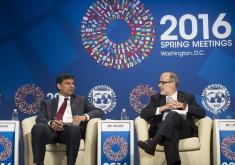
India's Reserve Bank Governor Raghuram Rajan and Chile’s Finance Minister Rodrigo Valdes discuss how to strengthen the international monetary system (photo: IMF)
Governor of the Reserve Bank of India Raghuram Rajan highlighted the existing gaps
in the system, questioning whether small countries had quick access to liquidity
if they needed it, and whether regional arrangements were sufficient, or a more
global arrangement was needed.
Watch the webcast.
Sub-Saharan Africa #IMFonAfrica
The Center for Global Development President Nancy Birdsall led a discussion on whether
lower growth in sub-Saharan Africa––weakened by lower commodity prices,
tighter global financing, and meager policy buffers––signal the end
of “Africa Rising”.
With growth at 3½ percent in 2015––the lowest rate in 15 years—panelists
discussed possible macroeconomic policy responses that could strengthen the region’s
resilience to external shocks and unlock its significant growth potential. Nigerian
Minister of Finance Kemi Odeosun said, “Oil is 13 percent of our GDP, but
represents 70 percent of government revenue, and the real vulnerability is overdependence
on oil. We need to be insulated from future oil shocks.”
Rwanda’s Minister of Finance Claver Gatete said his country is able to grow
at 6 percent thanks to heavy investments in infrastructure and education, financial
reforms, an improved business environment, and inclusive growth policies after the
economy declined in 1994–95 following the country’s genocide. Arvind
Subramanian, Chief Economic Advisor to the Minister of Finance in India, said, “In
the long-run, there is no correlation between commodity prices and growth.”
He said the fundamental dynamic in Africa is very positive, with more democratization,
reduced ethnic conflict, and a big demographic boom coming.
Watch the webcast.
The evolving role of China in the global economy #IMFonChina
As China transitions to a growth model driven by consumption and services, panelists
at this seminar discussed its economic outlook, affected by overcapacity, regulatory
frameworks, debt risks, and the wider use of renminbi internationalization.
On China’s rising debt level, Huang Haizhou, Managing Director of China International
Capital Corporation, said the country has room to maneuver on debt as a net exporter
of capital. He said that over the last two decades, China has built cushions—especially
in private and household sectors—to maintain its debt growth at a decent level.
IMF First Deputy Manager, David Lipton, said the decision to include the renminbi
in the SDR basket is a milestone, reflecting China's growing role in international
trade and finance. The greater use of the currency would allow China’s financial
integration to continue in a way that supports trade and economic growth in both
China and the region. Huang echoed Lipton’s point, saying that renminbi
internationalization can play an important role both internationally and domestically,
especially in terms of pushing reforms in China.
Watch the webcast and read the Survey story on China and the SDR.
Strengthening the international tax system #FiscalForum
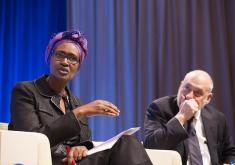
Oxfam Director Winnie Byanyima stresses the importance of using tax revenues to achieve development goals, as Columbia University Professor Joseph Stiglitz listens in (photo: IMF)
Panelists at the 2016 IMF Fiscal Forum agreed that reforming the international tax
system is a priority. They said the international tax system is still in many ways
rigged in favor of big multinational corporations, citing the creative ways in which
they manage to avoid or evade paying taxes. Swedish Finance Minister Magdalena Andersson
stressed the difficulty of taxing capital in a globalized world, and said companies
should deploy the creativity they use to avoid paying taxes to help eradicate poverty.
“The most important corporate responsibility is paying fair taxes,”
said Columbia University Professor Joseph Stiglitz.
Oxfam Executive Director
Winnie Byanyima pointed out, “developing countries have no chance to meet
the Sustainable Development Goals unless they can raise the necessary revenues.”
Watch the forum.
Digital disruptions to the Financial System #IMFDigitalDisrupt
The rapid growth of FinTech, and increasing cyber security risks as financial
institutions rely on highly-interconnected information technology and communications
systems are creating challenges and opportunities to the financial system. Some
disruptions include virtual currencies, peer-to-peer lending, and high frequency
trading.
The IMF’s First Deputy Managing Director, David Lipton, said policies will
need to strike a balance between addressing risks and stifling innovation. Carolyn
Wilkins, Senior Deputy Governor of the Bank of Canada said, “There’s
a sweet point between not coming in too early with regulation, but recognizing that
a lot of these technologies will not succeed or have benefits unless they figure
out the governance.”
The tech revolution has already fundamentally changed the global economy––with
M-Pesa, a popular
mobile banking technology, as one example. While many opportunities and innovations
have arisen from the FinTech revolution, cyber risks have also increased. Cyber
security in the financial sector is seen as integral to preserving global financial
stability.
“It’s not just risks to the contours or the fortress of the financial
institution. A smart-thinking financial institution is going to also have to think
about who that institution is connected to—third party vendors,” said
Sarah Bloom Raskin, U.S. Deputy Treasury Secretary. “That’s what we
saw in the Target breach. It wasn't the hack of the actual Target fortress, it was
a vendor that had weak defenses that created a vulnerability for Target,”
she added. “You need to protect yourself against breaches, but you have to
assume that everybody with whom you’re interacting with has been breached
as you create your policies,” said Bradley J. Wiskirchen, CEO of Keynetics
and Kount, who is also Chairman of the Board Directors for Clickbank.
Watch the seminar.
Panelists discuss increasing cyber security risks at the digital disruptions seminar
(photo: IMF)