Last year, COVID-19 prompted an unprecedented economic collapse in emerging market
economies, although a recovery soon followed. While growth will remain
bumpy until vaccination rollouts are well underway, the focus will soon
shift back to medium-term growth in emerging markets.
Prior to the pandemic, emerging market growth was on a secular decline—that
is, it was deteriorating over time irrespective of temporary economic
bright or dark spots. Secular stagnation, as it is known, is associated
with many problems, including unemployment. Keeping people at work, or
helping them get jobs, is tough when growth slows down.
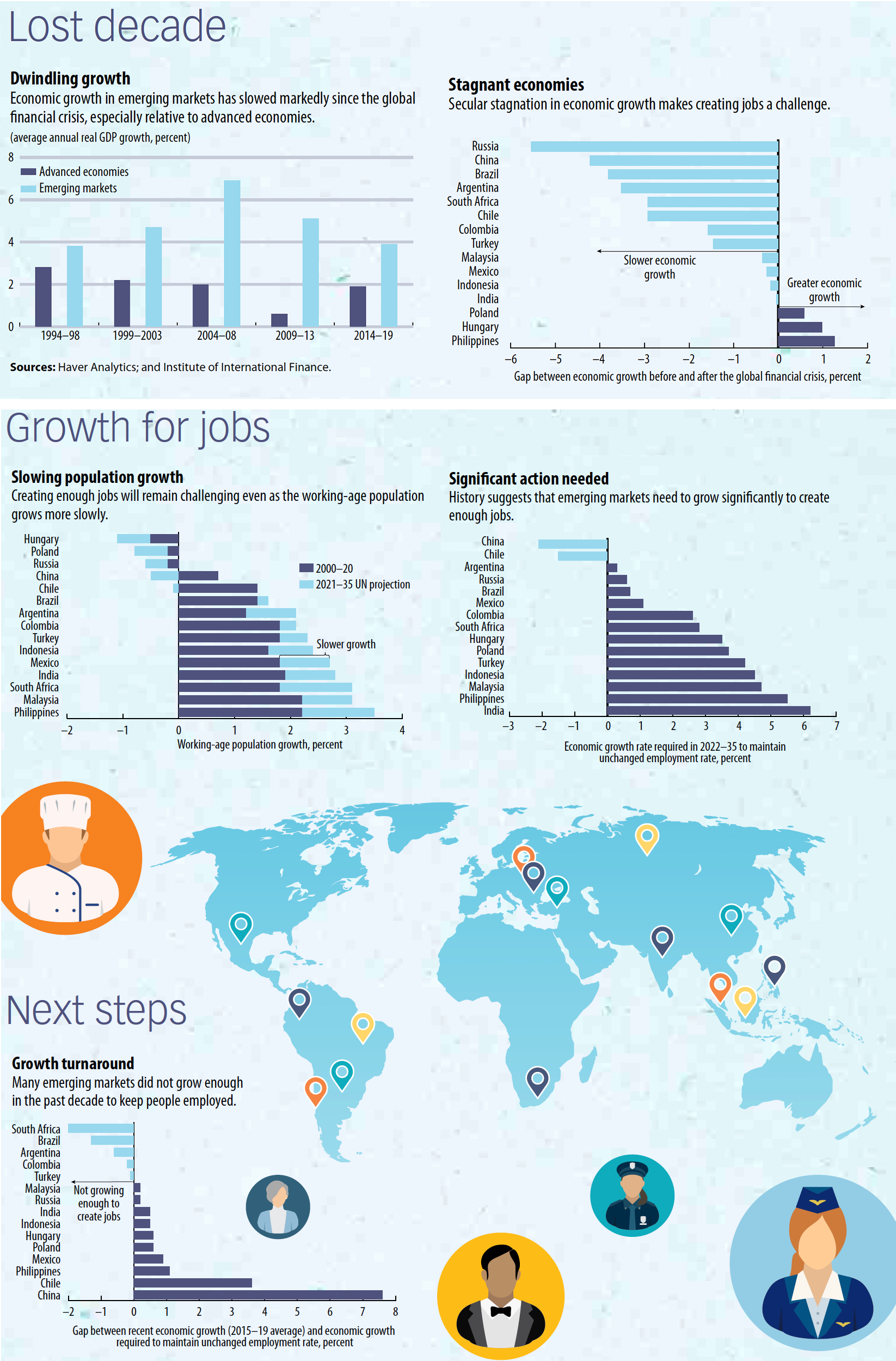
As our recent note from the Institute of International Finance shows, the
uncomfortable truth is that creating sufficient jobs in emerging markets
will require higher growth rates than those of the past decade. We
calculate how much emerging markets had to grow to create a certain number
of jobs in the past. We use these relationships and population projections
through 2035 to calculate how much countries must grow in the future to
create enough jobs for people entering the labor market, while keeping
stable the ratio of employment to the working-age population (the
proportion of the working-age population that is employed).
We find that creating jobs will still be challenging, even though
working-age populations will grow more slowly. The high growth needed to
create jobs is close to recent outcomes in only a few countries, including
India. In other countries, such as Brazil and South Africa, however,
unemployment will increase unless growth picks up.