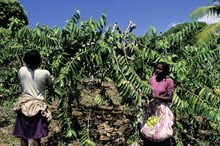
Ylang-ylang harvest for export in Anjouan, Comoros. Reforms enacted in recent years
have improved growth prospects (photo: Jean du Boisberranger/Newscom)
DEBT RELIEF FOR AFRICA
The IMF and World Bank Boards declared in June 2010 that Comoros had reached the
decision point under the Enhanced Heavily Indebted Poor Countries (HIPC) Initiative,
making the east African island nation eligible for comprehensive debt relief under
HIPC and the
Multilateral Debt Relief Initiative.
Reforms undertaken since then, as conditionality under Comoros’ Extended Credit
Facility arrangement with the IMF and under HIPC triggers, have helped the country
maintain macroeconomic stability, strengthen public financial management, and advance
the restructuring of the public utilities. In the education and health sectors,
much needed additional primary school classrooms have been built, and measles immunization
rates among children have substantially increased.
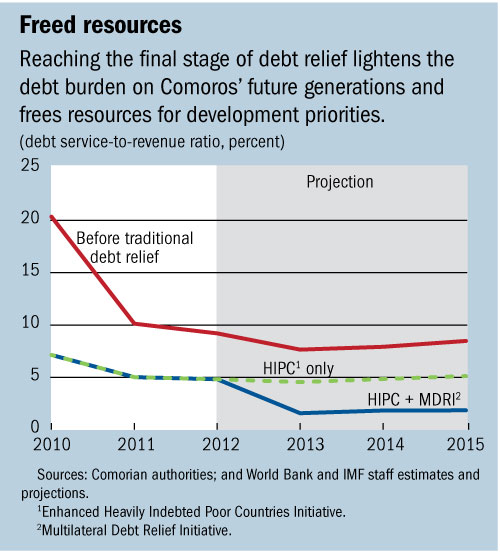
The debt relief of $176 million rewards the country’s graduation from the
Enhanced HIPC Initiative process as Comoros reached the HIPC final stage, or completion
point, and secured additional debt relief under the MDRI in December 2012. The relief
represents an irrevocable 59 percent reduction of external debt service over the
next 40 years (see chart).
Comoros is a small archipelago island nation of fewer than 1 million people located
off the East African coast close to Madagascar. Its economy is highly dependent
on remittances and on subsistence agriculture; the main exports are cloves, vanilla,
and ylang-ylang—an essence derived from flowers for use in the perfume industry.
Per capita GDP amounted to $930 in 2012.
Reaching the HIPC completion point substantially alleviates the debt burden on Comoros’
future generations and frees resources for development priorities. Comoros’
graduation under the enhanced HIPC Initiative brings to 35 the number of countries
that benefited from the initiative’s debt relief (see box).
The thirty-five
Afghanistan
Benin
Bolivia
Burkina Faso
Burundi
Cameroon
Central African Republic
Comoros
Republic of Congo
Democratic Republic of Congo
Cote d’Ivoire
Ethiopia
The Gambia
Ghana
Guinea
Guinea-Bissau
Guyana
Haiti
Honduras
Liberia
Madagascar
Malawi
Mali
Mauritania
Mozambique
Nicaragua
Niger
Rwanda
São Tomé and Príncipe
Senegal
Sierra Leone
Tanzania
Togo
Uganda
Zambia
Enhanced reform ownership
In the last 18 months, Comoros’ successful drive to the HIPC Initiative completion
point was sustained by notable government ownership. The completion point appeared
beyond reach in early 2011 as serious policy slippages in the fiscal and structural
areas stalled progress in the implementation of the country’s reform program,
which was supported by the IMF under the Extended Credit Facility arrangement.
The new cabinet, sworn in in June 2011 after the last presidential elections, swiftly
introduced critical corrective measures to steer the reform agenda back on track.
These included stepped-up efforts to strengthen domestic revenue mobilization, the
reversal of an unsustainable public wage increase granted by the outgoing administration,
and the appointment of effective managers in key civil service positions.
In this context, the authorities in late 2012 issued calls for investor expressions
of interest in an effort to enlist strategic partners of international repute in
the management of the state-owned telecommunication and power companies.
Timely implementation
“Reaching this milestone would clearly not have been possible without the
authorities playing a leadership role in ensuring timely implementation of the HIPC
completion point triggers,” noted IMF mission chief for the Comoros Mbuyamu
Matungulu. “The successful implementation of reforms undertaken in the last
few years has substantially improved Comoros’ macroeconomic and growth prospects,”
he added.
Matungulu said he hoped the government would continue closely adhering to its reform
agenda, to translate the improved economic outlook into tangible gains in living
standards for the population.