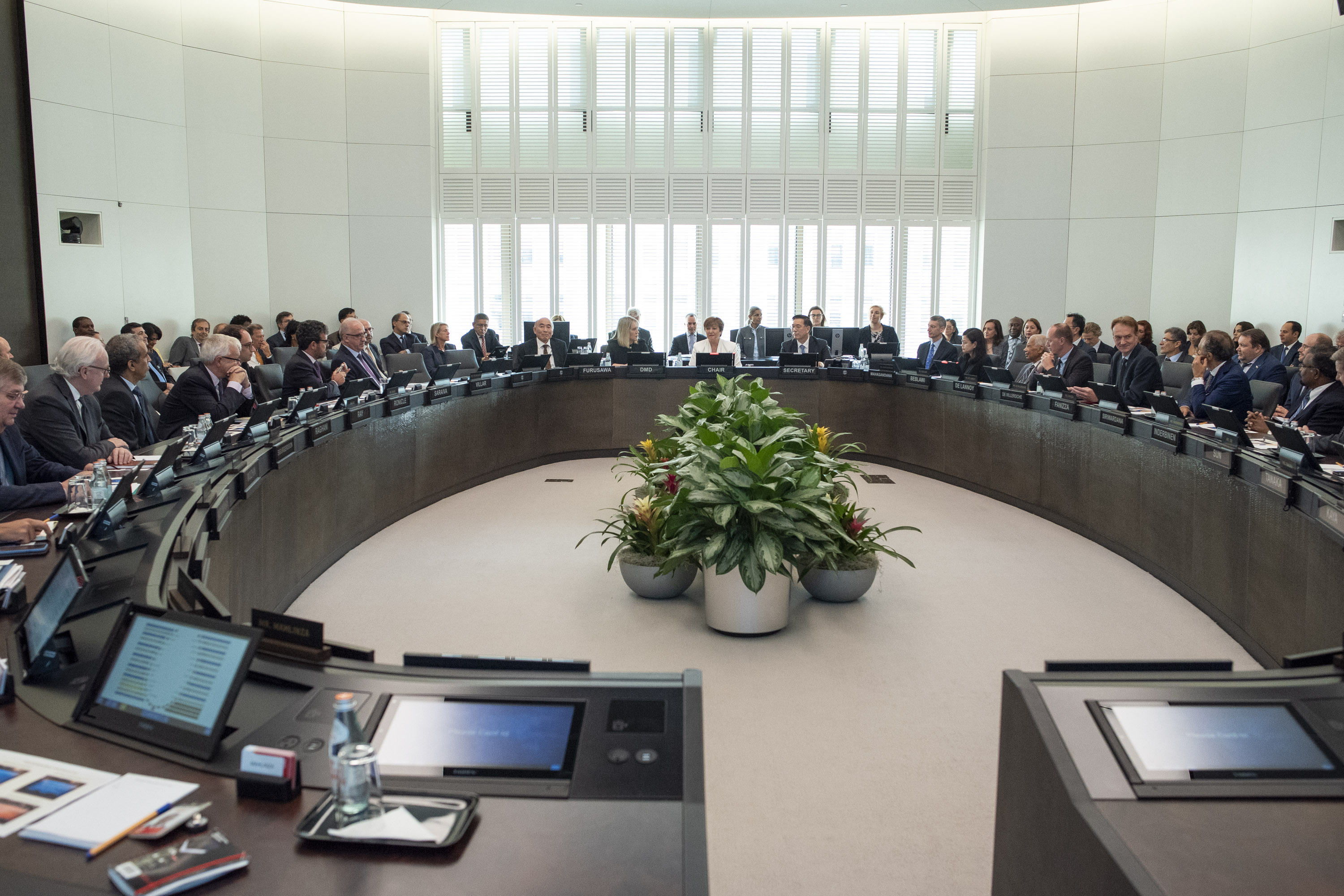
IMF Executive Board Discusses the Adequacy of the Fund’s Precautionary Balances
IMF News, January 8, 2021
Source details
- Canonical URL
- IMF Executive Board Discusses the Adequacy of the Fund’s Precautionary Balances
Other formats
Bibliographic details
- Published: January 8, 2021
Background and purpose of the review
- Review conducted on the standard two-year cycle but delayed by a few months to assess the impact of the COVID-19 pandemic on Fund financial risks.
- Review date referenced: October 30, 2020.
- Review applied the rules-based framework agreed in 2010, which:
- Includes an indicative range for precautionary balances linked to a forward-looking measure of total IMF credit.
- Allows for Board judgement in setting the target, taking into account a broad range of factors affecting adequacy.
Executive Board assessment — key findings and analysis
- Directors emphasized the importance of maintaining adequate precautionary balances to:
- Mitigate financial risks.
- Safeguard the strength of the Fund’s balance sheet.
- Protect the value of members’ reserve positions in the Fund.
- Directors judged the 2010 rules-based framework to remain broadly appropriate, with judgment and Board discretion continuing to play an important role.
- Role of SCA-1:
- Noted as instrumental in protecting the Fund against potential losses from overdue obligations and ensuring compliance with international financial reporting standards.
- Several Directors look forward to considering options on the role of the SCA-1.
- COVID-19-related developments and their impact:
- Fund credit exposure and related risks have increased significantly since the last review in 2018, with trends compounded by the COVID-19 crisis.
- Specific developments cited:
- "Credit outstanding has nearly doubled."
- Surge in emergency financing without conditionality.
- Commitments under precautionary arrangements are higher than at the last review.
- Credit concentration has increased.
- Scheduled repurchases are larger and more bunched.
- Current target for precautionary balances of SDR 20 billion is likely to fall below the indicative range in this and the next fiscal year.
Decisions, targets, and numeric outcomes
- Indicative medium-term target:
- Directors broadly agreed to raise the indicative medium-term target for precautionary balances to SDR 25 billion.
- "A few Directors would have preferred setting a higher target."
- Minimum floor:
- Directors supported keeping the minimum floor for precautionary balances at SDR 15 billion "for now" and "stood ready to revisit the issue, preferably after the FY 2022 review of the Investment Account."
- Reserve accumulation and financing:
- Directors broadly agreed there is no need for additional measures to accelerate the pace of reserve accumulation at this stage, but urged continued close monitoring.
- Despite uncertainty, the increased level of Fund credit is expected to generate sufficient lending income for precautionary balances to reach their new target over the medium term.
- "A few Directors nevertheless called for consideration of options to speed up reserve accumulation."
Policy considerations, risk management, and recommendations
- Precautionary balances are one element of a multi-layered risk management framework that also includes:
- Program design.
- Conditionality.
- Lending policies.
- The Fund’s preferred creditor status.
- Directors recommended a more holistic approach to assessing adequacy and composition of precautionary balances that takes account of other related Fund policies.
- Directors requested:
- Close monitoring given high uncertainty due to the pandemic.
- The Board should reassess the adequacy of precautionary balances before the next regular review.
- Consideration of options to isolate the impact of pension-related adjustments on the Fund’s precautionary balances to reduce their volatility.
Procedural notes
- This press release summarizes views expressed during the July 15, 2020 Executive Board discussion based on the paper entitled “Review of the Adequacy of the Fund’s Precautionary Balances.”
- Footnote clarifications:
- Precautionary balances comprise the Fund’s general and special reserves and the Special Contingent Account (SCA-1), except the portion of the Special Reserve attributed to gold sales profits.
- At the conclusion of the discussion, the Managing Director, as Chairman of the Board, summarizes the views of Executive Directors; an explanation of qualifiers used in summings up is noted in the source materials.
Press Release No. 21/5 — January 8, 2021, International Monetary Fund.
References
- https://www.imf.org/-/media/images/imf/bios/imfboard.jpg
- The Executive Board
- IMF COVID-19 Hub
- Policy Tracker
- Financial Assistance
- Questions & Answers
- Special Drawing Rights (SDRs) -- A Factsheet
- Press Releases
- PRESS CENTER
- http://www.IMF.org/external/np/sec/misc/qualifiers.htm
- https://www.imf.org/en/home